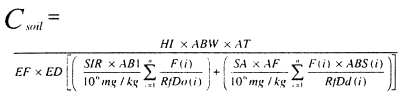
[Equation 740-3]
PERMANENT RULES
Effective Date of Rule: Thirty-one days after filing.
Purpose: This rule amendment specifically addresses the following:
| • | Risk Policies Applicable to Certain Mixtures: Changes to the rule require that cleanup levels for mixtures of dioxins and furans, PAHs, and PCBs must each be based on a cancer risk of one-in-a-million. |
| • | Toxic Equivalency Factors Used to Characterize Mixtures: Changes to the rule incorporate the most recent toxicity equivalency factors (TEFs) for dioxins/furans and PCBs recommended by the World Health Organization and updated potency equivalency factors (PEFs) for carcinogenic PAHs adopted by the California Environmental Protection Agency. |
| • | Methods for Calculating Soil Cleanup Levels: Changes to the rule include a method for considering the relative bioavailability of soil-bound dioxins and furans when establishing soil cleanup levels. |
| • | Evaluating Cross-media Impacts: Changes to the rule require that, when evaluating cross-media impacts, cleanup proponents consider the physical chemical properties of individuals PAH compounds or dioxin congeners. |
Citation of Existing Rules Affected by this Order: Amending chapter 173-340 WAC, WAC 173-340-708, 173-340-740, 173-340-745, and 173-340-900.
Statutory Authority for Adoption: RCW 70.105D.030(2).
Adopted under notice filed as WSR 07-08-100 on April 3, 2007.
Changes Other than Editing from Proposed to Adopted Version: A technical correction was made to the chemical abstract number for 1, 2, 3, 4, 7, 8 hexachloro dibenzo-p-dioxin in table 708-1, WAC 173-340-900. The correct CAS number is 39227-28-6.
A final cost-benefit analysis is available by contacting Ann McNeely, 300 Desmond Drive, Lacey, WA 98504, phone (360) 407-7205, fax (360) 407-7154, e-mail amcn461@ecy.wa.gov.
Number of Sections Adopted in Order to Comply with Federal Statute: New 0, Amended 0, Repealed 0; Federal Rules or Standards: New 0, Amended 0, Repealed 0; or Recently Enacted State Statutes: New 0, Amended 0, Repealed 0.
Number of Sections Adopted at Request of a Nongovernmental Entity: New 0, Amended 4, Repealed 0.
Number of Sections Adopted on the Agency's Own Initiative: New 0, Amended 4, Repealed 0.
Number of Sections Adopted in Order to Clarify, Streamline, or Reform Agency Procedures: New 0, Amended 4, Repealed 0.
Number of Sections Adopted Using Negotiated Rule Making: New 0, Amended 0, Repealed 0; Pilot Rule Making: New 0, Amended 0, Repealed 0; or Other Alternative Rule Making: New 0, Amended 0, Repealed 0.
Date Adopted: October 12, 2007.
Jay J. Manning
Director
OTS-9291.5
AMENDATORY SECTION(Amending Order 97-09A, filed 2/12/01,
effective 8/15/01)
WAC 173-340-708
Human health risk assessment procedures.
(1) Purpose. This section defines the risk assessment
framework that shall be used to establish cleanup levels, and
remediation levels using a quantitative risk assessment, under
this chapter. As used in this section, cleanup levels and
remediation levels means the human health risk assessment
component of these levels. This chapter defines certain
default values and methods to be used in calculating cleanup
levels and remediation levels. This section allows varying
from these default values and methods under certain
circumstances. When deciding whether to approve alternate
values and methods the department shall ensure that the use of
alternative values and methods will not significantly delay
site cleanups.
(2) Selection of indicator hazardous substances.
When defining cleanup requirements at a site that is contaminated with a large number of hazardous substances, the department may eliminate from consideration those hazardous substances that contribute a small percentage of the overall threat to human health and the environment. The remaining hazardous substances shall serve as indicator hazardous substances for purposes of defining site cleanup requirements. See WAC 173-340-703 for additional information on establishing indicator hazardous substances.
(3) Reasonable maximum exposure.
(a) Cleanup levels and remediation levels shall be based on estimates of current and future resource uses and reasonable maximum exposures expected to occur under both current and potential future site use conditions, as specified further in this chapter.
(b) The reasonable maximum exposure is defined as the highest exposure that is reasonably expected to occur at a site under current and potential future site use. WAC 173-340-720 through 173-340-760 define the reasonable maximum exposures for ground water, surface water, soil, and air. These reasonable maximum exposures will apply to most sites where individuals or groups of individuals are or could be exposed to hazardous substances. For example, the reasonable maximum exposure for most ground water is defined as exposure to hazardous substances in drinking water and other domestic uses.
(c) Persons performing cleanup actions under this chapter may use the evaluation criteria in WAC 173-340-720 through 173-340-760, where allowed in those sections, to demonstrate that the reasonable maximum exposure scenarios specified in those sections are not appropriate for cleanup levels for a particular site. For example, the criteria in WAC 173-340-720(2) could be used to demonstrate that the reasonable maximum exposure for ground water beneath a site does not need to be based on drinking water use. The use of an alternate exposure scenario shall be documented by the person performing the cleanup action. Documentation for the use of alternate exposure scenarios under this provision shall be based on the results of investigations performed in accordance with WAC 173-340-350.
(d) Persons performing cleanup actions under this chapter may also use alternate reasonable maximum exposure scenarios to help assess the protectiveness to human health of a cleanup action alternative that incorporates remediation levels and uses engineered controls and/or institutional controls to limit exposure to the contamination remaining on the site.
(i) An alternate reasonable maximum exposure scenario shall reflect the highest exposure that is reasonably expected to occur under current and potential future site conditions considering, among other appropriate factors, the potential for institutional controls to fail and the extent of the time period of failure under these scenarios and the land uses at the site.
(ii) Land uses other than residential and industrial, such as agricultural, recreational, and commercial, shall not be used as the basis for a reasonable maximum exposure scenario for the purpose of establishing a cleanup level. However, these land uses may be used as a basis for an alternate reasonable maximum exposure scenario for the purpose of assessing the protectiveness of a remedy. For example, if a cap (with appropriate institutional controls) is the proposed cleanup action at a commercial site, the reasonable maximum exposure scenario for assessing the protectiveness of the cap with regard to direct soil contact could be changed from a child living on the site to a construction or maintenance worker and child trespasser scenario.
(iii) The department expects that in evaluating the protectiveness of a remedy with regard to the soil direct contact pathway, many types of commercial sites may, where appropriate, qualify for alternative exposure scenarios under this provision since contaminated soil at these sites is typically characterized by a cover of buildings, pavement, and landscaped areas. Examples of these types of sites include:
(A) Commercial properties in a location removed from single family homes, duplexes or subdivided individual lots;
(B) Private and public recreational facilities where access to these facilities is physically controlled (e.g., a private golf course to which access is restricted by fencing);
(C) Urban residential sites (e.g., upper-story residential units over ground floor commercial businesses);
(D) Offices, restaurants, and other facilities primarily devoted to support administrative functions of a commercial/industrial nature (e.g., an employee credit union or cafeteria in a large office or industrial complex).
(e) A conceptual site model may be used to identify when individuals or groups of individuals may be exposed to hazardous substances through more than one exposure pathway. For example, a person may be exposed to hazardous substances from a site by drinking contaminated ground water, eating contaminated fish, and breathing contaminated air. At sites where the same individuals or groups of individuals are or could be consistently exposed through more than one pathway, the reasonable maximum exposure shall represent the total exposure through all of those pathways. At such sites, the cleanup levels and remediation levels derived for individual pathways under WAC 173-340-720 through 173-340-760 and WAC 173-340-350 through 173-340-390 shall be adjusted downward to take into account multiple exposure pathways.
(4) Cleanup levels for individual hazardous substances. Cleanup levels for individual hazardous substances will generally be based on a combination of requirements in applicable state and federal laws and risk assessment.
(5) Multiple hazardous substances.
(a) Cleanup levels for individual hazardous substances established under Methods B and C and remediation levels shall be adjusted downward to take into account exposure to multiple hazardous substances. This adjustment needs to be made only if, without this adjustment, the hazard index would exceed one (1) or the total excess cancer risk would exceed one in one hundred thousand (1 x 10⁻⁵).
(b) Adverse effects resulting from exposure to two or more hazardous substances with similar types of toxic response are assumed to be additive unless scientific evidence is available to demonstrate otherwise. Cancer risks resulting from exposure to two or more carcinogens are assumed to be additive unless scientific evidence is available to demonstrate otherwise.
(c) For noncarcinogens, for purposes of establishing cleanup levels under Methods B and C, and for remediation levels, the health threats resulting from exposure to two or more hazardous substances with similar types of toxic response may be apportioned between those hazardous substances in any combination as long as the hazard index does not exceed one (1).
(d) For carcinogens, for purposes of establishing cleanup levels under Methods B and C, and for remediation levels, the cancer risks resulting from exposure to multiple hazardous substances may be apportioned between hazardous substances in any combination as long as the total excess cancer risk does not exceed one in one hundred thousand (1 x 10⁻⁵).
(e) The department may require biological testing to assess the potential interactive effects associated with chemical mixtures.
(f) When making adjustments to cleanup levels and remediation levels for multiple hazardous substances, the concentration for individual hazardous substances shall not be adjusted downward to less than the practical quantitation limit or natural background.
(6) Multiple pathways of exposure.
(a) Estimated doses of individual hazardous substances resulting from more than one pathway of exposure are assumed to be additive unless scientific evidence is available to demonstrate otherwise.
(b) Cleanup levels and remediation levels based on one pathway of exposure shall be adjusted downward to take into account exposures from more than one exposure pathway. The number of exposure pathways considered at a given site shall be based on the reasonable maximum exposure scenario as defined in WAC 173-340-708(3). This adjustment needs to be made only if exposure through multiple pathways is likely to occur at a site and, without the adjustment, the hazard index would exceed one (1) or the total excess cancer risk would exceed one in one hundred thousand (1 x 10⁻⁵).
(c) For noncarcinogens, for purposes of establishing cleanup levels under Methods B and C, and remediation levels, the health threats associated with exposure via multiple pathways may be apportioned between exposure pathways in any combination as long as the hazard index does not exceed one (1).
(d) For carcinogens, for purposes of establishing cleanup levels under Methods B and C, and for remediation levels, the cancer risks associated with exposure via multiple pathways may be apportioned between exposure pathways in any combination as long as the total excess cancer risk does not exceed one in one hundred thousand (1 x 10⁻⁵).
(e) When making adjustments to cleanup levels and remediation levels for multiple pathways of exposure, the concentration for individual hazardous substances shall not be adjusted downward to less than the practical quantitation limit or natural background.
(7) Reference doses.
(a) The chronic reference dose/reference concentration and the developmental reference dose/reference concentration shall be used to establish cleanup levels and remediation levels under this chapter. Cleanup levels and remediation levels shall be established using the value which results in the most protective concentration.
(b) Inhalation reference doses/reference concentrations shall be used in WAC 173-340-750. Where the inhalation reference dose/reference concentration is reported as a concentration in air, that value shall be converted to a corresponding inhaled intake (mg/kg-day) using a human body weight of 70 kg and an inhalation rate of 20 m3/day, and take into account, where available, the respiratory deposition and absorption characteristics of the gases and inhaled particles.
(c) A subchronic reference dose/reference concentration may be used to evaluate potential noncarcinogenic effects resulting from exposure to hazardous substances over short periods of time. This value may be used in place of the chronic reference dose/reference concentration where it can be demonstrated that a particular hazardous substance will degrade to negligible concentrations during the exposure period.
(d) For purposes of establishing cleanup levels and remediation levels for hazardous substances under this chapter, a reference dose/reference concentration established by the United States Environmental Protection Agency and available through the "integrated risk information system" (IRIS) data base shall be used. If a reference dose/reference concentration is not available through the IRIS data base, a reference dose/reference concentration from the U.S. EPA Health Effects Assessment Summary Table ("HEAST") data base or, if more appropriate, the National Center for Environmental Assessment ("NCEA") shall be used.
(e) If a reference dose/reference concentration is available through IRIS, HEAST, or the NCEA, it shall be used unless the department determines that there is clear and convincing scientific data which demonstrates that the use of this value is inappropriate.
(f) If a reference dose/reference concentration for a hazardous substance including petroleum fractions and petroleum constituents is not available through IRIS, HEAST or the NCEA or is demonstrated to be inappropriate under (e) of this subsection and the department determines that development of a reference dose/reference concentration is necessary for the hazardous substance at the site, then a reference dose/reference concentration shall be established on a case-by-case basis. When establishing a reference dose on a case-by-case basis, the methods described in "Reference Dose (RfD): Description and Use in Health Risk Assessment: Background Document 1A", USEPA, March 15, 1993, shall be used.
(g) In estimating a reference dose/reference concentration for a hazardous substance under (e) or (f) of this subsection, the department shall, as appropriate, consult with the science advisory board, the department of health, and the United States Environmental Protection Agency and may, as appropriate, consult with other qualified persons. Scientific data supporting such a change shall be subject to the requirements under WAC 173-340-702 (14), (15) and (16). Once the department has established a reference dose/reference concentration for a hazardous substance under this provision, the department is not required to consult again for the same hazardous substance.
(h) Where a reference dose/reference concentration other than those established under (d) or (g) of this subsection is used to establish a cleanup level or remediation level at individual sites, the department shall summarize the scientific rationale for the use of those values in the cleanup action plan. The department shall provide the opportunity for public review and comment on this value in accordance with the requirements of WAC 173-340-380 and 173-340-600.
(8) Carcinogenic potency factor.
(a) For purposes of establishing cleanup levels and remediation levels for hazardous substances under this chapter, a carcinogenic potency factor established by the United States Environmental Protection Agency and available through the IRIS data base shall be used. If a carcinogenic potency factor is not available from the IRIS data base, a carcinogenic potency factor from HEAST or, if more appropriate, from the NCEA shall be used.
(b) If a carcinogenic potency factor is available from the IRIS, HEAST or the NCEA, it shall be used unless the department determines that there is clear and convincing scientific data which demonstrates that the use of this value is inappropriate.
(c) If a carcinogenic potency factor is not available through IRIS, HEAST or the NCEA or is demonstrated to be inappropriate under (b) of this subsection and the department determines that development of a cancer potency factor is necessary for the hazardous substance at the site, then one of the following methods shall be used to establish a carcinogenic potency factor:
(i) The carcinogenic potency factor may be derived from appropriate human epidemiology data on a case-by-case basis; or
(ii) The carcinogenic potency factor may be derived from animal bioassay data using the following procedures:
(A) All carcinogenicity bioassays shall be reviewed and data of appropriate quality shall be used for establishing the carcinogenic potency factor.
(B) The linearized multistage extrapolation model shall be used to estimate the slope of the dose-response curve unless the department determines that there is clear and convincing scientific data which demonstrates that the use of an alternate extrapolation model is more appropriate;
(C) All doses shall be adjusted to give an average daily dose over the study duration; and
(D) An interspecies scaling factor shall be used to take into account differences between animals and humans. For oral carcinogenic toxicity values this scaling factor shall be based on the assumption that milligrams per surface area is an equivalent dose between species unless the department determines there is clear and convincing scientific data which demonstrates that an alternate procedure is more appropriate. The slope of the dose response curve for the test species shall be multiplied by this scaling factor in order to obtain the carcinogenic potency factor, except where such scaling factors are incorporated into the extrapolation model under (B) of this subsection. The procedure to derive a human equivalent concentration of inhaled particles and gases shall take into account, where available, the respiratory deposition and absorption characteristics of the gases and inhaled particles. Where adequate pharmacokinetic and metabolism studies are available, data from these studies may be used to adjust the interspecies scaling factor.
(d) ((When assessing the potential carcinogenic risk of
mixtures of chlorinated dibenzo-p-dioxins (CDD) and
chlorinated dibenzofurans (CDF) either of the following
methods shall be used unless the department determines that
there is clear and convincing scientific data which
demonstrates that the use of these methods is inappropriate:
(i) The entire mixture is assumed to be as toxic as 2, 3, 7, 8 CDD or 2, 3, 7, 8 CDF, as applicable; or
(ii) The toxicity equivalency factors and methodology described in: EPA. 1989. "Interim procedures for estimating risks associated with exposure to mixtures of chlorinated dibenzo-p-dioxins and dibenzofurans (CDDs and CDFs) and 1989 update", USEPA, Risk Assessment Forum, Washington, D.C., publication number EPA/625/3-89/016.)) Mixtures of dioxins and furans. When establishing and determining compliance with cleanup levels and remediation levels for mixtures of chlorinated dibenzo-p-dioxins (dioxins) and/or chlorinated dibenzofurans (furans), the following procedures shall be used:
(i) Assessing as single hazardous substance. When establishing and determining compliance with cleanup levels and remediation levels, including when determining compliance with the excess cancer risk requirements in this chapter, mixtures of dioxins and/or furans shall be considered a single hazardous substance.
(ii) Establishing cleanup levels and remediation levels. The cleanup levels and remediation levels established for 2,3,7,8 tetrachloro dibenzo-p-dioxin (2,3,7,8-TCDD) shall be used, respectively, as the cleanup levels and remediation levels for mixtures of dioxins and/or furans.
(iii) Determining compliance with cleanup levels and remediation levels. When determining compliance with the cleanup levels and remediation levels established for mixtures of dioxins and/or furans, the following procedures shall be used:
(A) Calculate the total toxic equivalent concentration of 2,3,7,8-TCDD for each sample of the mixture. The total toxic equivalent concentration shall be calculated using the following method, unless the department determines that there is clear and convincing scientific data which demonstrates that the use of this method is inappropriate:
(I) Analyze samples from the medium of concern to determine the concentration of each dioxin and furan congener listed in Table 708-1;
(II) For each sample analyzed, multiply the measured concentration of each congener in the sample by its corresponding toxicity equivalency factor (TEF) in Table 708-1 to obtain the toxic equivalent concentration of 2,3,7,8-TCDD for that congener; and
(III) For each sample analyzed, add together the toxic equivalent concentrations of all the congeners within the sample to obtain the total toxic equivalent concentration of 2,3,7,8-TCDD for that sample.
(B) After calculating the total toxic equivalent concentration of each sample of the mixture, use the applicable compliance monitoring requirements in WAC 173-340-720 through 173-340-760 to determine whether the total toxic equivalent concentrations of the samples comply with the cleanup level or remediation level for the mixture at the applicable point of compliance.
(iv) Protecting the quality of other media. When establishing cleanup levels and remediation levels for mixtures of dioxins and/or furans in a medium of concern that are based on protection of another medium (the receiving medium) (e.g., soil levels protective of ground water quality), the following procedures shall be used:
(A) The cleanup level or remediation level for 2,3,7,8-TCDD in the receiving medium shall be used, respectively, as the cleanup level or remediation level for the receiving medium.
(B) When determining the concentrations in the medium of concern that will achieve the cleanup level or remediation level in the receiving medium, the congener-specific physical and chemical properties shall be considered during that assessment.
(e) ((When assessing the potential carcinogenic risk of
mixtures of polycyclic aromatic hydrocarbons, either of the
following methods shall be used unless the department
determines that there is clear and convincing scientific data
which demonstrates that the use of these methods is
inappropriate:
(i) The entire mixture is assumed to be as toxic as benzo(a)pyrene; or
(ii) The toxicity equivalency factors and methodology described in "CalEPA. 1994. Benzo(a)pyrene as a toxic air contaminant. Part B: Health Assessment." Published by the Office of Environmental Health Hazard Assessment, California Environmental Protection Agency, Berkeley, CA.)) Mixtures of carcinogenic PAHs. When establishing and determining compliance with cleanup levels and remediation levels for mixtures of carcinogenic polycyclic aromatic hydrocarbons (carcinogenic PAHs), the following procedures shall be used:
(i) Assessing as single hazardous substance. When establishing and determining compliance with cleanup levels and remediation levels, including when determining compliance with the excess cancer risk requirements in this chapter, mixtures of carcinogenic PAHs shall be considered a single hazardous substance.
(ii) Establishing cleanup levels and remediation levels. The cleanup levels and remediation levels established for benzo(a)pyrene shall be used, respectively, as the cleanup levels and remediation levels for mixtures of carcinogenic PAHs.
(iii) Determining compliance with cleanup levels and remediation levels. When determining compliance with cleanup levels and remediation levels established for mixtures of carcinogenic PAHs, the following procedures shall be used:
(A) Calculate the total toxic equivalent concentration of benzo (a) pyrene for each sample of the mixture. The total toxic equivalent concentration shall be calculated using the following method, unless the department determines that there is clear and convincing scientific data which demonstrates that the use of this method is inappropriate:
(I) Analyze samples from the medium of concern to determine the concentration of each carcinogenic PAH listed in Table 708-2 and, for those carcinogenic PAHs required by the department under WAC 173-340-708 (8)(e)(iv), in Table 708-3;
(II) For each sample analyzed, multiply the measured concentration of each carcinogenic PAH in the sample by its corresponding toxicity equivalency factor (TEF) in Tables 708-2 and 708-3 to obtain the toxic equivalent concentration of benzo(a)pyrene for that carcinogenic PAH; and
(III) For each sample analyzed, add together the toxic equivalent concentrations of all the carcinogenic PAHs within the sample to obtain the total toxic equivalent concentration of benzo(a)pyrene for that sample.
(B) After calculating the total toxic equivalent concentration of each sample of the mixture, use the applicable compliance monitoring requirements in WAC 173-340-720 through 173-340-760 to determine whether the total toxic equivalent concentrations of the samples comply with the cleanup level or remediation level for the mixture at the applicable point of compliance.
(iv) Protecting the quality of other media. When establishing cleanup levels and remediation levels for mixtures of carcinogenic PAHs in a medium of concern that are based on protection of another medium (the receiving medium) (e.g., soil levels protective of ground water quality), the following procedures shall be used:
(A) The cleanup level or remediation level for benzo(a)pyrene in the receiving medium shall be used, respectively, as the cleanup level or remediation level for the receiving medium.
(B) When determining the concentrations in the medium of concern that will achieve the cleanup level or remediation level in the receiving medium, the carcinogenic PAH-specific physical and chemical properties shall be considered during that assessment.
(v) When using this methodology, at a minimum, the
((following)) compounds in Table 708-2 shall be analyzed for
and included in the calculations((: Benzo[a]pyrene,
Benz[a]anthracene, Benzo[b]fluoranthene, Benzo[k]fluoranthene,
Chrysene, Dibenz[a,h]anthracene, Indeno[1,2,3cd]pyrene)). The
department may require additional compounds ((from the CalEPA
list)) in Table 708-3 to be included in the methodology should
site testing data or information from other comparable sites
or waste types indicate the additional compounds are
potentially present at the site. NOTE: Many of the
polycyclic aromatic hydrocarbons ((on the CalEPA list)) in
Table 708-3 are found primarily in air emissions from
combustion sources and may not be present in the soil or water
at contaminated sites. Users should consult with the
department for information on the need to test for these
additional compounds.
(f) PCB mixtures. When establishing and determining compliance with cleanup levels and remediation levels for polychlorinated biphenyls (PCBs) mixtures, the following procedures shall be used:
(i) Assessing as single hazardous substance. When establishing and determining compliance with cleanup levels and remediation levels, including when determining compliance with the excess cancer risk requirements in this chapter, PCB mixtures shall be considered a single hazardous substance.
(ii) Establishing cleanup levels and remediation levels. When establishing cleanup levels and remediation levels under Methods B and C for PCB mixtures, the following procedures shall be used unless the department determines that there is clear and convincing scientific data which demonstrates that the use of these methods is inappropriate:
(A) Assume the PCB mixture is equally potent and use the appropriate carcinogenic potency factor provided for under WAC 173-340-708 (8)(a) through (c) for the entire mixture; or
(B) Use the toxicity equivalency factors for the dioxin-like PCBs congeners in Table 708-4 and procedures approved by the department. When using toxicity equivalency factors, the department may require that the health effects posed by the dioxin-like PCB congeners and nondioxin-like PCB congeners be considered in the evaluation.
(iii) Determining compliance with cleanup levels and remediation levels. When determining compliance with cleanup levels and remediation levels established for PCB mixtures, the following procedures shall be used:
(A) Analyze compliance monitoring samples for a total PCB concentration and use the applicable compliance monitoring requirements in WAC 173-340-720 through 173-340-760 to determine whether the total PCB concentrations of the samples complies with the cleanup level or remediation level for the mixture at the applicable point of compliance; or
(B) When using toxicity equivalency factors to determine compliance with cleanup or remediation levels for PCB mixtures, use procedures approved by the department.
(g) In estimating a carcinogenic potency factor for a hazardous substance under (c) of this subsection, or approving the use of a toxicity equivalency factor other than that established under (d), (e) or (f) of this subsection, the department shall, as appropriate, consult with the science advisory board, the department of health, and the United States Environmental Protection Agency and may, as appropriate, consult with other qualified persons. Scientific data supporting such a change shall be subject to the requirements under WAC 173-340-702 (14), (15) and (16). Once the department has established a carcinogenic potency factor or approved an alternative toxicity equivalency factor for a hazardous substance under this provision, the department is not required to consult again for the same hazardous substance.
(((g))) (h) Where a carcinogenic potency factor other
than that established under (a)((, (d) and (e))) of this
subsection or a toxicity equivalency factor other than that
established under (d), (e) or (f) of this subsection is used
to establish cleanup levels or remediation levels at
individual sites, the department shall summarize the
scientific rationale for the use of that value in the cleanup
action plan. The department shall provide the opportunity for
public review and comment on this value in accordance with the
requirements of WAC 173-340-380 and 173-340-600.
(9) Bioconcentration factors.
(a) For purposes of establishing cleanup levels and remediation levels for a hazardous substance under WAC 173-340-730, a bioconcentration factor established by the United States Environmental Protection Agency and used to establish the ambient water quality criterion for that substance under section 304 of the Clean Water Act shall be used. These values shall be used unless the department determines that there is adequate scientific data which demonstrates that the use of an alternate value is more appropriate. If the department determines that a bioconcentration factor is appropriate for a specific hazardous substance and no such factor has been established by USEPA, then other appropriate EPA documents, literature sources or empirical information may be used to determine a bioconcentration factor.
(b) When using a bioconcentration factor other than that used to establish the ambient water quality criterion, the department shall, as appropriate, consult with the science advisory board, the department of health, and the United States Environmental Protection Agency. Scientific data supporting such a value shall be subject to the requirements under WAC 173-340-702 (14), (15) and (16). Once the department has established a bioconcentration factor for a hazardous substance under this provision, the department is not required to consult again for the same hazardous substance.
(c) Where a bioconcentration factor other than that established under (a) of this subsection is used to establish cleanup levels or remediation levels at individual sites, the department shall summarize the scientific rationale for the use of that factor in the draft cleanup action plan. The department shall provide the opportunity for public review and comment on the value in accordance with the requirements of WAC 173-340-380 and 173-340-600.
(10) Exposure parameters.
(a) As a matter of policy, the department has defined in WAC 173-340-720 through 173-340-760 the default values for exposure parameters to be used when establishing cleanup levels and remediation levels under this chapter. Except as provided for in (b) and (c) of this subsection and in WAC 173-340-720 through 173-340-760, these default values shall not be changed for individual hazardous substances or sites.
(b) Exposure parameters that are primarily a function of the exposed population characteristics (such as body weight and lifetime) and those that are primarily a function of human behavior that cannot be controlled through an engineered or institutional control (such as: Fish consumption rate; soil ingestion rate; drinking water ingestion rate; and breathing rate) are not expected to vary on a site-by-site basis. The default values for these exposure parameters shall not be changed when calculating cleanup levels except when necessary to establish a more stringent cleanup level to protect human health. For remediation levels the default values for these exposure parameters may only be changed when an alternate reasonable maximum exposure scenario is used, as provided for in WAC 173-340-708 (3)(d), that reflects a different exposed population such as using an adult instead of a child exposure scenario. Other exposure parameters may be changed only as follows:
(i) For calculation of cleanup levels, the types of exposure parameters that may be changed are those that are:
(A) Primarily a function of reliably measurable characteristics of the hazardous substance, soil, hydrologic or hydrogeologic conditions at the site; and
(B) Not dependent on the success of engineered controls or institutional controls for controlling exposure of persons to the hazardous substances at the site.
The default values for these exposure parameters may be changed where there is adequate scientific data to demonstrate that use of an alternative or additional value would be more appropriate for the conditions present at the site. Examples of exposure parameters for which the default values may be changed under this provision are as follows: Contaminant leaching and transport variables (such as the soil organic carbon content, aquifer permeability and soil sorption coefficient); inhalation correction factor; fish bioconcentration factor; soil gastrointestinal absorption fraction; and inhalation absorption percentage.
(ii) For calculation of remediation levels, in addition to the exposure parameters that may be changed under (b)(i) of this subsection, the types of exposure parameters that may be changed from the default values are those where a demonstration can be made that the proposed cleanup action uses engineered controls and/or institutional controls that can be successfully relied on, for the reasonably foreseeable future, to control contaminant mobility and/or exposure to the contamination remaining on the site. In general, exposure parameters that may be changed under this provision are those that define the exposure frequency, exposure duration and exposure time. The default values for these exposure parameters may be changed where there is adequate scientific data to demonstrate that use of an alternative or additional value would be more appropriate for the conditions present at the site. Examples of exposure parameters for which the default value may be changed under this provision are as follows: Infiltration rate; frequency of soil contact; duration of soil exposure; duration of drinking water exposure; duration of air exposure; drinking water fraction; and fish diet fraction.
(c) When the modifications provided for in (b) of this subsection result in significantly higher values for cleanup levels or remediation levels than would be calculated using the default values for exposure parameters, the risk from other potentially relevant pathways of exposure shall be addressed under the procedures provided for in WAC 173-340-720 through 173-340-760. For exposure pathways and parameters for which default values are not specified in this chapter, the framework provided for by this subsection, along with the quality of information requirements in WAC 173-340-702, shall be used to establish appropriate or additional assumptions for these parameters and pathways.
(d) Where the department approves the use of exposure parameters other than those established under WAC 173-340-720 through 173-340-760 to establish cleanup levels or remediation levels at individual sites, the department shall summarize the scientific rationale for the use of those parameters in the cleanup action plan. The department shall provide the opportunity for public review and comment on those values in accordance with the requirements of WAC 173-340-380 and 173-340-600. Scientific data supporting such a change shall be subject to the requirements under WAC 173-340-702 (14), (15) and (16).
(11) Probabilistic risk assessment. Probabilistic risk assessment methods may be used under this chapter only on an informational basis for evaluating alternative remedies. Such methods shall not be used to replace cleanup standards and remediation levels derived using deterministic methods under this chapter until the department has adopted rules describing adequate technical protocols and policies for the use of probabilistic risk assessment under this chapter.
[Statutory Authority: Chapter 70.105D RCW. 01-05-024 (Order 97-09A), § 173-340-708, filed 2/12/01, effective 8/15/01; 91-04-019, § 173-340-708, filed 1/28/91, effective 2/28/91.]
(a) Presumed exposure scenario soil cleanup levels shall be based on estimates of the reasonable maximum exposure expected to occur under both current and future site use conditions. The department has determined that residential land use is generally the site use requiring the most protective cleanup levels and that exposure to hazardous substances under residential land use conditions represents the reasonable maximum exposure scenario. Unless a site qualifies for use of an industrial soil cleanup level under WAC 173-340-745, soil cleanup levels shall use this presumed exposure scenario and be established in accordance with this section.
(b) In the event of a release of a hazardous substance to the soil at a site, a cleanup action complying with this chapter shall be conducted to address all areas where the concentration of hazardous substances in the soil exceeds cleanup levels at the relevant point of compliance.
(c) The department may require more stringent soil cleanup standards than required by this section where, based on a site-specific evaluation, the department determines that this is necessary to protect human health and the environment. Any imposition of more stringent requirements under this provision shall comply with WAC 173-340-702 and 173-340-708. The following are examples of situations that may require more stringent cleanup levels.
(i) Concentrations that eliminate or substantially reduce the potential for food chain contamination;
(ii) Concentrations that eliminate or substantially reduce the potential for damage to soils or biota in the soils which could impair the use of soils for agricultural or silvicultural purposes;
(iii) Concentrations necessary to address the potential health risk posed by dust at a site;
(iv) Concentrations necessary to protect the ground water at a particular site;
(v) Concentrations necessary to protect nearby surface waters from hazardous substances in runoff from the site; and
(vi) Concentrations that eliminate or minimize the potential for the accumulation of vapors in buildings or other structures.
(d) Relationship between soil cleanup levels and other cleanup standards. Soil cleanup levels shall be established at concentrations that do not directly or indirectly cause violations of ground water, surface water, sediment, or air cleanup standards established under this chapter or applicable state and federal laws. A property that qualifies for a Method C soil cleanup level under WAC 173-340-745 does not necessarily qualify for a Method C cleanup level in other media. Each medium must be evaluated separately using the criteria applicable to that medium.
(2) Method A soil cleanup levels for unrestricted land use.
(a) Applicability. Method A soil cleanup levels may only be used at sites qualifying under WAC 173-340-704(1).
(b) General requirements. Method A soil cleanup levels shall be at least as stringent as all of the following:
(i) Concentrations in Table 740-1 and compliance with the corresponding footnotes;
(ii) Concentrations established under applicable state and federal laws;
(iii) Concentrations that result in no significant adverse effects on the protection and propagation of terrestrial ecological receptors using the procedures specified in WAC 173-340-7490 through 173-340-7493, unless it is demonstrated under those sections that establishing a soil concentration is unnecessary; and
(iv) For a hazardous substance that is deemed an indicator hazardous substance under WAC 173-340-708(2) and for which there is no value in Table 740-1 or applicable state and federal laws, a concentration that does not exceed the natural background concentration or the practical quantification limit, subject to the limitations in this chapter.
(3) Method B soil cleanup levels for unrestricted land use.
(a) Applicability. Method B soil cleanup levels consist of standard and modified cleanup levels determined using the procedures in this subsection. Either standard or modified Method B soil cleanup levels may be used at any site.
(b) Standard Method B soil cleanup levels. Standard Method B cleanup levels for soils shall be at least as stringent as all of the following:
(i) Applicable state and federal laws. Concentrations established under applicable state and federal laws;
(ii) Environmental protection. Concentrations that result in no significant adverse effects on the protection and propagation of terrestrial ecological receptors established using the procedures specified in WAC 173-340-7490 through 173-340-7494 unless it is demonstrated under those sections that establishing a soil concentration is unnecessary.
(iii) Human health protection. For hazardous substances for which sufficiently protective, health-based criteria or standards have not been established under applicable state and federal laws, those concentrations that protect human health as determined by evaluating the following exposure pathways:
(A) Ground water protection. Concentrations that will not cause contamination of ground water at levels which exceed ground water cleanup levels established under WAC 173-340-720 as determined using the methods described in WAC 173-340-747.
(B) Soil direct contact. Concentrations that, due to direct contact with contaminated soil, are estimated to result in no acute or chronic noncarcinogenic toxic effects on human health using a hazard quotient of one (1) and concentrations for which the upper bound on the estimated excess cancer risk is less than or equal to one in one million (1 x 10⁻⁶). Equations 740-1 and 740-2 and the associated default assumptions shall be used to calculate the concentration for direct contact with contaminated soil.
(I) Noncarcinogens. For noncarcinogenic toxic effects of hazardous substances due to soil ingestion, concentrations shall be determined using Equation 740-1. For petroleum mixtures and components of such mixtures, see (b)(iii)(B)(III) of this subsection.
| [Equation 740-1] | |||||
Soil Cleanup Level (mg/kg) |
= | RfD x ABW x UCF x HQ x AT SIR x AB1 x EF x ED |
|||
| Where: | |||||
| RfD | = | Reference dose as defined in WAC 173-340-708(7) (mg/kg-day) |
|||
| ABW | = | Average body weight over the exposure duration (16 kg) | |||
| UCF | = | Unit conversion factor (1,000,000 mg/kg) | |||
| SIR | = | Soil ingestion rate (200 mg/day) | |||
| AB1 | = | Gastrointestinal absorption fraction (1.0) (unitless) | |||
| EF | = | Exposure frequency (1.0) (unitless) | |||
| HQ | = | Hazard quotient (1) (unitless) | |||
| AT | = | Averaging time (6 years) | |||
| ED | = | Exposure duration (6 years) | |||
| [Equation 740-2] | |||||
Soil Cleanup Level (mg/kg) |
= | RISK x ABW x AT x UCF CPF x SIR x AB1 x ED x EF |
|||
| Where: | |||||
| RISK | = | Acceptable cancer risk level (1 in 1,000,000) (unitless) | |||
| ABW | = | Average body weight over the exposure duration (16 kg) | |||
| AT | = | Averaging time (75 years) | |||
| UCF | = | Unit conversion factor (1,000,000 mg/kg) | |||
| CPF | = | Carcinogenic potency factor as defined in (kg-day/mg) |
|||
| SIR | = | Soil ingestion rate (200 mg/day) | |||
| AB1 | = | Gastrointestinal absorption fraction (1.0) (unitless). May use 0.6 for mixtures of dioxins and/or furans |
|||
| ED | = | Exposure duration (6 years) | |||
| EF | = | Exposure frequency (1.0) (unitless) | |||
|
| Where: | |
| Csoil = | TPH soil cleanup level (mg/kg) |
| HI = | Hazard index (1) (unitless) |
| ABW = | Average body weight over the exposure duration (16 kg) |
| AT = | Averaging time (6 years) |
| EF = | Exposure frequency (1.0) (unitless) |
| ED = | Exposure duration (6 years) |
| SIR = | Soil ingestion rate (200 mg/day) |
| AB1 = | Gastrointestinal absorption fraction (1.0) (unitless) |
| F(i) = | Fraction (by weight) of petroleum component (i) (unitless) |
| SA = | Dermal surface area (2,200 cm2) |
| AF = | Adherence factor (0.2 mg/cm2-day) |
| ABS = | Dermal absorption fraction for petroleum component (i) (unitless). May use chemical-specific values or the following defaults: |
| • | 0.0005 for volatile petroleum components with vapor press > = benzene |
| • | 0.03 for volatile petroleum components with vapor press < benzene |
| • | 0.1 for other petroleum components |
| RfDo(i) = | Oral reference dose of petroleum component (i) as defined in WAC 173-340-708(7) (mg/kg-day) |
| RfDd(i) = | Dermal reference dose for petroleum component (i) (mg/kg-day) derived by RfDo x GI |
| GI = | Gastrointestinal absorption conversion factor (unitless). May use chemical-specific values or the following defaults: |
| • | 0.8 for volatile petroleum components |
| • | 0.5 for other petroleum components |
| n = | The number of petroleum components (petroleum fractions plus volatile organic compounds with an RfD) present in the petroleum mixture. (See Table 830-1.) |
(I) For gasoline range organics, whenever the total petroleum hydrocarbon (TPH) concentration is significantly higher than a concentration derived for protection of ground water for drinking water beneficial use under WAC 173-340-747(6) using the default assumptions;
(II) For diesel range organics, whenever the total petroleum hydrocarbon (TPH) concentration is greater than 10,000 mg/kg;
(III) For other volatile organic compounds, including petroleum components, whenever the concentration is significantly higher than a concentration derived for protection of ground water for drinking water beneficial use under WAC 173-340-747(4).
See subsection (3)(c)(iv)(B) of this section for methods that may be used to evaluate the soil to vapor pathway.
(c) Modified Method B soil cleanup levels.
(i) General. Modified Method B soil cleanup levels are standard Method B soil cleanup levels, modified with chemical-specific or site-specific data. When making these modifications, the resultant cleanup levels shall meet applicable state and federal laws, meet health risk levels for standard Method B soil cleanup levels, and be demonstrated to be environmentally protective using the procedures specified in WAC 173-340-7490 through 173-340-7494. Changes to exposure assumptions must comply with WAC 173-340-708(10).
(ii) Allowable modifications. The following modifications can be made to the default assumptions in the standard Method B equations to derive modified Method B soil cleanup levels:
(A) For the protection of ground water, see WAC 173-340-747;
(B) For soil ingestion, the gastrointestinal absorption fraction, may be modified if the requirements of WAC 173-340-702 (14), (15), (16), and 173-340-708(10) are met;
(C) For dermal contact, the adherence factor, dermal absorption fraction and gastrointestinal absorption conversion factor may be modified if the requirements of WAC 173-340-702 (14), (15), (16), and 173-340-708(10) are met;
(D) The toxicity equivalent factors((, as described))
provided in WAC 173-340-708 (8)((, may be used for assessing
the potential carcinogenic risk of mixtures of chlorinated
dibenzo-p-dioxins, chlorinated dibenzofurans and polycyclic
aromatic hydrocarbons)) (d), (e), and (f), may be modified if
the requirements of WAC 173-340-708 (8)(g) and (h) are met;
(E) The reference dose and cancer potency factor may be modified if the requirements in WAC 173-340-708 (7) and (8) are met; and
(F) Other modifications incorporating new science as provided for in WAC 173-340-702 (14), (15) and (16).
(iii) Dermal contact. For hazardous substances other than petroleum mixtures, dermal contact with the soil shall be evaluated whenever the proposed changes to Equations 740-1 or 740-2 would result in a significantly higher soil cleanup level than would be calculated without the proposed changes. When conducting this evaluation, the following equations and default assumptions shall be used.
(A) For noncarcinogens use Equation 740-4. This equation takes into account concurrent exposure due to ingestion and dermal contact with soil.
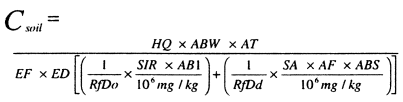 |
| Where: | |
| Csoil = | Soil cleanup level (mg/kg) |
| HQ = | Hazard quotient (unitless) |
| ABW = | Average body weight over the exposure duration (16 kg) |
| AT = | Averaging time (6 years) |
| EF = | Exposure frequency (1.0) (unitless) |
| ED = | Exposure duration (6 years) |
| SIR = | Soil ingestion rate (200 mg/day) |
| AB1 = | Gastrointestinal absorption fraction (1.0) (unitless) |
| SA = | Dermal surface area (2,200 cm2) |
| AF = | Adherence factor (0.2 mg/cm2-day) |
| ABS = | Dermal absorption fraction (unitless). |
| May use chemical-specific values or the following defaults: | |
| • | 0.01 for inorganic hazardous substances |
| • | 0.0005 for volatile organic compounds with vapor press > = benzene |
| • | 0.03 for volatile organic compounds with vapor press < benzene |
| • | 0.1 for other organic hazardous substances |
| RfDo = | Oral reference dose as defined in WAC 173-340-708(7) (mg/kg-day) |
| RfDd = | Dermal reference dose (mg/kg-day) derived by RfDo x GI |
| GI = | Gastrointestinal absorption conversion factor (unitless). |
| May use chemical specific values or the following defaults: | |
| • | 0.2 for inorganic hazardous substances |
| • | 0.8 for volatile organic compounds |
| • | 0.5 for other organic hazardous substances |
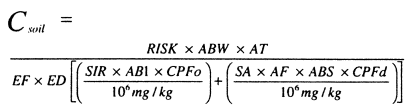 |
| Where: | |
| Csoil = | Soil cleanup level (mg/kg) |
| RISK = | Acceptable cancer risk (1 in 1,000,000) (unitless) |
| ABW = | Average body weight over the exposure duration (16 kg) |
| AT = | Averaging time (75 years) |
| EF = | Exposure frequency (1.0) (unitless) |
| ED = | Exposure duration (6 years) |
| SIR = | Soil ingestion rate (200 mg/day) |
| AB1 = | Gastrointestinal absorption fraction (1.0)
(unitless). May use 0.6 for mixtures of dioxins and/or furans |
| CPFo = | Oral cancer potency factor as defined in WAC 173-340-708(8) (kg-day/mg) |
| CPFd = | Dermal cancer potency factor (kg-day/mg) derived by CPFo/GI |
| GI = | Gastrointestinal absorption conversion factor (unitless). |
| May use chemical-specific values or the following defaults: | |
| • | 0.2 for inorganic hazardous substances |
| • | 0.8 for volatile organic compounds and for mixtures of dioxins and/or furans |
| • | 0.5 for other organic hazardous substances |
| SA = | Dermal surface area (2,200 cm2) |
| AF = | Adherence factor (0.2 mg/cm2-day) |
| ABS = | Dermal absorption fraction (unitless). May use chemical-specific values or the following defaults: |
| • | 0.01 for inorganic hazardous substances |
| • | 0.0005 for volatile organic compounds with vapor press > = benzene |
| • | 0.03 for volatile organic compounds with vapor press < benzene and for mixtures of dioxins and/or furans |
| • | 0.1 for other organic hazardous substances |
(iv) Soil vapors.
(A) Applicability. The soil to vapor pathway shall be evaluated for volatile organic compounds whenever any of the following conditions exist:
(I) For other than petroleum hydrocarbon mixtures, the proposed changes to the standard Method B equations (Equations 740-1 and 740-2) or default values would result in a significantly higher soil cleanup level than would be calculated without the proposed changes;
(II) For petroleum hydrocarbon mixtures, the proposed changes to the standard Method B equations (Equations 740-3, 740-4 and 740-5) or default values would result in a significantly higher soil cleanup level than would be calculated without the proposed changes;
(III) For gasoline range organics, whenever the total petroleum hydrocarbon (TPH) concentration is significantly higher than a concentration derived for protection of ground water for drinking water beneficial use under WAC 173-340-747(6) using the default assumptions;
(IV) For diesel range organics, whenever the total petroleum hydrocarbon (TPH) concentration is greater than 10,000 mg/kg;
(V) For other volatile organic compounds, including petroleum components, whenever the concentration is significantly higher than a concentration derived for protection of ground water for drinking water beneficial use under WAC 173-340-747(4).
(B) Evaluation methods. Soil cleanup levels that are protective of the indoor and ambient air shall be determined on a site-specific basis. Soil cleanup levels may be evaluated as being protective of air pathways using any of the following methods:
(I) Measurements of the soil vapor concentrations, using methods approved by the department, demonstrating vapors in the soil would not exceed air cleanup levels established under WAC 173-340-750.
(II) Measurements of ambient air concentrations and/or indoor air vapor concentrations throughout buildings, using methods approved by the department, demonstrating air does not exceed cleanup levels established under WAC 173-340-750. Such measurements must be representative of current and future site conditions when vapors are likely to enter and accumulate in structures. Measurement of ambient air may be excluded if it can be shown that indoor air is the most protective point of exposure.
(III) Use of modeling methods approved by the department to demonstrate the air cleanup standards established under WAC 173-340-750 will not be exceeded. When this method is used, the department may require soil vapor and/or air monitoring to be conducted to verify the calculations and compliance with air cleanup standards.
(IV) Other methods as approved by the department demonstrating the air cleanup standards established under WAC 173-340-750 will not be exceeded.
(d) Using modified Method B to evaluate soil remediation levels. In addition to the adjustments allowed under subsection (3)(c) of this section, adjustments to the reasonable maximum exposure scenario or default exposure assumptions are allowed when using a quantitative site-specific risk assessment to evaluate the protectiveness of a remedy. See WAC 173-340-355, 173-340-357, and 173-340-708 (3)(d) and (10)(b).
(4) Method C soil cleanup levels. This section does not provide procedures for establishing Method C soil cleanup levels. Except for qualifying industrial properties, Method A and Method B, as described in this section, are the only methods available for establishing soil cleanup levels at sites. See WAC 173-340-745 for use of Method C soil cleanup levels at qualifying industrial properties. See also WAC 173-340-357 and 173-340-708 (3)(d) for how land use may be considered when selecting a cleanup action at a site.
(5) Adjustments to cleanup levels.
(a) Total site risk adjustments. Soil cleanup levels for individual hazardous substances developed in accordance with subsection (3) of this section, including cleanup levels based on applicable state and federal laws, shall be adjusted downward to take into account exposure to multiple hazardous substances and/or exposure resulting from more than one pathway of exposure. These adjustments need to be made only if, without these adjustments, the hazard index would exceed one (1) or the total excess cancer risk would exceed one in one hundred thousand (1 x 10⁻⁵). These adjustments shall be made in accordance with the procedures specified in WAC 173-340-708 (5) and (6). In making these adjustments, the hazard index shall not exceed one (1) and the total excess cancer risk shall not exceed one in one hundred thousand (1 x 10⁻⁵).
(b) Adjustments to applicable state and federal laws. Where a cleanup level developed under subsection (2) or (3) of this section is based on an applicable state or federal law and the level of risk upon which the standard is based exceeds an excess cancer risk of one in one hundred thousand (1 x 10⁻⁵) or a hazard index of one (1), the cleanup level must be adjusted downward so that the total excess cancer risk does not exceed one in one hundred thousand (1 x 10⁻⁵) and the hazard index does not exceed one (1) at the site.
(c) Natural background and PQL considerations. Cleanup levels determined under subsection (2) or (3) of this section, including cleanup levels adjusted under subsection (5)(a) and (b) of this section, shall not be set at levels below the practical quantitation limit or natural background, whichever is higher. See WAC 173-340-707 and 173-340-709 for additional requirements pertaining to practical quantitation limits and natural background.
(6) Point of compliance.
(a) The point of compliance is the point or points where the soil cleanup levels established under subsection (2) or (3) of this section shall be attained.
(b) For soil cleanup levels based on the protection of ground water, the point of compliance shall be established in the soils throughout the site.
(c) For soil cleanup levels based on protection from vapors, the point of compliance shall be established in the soils throughout the site from the ground surface to the uppermost ground water saturated zone (e.g., from the ground surface to the uppermost water table).
(d) For soil cleanup levels based on human exposure via direct contact or other exposure pathways where contact with the soil is required to complete the pathway, the point of compliance shall be established in the soils throughout the site from the ground surface to fifteen feet below the ground surface. This represents a reasonable estimate of the depth of soil that could be excavated and distributed at the soil surface as a result of site development activities.
(e) For soil cleanup levels based on ecological considerations, see WAC 173-340-7490 for the point of compliance.
(f) The department recognizes that, for those cleanup actions selected under this chapter that involve containment of hazardous substances, the soil cleanup levels will typically not be met at the points of compliance specified in (b) through (e) of this subsection. In these cases, the cleanup action may be determined to comply with cleanup standards, provided:
(i) The selected remedy is permanent to the maximum extent practicable using the procedures in WAC 173-340-360;
(ii) The cleanup action is protective of human health. The department may require a site-specific human health risk assessment conforming to the requirements of this chapter to demonstrate that the cleanup action is protective of human health;
(iii) The cleanup action is demonstrated to be protective of terrestrial ecological receptors under WAC 173-340-7490 through 173-340-7494;
(iv) Institutional controls are put in place under WAC 173-340-440 that prohibit or limit activities that could interfere with the long-term integrity of the containment system;
(v) Compliance monitoring under WAC 173-340-410 and periodic reviews under WAC 173-340-430 are designed to ensure the long-term integrity of the containment system; and
(vi) The types, levels and amount of hazardous substances remaining on-site and the measures that will be used to prevent migration and contact with those substances are specified in the draft cleanup action plan.
(7) Compliance monitoring.
(a) Compliance with soil cleanup levels shall be based on total analyses of the soil fraction less than two millimeters in size. When it is reasonable to expect that larger soil particles could be reduced to two millimeters or less during current or future site use and this reduction could cause an increase in the concentrations of hazardous substances in the soil, soil cleanup levels shall also apply to these larger soil particles. Compliance with soil cleanup levels shall be based on dry weight concentrations. The department may approve the use of alternate procedures for stabilized soils.
(b) When soil levels have been established at a site, sampling of the soil shall be conducted to determine if compliance with the soil cleanup levels has been achieved. Sampling and analytical procedures shall be defined in a compliance monitoring plan prepared under WAC 173-340-410. The sample design shall provide data that are representative of the area where exposure to hazardous substances may occur.
(c) The data analysis and evaluation procedures used to evaluate compliance with soil cleanup levels shall be defined in a compliance monitoring plan prepared under WAC 173-340-410. These procedures shall meet the following general requirements:
(i) Methods of data analysis shall be consistent with the sampling design. Separate methods may be specified for surface soils and deeper soils;
(ii) When cleanup levels are based on requirements specified in applicable state and federal laws, the procedures for evaluating compliance that are specified in those requirements shall be used to evaluate compliance with cleanup levels unless those procedures conflict with the intent of this section;
(iii) Where procedures for evaluating compliance are not specified in an applicable state and federal law, statistical methods shall be appropriate for the distribution of sampling data for each hazardous substance. If the distributions for hazardous substances differ, more than one statistical method may be required; and
(iv) The data analysis plan shall specify which parameters are to be used to determine compliance with soil cleanup levels.
(A) For cleanup levels based on short-term or acute toxic effects on human health or the environment, an upper percentile soil concentration shall be used to evaluate compliance with cleanup levels.
(B) For cleanup levels based on chronic or carcinogenic threats, the true mean soil concentration shall be used to evaluate compliance with cleanup levels.
(d) When data analysis procedures for evaluating compliance are not specified in an applicable state or federal law the following procedures shall be used:
(i) A confidence interval approach that meets the following requirements:
(A) The upper one sided ninety-five percent confidence limit on the true mean soil concentration shall be less than the soil cleanup level. For lognormally distributed data, the upper one-sided ninety-five percent confidence limit shall be calculated using Land's method; and
(B) Data shall be assumed to be lognormally distributed unless this assumption is rejected by a statistical test. If a lognormal distribution is inappropriate, data shall be assumed to be normally distributed unless this assumption is rejected by a statistical test. The W test, D'Agostino's test, or, censored probability plots, as appropriate for the data, shall be the statistical methods used to determine whether the data are lognormally or normally distributed;
(ii) For an evaluation conducted under (c)(iv)(A) of this subsection, a parametric test for percentiles based on tolerance intervals to test the proportion of soil samples having concentrations less than the soil cleanup level. When using this method, the true proportion of samples that do not exceed the soil cleanup level shall not be less than ninety percent. Statistical tests shall be performed with a Type I error level of 0.05;
(iii) Direct comparison of soil sample concentrations with cleanup levels may be used to evaluate compliance with cleanup levels where selective sampling of soil can be reliably expected to find suspected soil contamination. There must be documented, reliable information that the soil samples have been taken from the appropriate locations. Persons using this method must demonstrate that the basis used for selecting the soil sample locations provides a high probability that any existing areas of soil contamination have been found; or
(iv) Other statistical methods approved by the department.
(e) All data analysis methods used, including those specified in state and federal law, must meet the following requirements:
(i) No single sample concentration shall be greater than two times the soil cleanup level. Higher exceedances to control false positive error rates at five percent may be approved by the department when the cleanup level is based on background concentrations; and
(ii) Less than ten percent of the sample concentrations shall exceed the soil cleanup level. Higher exceedances to control false positive error rates at five percent may be approved by the department when the cleanup level is based on background concentrations.
(f) When using statistical methods to demonstrate compliance with soil cleanup levels, the following procedures shall be used for measurements below the practical quantitation limit:
(i) Measurements below the method detection limit shall be assigned a value equal to one-half the method detection limit when not more than fifteen percent of the measurements are below the practical quantitation limit.
(ii) Measurements above the method detection limit but below the practical quantitation limit shall be assigned a value equal to the method detection limit when not more than fifteen percent of the measurements are below the practical quantitation limit.
(iii) When between fifteen and fifty percent of the measurements are below the practical quantitation limit and the data are assumed to be lognormally or normally distributed, Cohen's method shall be used to calculate a corrected mean and standard deviation for use in calculating an upper confidence limit on the true mean soil concentration.
(iv) If more than fifty percent of the measurements are below the practical quantitation limit, the largest value in the data set shall be used in place of an upper confidence limit on the true mean soil concentration.
(v) The department may approve alternate statistical procedures for handling nondetected values or values below the practical quantitation limit.
(vi) If a hazardous substance or petroleum fraction has never been detected in any sample at a site and these substances are not suspected of being present at the site based on site history and other knowledge, that hazardous substance or petroleum fraction may be excluded from the statistical analysis.
[Statutory Authority: Chapter 70.105D RCW. 01-05-024 (Order 97-09A), § 173-340-740, filed 2/12/01, effective 8/15/01; 96-04-010 (Order 94-37), § 173-340-740, filed 1/26/96, effective 2/26/96; 91-04-019, § 173-340-740, filed 1/28/91, effective 2/28/91.]
Reviser's note: The brackets and enclosed material in the text of the above section occurred in the copy filed by the agency and appear in the Register pursuant to the requirements of RCW 34.08.040.
AMENDATORY SECTION(Amending Order 97-09A, filed 2/12/01,
effective 8/15/01)
WAC 173-340-745
Soil cleanup standards for industrial
properties.
(1) Applicability.
(a) Criteria. This section shall be used to establish soil cleanup levels where the department has determined that industrial land use represents the reasonable maximum exposure. Soil cleanup levels for this presumed exposure scenario shall be established in accordance with this section. To qualify as an industrial land use and to use an industrial soil cleanup level a site must meet the following criteria:
(i) The area of the site where industrial property soil cleanup levels are proposed must meet the definition of an industrial property under WAC 173-340-200;
Industrial soil cleanup levels are based on an adult worker exposure scenario. It is essential to evaluate land uses and zoning for compliance with this definition in the context of this exposure scenario. Local governments use a variety of zoning categories for industrial land uses so a property does not necessarily have to be in a zone called "industrial" to meet the definition of "industrial property." Also, there are land uses allowed in industrial zones that are actually commercial or residential, rather than industrial, land uses. Thus, an evaluation to determine compliance with this definition should include a review of the actual text in the comprehensive plan and zoning ordinance pertaining to the site and a visit to the site to observe land uses in the zone. When evaluating land uses to determine if a property use not specifically listed in the definition is a "traditional industrial use" or to determine if the property is "zoned for industrial use," the following characteristics shall be considered:
(A) People do not normally live on industrial property. The primary potential exposure is to adult employees of businesses located on the industrial property;
(B) Access to industrial property by the general public is generally not allowed. If access is allowed, it is highly limited and controlled due to safety or security considerations;
(C) Food is not normally grown/raised on industrial property. (However, food processing operations are commonly considered industrial facilities);
(D) Operations at industrial properties are often (but not always) characterized by use and storage of chemicals, noise, odors and truck traffic;
(E) The surface of the land at industrial properties is often (but not always) mostly covered by buildings or other structures, paved parking lots, paved access roads and material storage areas--minimizing potential exposure to the soil; and
(F) Industrial properties may have support facilities consisting of offices, restaurants, and other facilities that are commercial in nature but are primarily devoted to administrative functions necessary for the industrial use and/or are primarily intended to serve the industrial facility employees and not the general public.
(ii) The cleanup action provides for appropriate institutional controls implemented in accordance with WAC 173-340-440 to limit potential exposure to residual hazardous substances. This shall include, at a minimum, placement of a covenant on the property restricting use of the area of the site where industrial soil cleanup levels are proposed to industrial property uses; and
(iii) Hazardous substances remaining at the property after remedial action would not pose a threat to human health or the environment at the site or in adjacent nonindustrial areas. In evaluating compliance with this criterion, at a minimum the following factors shall be considered:
(A) The potential for access to the industrial property by the general public, especially children. The proximity of the industrial property to residential areas, schools or childcare facilities shall be considered when evaluating access. In addition, the presence of natural features, manmade structures, arterial streets or intervening land uses that would limit or encourage access to the industrial property shall be considered. Fencing shall not be considered sufficient to limit access to an industrial property since this is insufficient to assure long term protection;
(B) The degree of reduction of potential exposure to residual hazardous substances by the selected remedy. Where the residual hazardous substances are to be capped to reduce exposure, consideration shall be given to the thickness of the cap and the likelihood of future site maintenance activities, utility and drainage work, or building construction reexposing residual hazardous substances;
(C) The potential for transport of residual hazardous substances to off-property areas, especially residential areas, schools and childcare facilities;
(D) The potential for significant adverse effects on wildlife caused by residual hazardous substances using the procedures in WAC 173-340-7490 through 173-340-7494; and
(E) The likelihood that these factors would not change for the foreseeable future.
(b) Expectations. In applying the criteria in (a) of this subsection, the department expects the following results:
(i) The department expects that properties zoned for heavy industrial or high intensity industrial use and located within a city or county that has completed a comprehensive plan and adopted implementing zoning regulations under the Growth Management Act (chapter 36.70A RCW) will meet the definition of industrial property. For cities and counties not planning under the Growth Management Act, the department expects that spot zoned industrial properties will not meet the definition of industrial property but that properties that are part of a larger area zoned for heavy industrial or high intensity industrial use will meet the definition of an industrial property;
(ii) For both GMA and non-GMA cities and counties, the department expects that light industrial and commercial zones and uses should meet the definition of industrial property where the land uses are comparable to those cited in the definition of industrial property or the land uses are an integral part of a qualifying industrial use (such as, ancillary or support facilities). This will require a site-by-site evaluation of the zoning text and land uses;
(iii) The department expects that for portions of industrial properties in close proximity to (generally, within a few hundred feet) residential areas, schools or childcare facilities, residential soil cleanup levels will be used unless:
(A) Access to the industrial property is very unlikely or, the hazardous substances that are not treated or removed are contained under a cap of clean soil (or other materials) of substantial thickness so that it is very unlikely the hazardous substances would be disturbed by future site maintenance and construction activities (depths of even shallow footings, utilities and drainage structures in industrial areas are typically three to six feet); and
(B) The hazardous substances are relatively immobile (or have other characteristics) or have been otherwise contained so that subsurface lateral migration or surficial transport via dust or runoff to these nearby areas or facilities is highly unlikely; and
(iv) Note that a change in the reasonable maximum exposure to industrial site use primarily affects the direct contact exposure pathway. Thus, for example, for sites where the soil cleanup level is based primarily on the potential for the hazardous substance to leach and cause ground water contamination, it is the department's expectation that an industrial land use will not affect the soil cleanup level. Similarly, where the soil cleanup level is based primarily on surface water protection or other pathways other than direct human contact, land use is not expected to affect the soil cleanup level.
(2) General considerations.
(a) In the event of a release of a hazardous substance at a site qualifying as industrial property, a cleanup action that complies with this chapter shall be conducted to address those soils with hazardous substance concentrations which exceed industrial soil cleanup levels at the relevant point of compliance.
(b) Soil cleanup levels for areas beyond the industrial property boundary that do not qualify for industrial soil cleanup levels under this section (including implementation of institutional controls and a covenant restricting use of the property to industrial property uses) shall be established in accordance with WAC 173-340-740.
(c) Industrial soil cleanup levels shall be established at concentrations that do not directly or indirectly cause violations of ground water, surface water, sediment or air cleanup standards established under this chapter or under applicable state and federal laws. A property that qualifies for an industrial soil cleanup level under this section does not necessarily qualify for a Method C cleanup level in other media. Each medium must be evaluated separately using the criteria applicable to that medium.
(d) The department may require more stringent soil cleanup standards than required by this section when, based on a site-specific evaluation, the department determines that this is necessary to protect human health and the environment, including consideration of the factors in WAC 173-340-740 (1)(c). Any imposition of more stringent requirements under this provision shall comply with WAC 173-340-702 and 173-340-708.
(3) Method A industrial soil cleanup levels.
(a) Applicability. Method A industrial soil cleanup levels may be used only at any industrial property qualifying under WAC 173-340-704(1).
(b) General requirements. Method A industrial soil cleanup levels shall be at least as stringent as all of the following:
(i) Concentrations in Table 745-1 and compliance with the corresponding footnotes;
(ii) Concentrations established under applicable state and federal laws;
(iii) Concentrations that result in no significant adverse effects on the protection and propagation of terrestrial ecological receptors using the procedures specified in WAC 173-340-7490 through 173-340-7493, unless it is demonstrated under those sections that establishing a soil concentration is unnecessary; and
(iv) For a hazardous substance that is deemed an indicator hazardous substance under WAC 173-340-708(2) and for which there is no value in Table 745-1 or applicable state and federal laws, a concentration that does not exceed the natural background concentration or the practical quantification limit, subject to the limitations in this chapter.
(4) Method B industrial soil cleanup levels. This section does not provide procedures for establishing Method B industrial soil cleanup levels. Method C is the standard method for establishing soil cleanup levels at industrial sites and its use is conditioned upon the continued use of the site for industrial purposes. The person conducting the cleanup action also has the option of establishing unrestricted land use soil cleanup levels under WAC 173-340-740 for qualifying industrial properties. This option may be desirable when the person wants to avoid restrictions on the future use of the property. When a site does not qualify for a Method A or Method C industrial soil cleanup level under this section, or the user chooses to establish unrestricted land use soil cleanup levels at a site, soil cleanup levels must be established using Methods A or B under WAC 173-340-740.
(5) Method C industrial soil cleanup levels.
(a) Applicability. Method C industrial soil cleanup levels consist of standard and modified cleanup levels as described in this subsection. Either standard or modified Method C soil cleanup levels may be used at any industrial property qualifying under subsection (1) of this section.
(b) Standard Method C industrial soil cleanup levels. Standard Method C industrial soil cleanup levels for industrial properties shall be at least as stringent as all of the following:
(i) Applicable state and federal laws. Concentrations established under applicable state and federal laws;
(ii) Environmental protection. Concentrations that result in no significant adverse effects on the protection and propagation of wildlife established using the procedures specified in WAC 173-340-7490 through 173-340-7494, unless it is demonstrated under those sections that establishing a soil concentration is unnecessary.
(iii) Human health protection. For hazardous substances for which sufficiently protective, health-based criteria or standards have not been established under applicable state and federal laws, those concentrations that protect human health as determined by evaluating the following exposure pathways:
(A) Ground water protection. Concentrations that will not cause contamination of ground water to concentrations which exceed ground water cleanup levels established under WAC 173-340-720 as determined using the methods described in WAC 173-340-747.
(B) Soil direct contact. Concentrations that, due to direct contact with contaminated soil, are estimated to result in no acute or chronic noncarcinogenic toxic effects on human health using a hazardous quotient of one (1) and concentrations for which the upper bound on the estimated excess cancer risk is less than or equal to one in one hundred thousand (1 x 10⁻⁵). Equations 745-1 and 745-2 and the associated default assumptions shall be used to conduct this calculation.
(I) Noncarcinogens. For noncarcinogenic toxic effects of hazardous substances due to soil ingestion, concentrations shall be determined using Equation 745-1. For petroleum mixtures and components of such mixtures, see (b)(iii)(B)(III) of this subsection.
| [Equation 745-1] | ||||
Soil Cleanup Level (mg/kg) |
= | RfD x ABW x UCF x HQ x AT SIR x AB1 x EF x ED |
||
| Where: | ||||
| RfD | = | Reference dose as specified in WAC 173-340-708(7) (mg/kg-day) | ||
| ABW | = | Average body weight over the exposure duration (70 kg) | ||
| UCF | = | Unit conversion factor (1,000,000 mg/kg) | ||
| SIR | = | Soil ingestion rate (50 mg/day) | ||
| AB1 | = | Gastrointestinal absorption fraction (1.0) (unitless) | ||
| EF | = | Exposure frequency (0.4) (unitless) | ||
| HQ | = | Hazard quotient (1) (unitless) | ||
| AT | = | Averaging time (20 years) | ||
| ED | = | Exposure duration (20 years) | ||
| [Equation 745-2] | ||||
Soil Cleanup Level (mg/kg) |
= |
RISK x ABW x AT x UCF CPF x SIR x AB1 x ED x EF |
||
| Where: | ||||
| RISK | = | Acceptable cancer risk level (1 in 100,000) (unitless) | ||
| ABW | = | Average body weight over the exposure duration (70 kg) | ||
| AT | = | Averaging time (75 years) | ||
| UCF | = | Unit conversion factor (1,000,000 mg/kg) | ||
| CPF | = | Carcinogenic Potency Factor as specified in WAC 173-340-708(8) (kg-day/mg) | ||
| SIR | = | Soil ingestion rate (50 mg/day) | ||
| AB1 | = | Gastrointestinal absorption fraction (1.0)
(unitless). May use 0.6 for mixtures of dioxins and/or furans |
||
| ED | = | Exposure duration (20 years) | ||
| EF | = | Exposure frequency (0.4) (unitless) | ||
align="center"
[Equation 745-3]
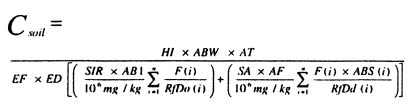 |
| Where: | |
| Csoil = | TPH soil cleanup level (mg/kg) |
| HI = | Hazard index (1) (unitless) |
| ABW = | Average body weight over the exposure duration (70 kg) |
| AT = | Averaging time (20 years) |
| EF = | Exposure frequency (0.7) (unitless) |
| ED = | Exposure duration (20 years) |
| SIR = | Soil ingestion rate (50 mg/day) |
| AB1 = | Gastrointestinal absorption fraction (1.0) (unitless) |
| F(i) = | Fraction (by weight) of petroleum component (i) (unitless) |
| SA = | Dermal surface area (2,500 cm2) |
| AF = | Adherence factor (0.2 mg/cm2-day) |
| ABS = | Dermal absorption fraction for petroleum component (i) (unitless). May use chemical-specific values or the following defaults: |
| • | 0.0005 for volatile petroleum components with vapor press > = benzene |
| • | 0.03 for volatile petroleum components with vapor press < benzene |
| • | 0.1 for other petroleum components |
| RfDo(i) = | Oral reference dose of petroleum component (i) as defined in WAC 173-340-708(7) (mg/kg-day) |
| RfDd(i) = | Dermal reference dose for petroleum component (i) (mg/kg-day) derived by RfDo x GI |
| GI = | Gastrointestinal absorption conversion factor (unitless). May use chemical-specific values or the following defaults: |
| • | 0.8 for volatile petroleum components |
| • | 0.5 for other petroleum components |
| n = | The number of petroleum components (petroleum fractions plus volatile organic compounds with an RfD) present in the petroleum mixture. (See Table 830-1.) |
(I) For gasoline range organics, whenever the total petroleum hydrocarbon (TPH) concentration is significantly higher than a concentration derived for protection of ground water for drinking water beneficial use under WAC 173-340-747(6) using the default assumptions;
(II) For diesel range organics, whenever the total petroleum hydrocarbon (TPH) concentration is greater than 10,000 mg/kg;
(III) For other volatile organic compounds, including petroleum components, whenever the concentration is significantly higher than a concentration derived for protection of ground water for drinking water beneficial use under WAC 173-340-747(4).
See subsection (5)(c)(iv)(B) of this section for methods that may be used to evaluate the soil to vapor pathway.
(c) Modified Method C soil cleanup levels.
(i) General. Modified Method C soil cleanup levels are standard Method C soil cleanup levels modified with chemical-specific or site-specific data. When making these adjustments, the resultant cleanup levels shall meet applicable state and federal laws, meet health risk levels for standard Method C soil cleanup levels, and be demonstrated to be environmentally protective using the procedures specified in WAC 173-340-7490 through 173-340-7494. Changes to exposure assumptions must comply with WAC 173-340-708(10).
(ii) Allowable modifications. The following modifications may be made to the default assumptions in the standard Method C equations to derive modified Method C soil cleanup levels:
(A) For the protection of ground water see WAC 173-340-747;
(B) For soil ingestion, the gastrointestinal absorption fraction may be modified if the requirements of WAC 173-340-702 (14), (15), (16), and 173-340-708(10) are met;
(C) For dermal contact, the adherence factor, dermal absorption fraction and gastrointestinal absorption conversion factor may be modified if the requirements of WAC 173-340-702 (14), (15), (16), and 173-340-708(10) are met;
(D) The toxicity equivalent factors((, as described))
provided in WAC 173-340-708 (8)((, may be used for assessing
the potential carcinogenic risk of mixtures of chlorinated
dibenzo-p-dioxins, chlorinated dibenzofurans and polycyclic
aromatic hydrocarbons)) (d), (e) and (f), may be modified
provided the requirements of WAC 173-340-708 (8)(g) and (h)
are met;
(E) The reference dose and cancer potency factor may be modified if the requirements in WAC 173-340-708 (7) and (8) are met; and
(F) Modifications incorporating new science as provided for in WAC 173-340-702 (14), (15) and (16).
(iii) Dermal contact. For hazardous substances other than petroleum mixtures, dermal contact with the soil shall be evaluated whenever the proposed changes to Equations 745-1 and 745-2 would result in a significantly higher soil cleanup level than would be calculated without the proposed changes. When conducting this evaluation, the following equations and default assumptions shall be used:
(A) For noncarcinogens use Equation 745-4. This equation takes into account concurrent exposure due to ingestion and dermal contact with soil.
align="center"
[Equation 745-4]
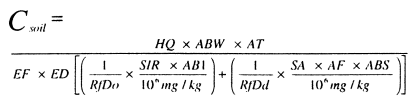 |
| Where: | |
| Csoil = | Soil cleanup level (mg/kg) |
| HQ = | Hazard quotient (unitless) |
| ABW = | Average body weight over the exposure duration (70 kg) |
| AT = | Averaging time (20 years) |
| EF = | Exposure frequency (0.7) (unitless) |
| ED = | Exposure duration (20 years) |
| SIR = | Soil ingestion rate (50 mg/day) |
| AB1 = | Gastrointestinal absorption fraction (1.0) (unitless) |
| SA = | Dermal surface area (2,500 mg/cm2) |
| AF = | Adherence factor (0.2 mg/cm2-day) |
| ABS = | Dermal absorption fraction (unitless). May use chemical-specific values or the following defaults: |
| • | 0.01 for inorganic hazardous substances |
| • | 0.0005 for volatile organic compounds with vapor press > = benzene |
| • | 0.03 for volatile organic compounds with vapor press < benzene |
| • | 0.1 for other organic hazardous substances |
| RfDo = | Oral reference dose as defined in WAC 173-340-708(7) (mg/kg-day) |
| RfDd = | Dermal reference dose (mg/kg-day) derived by RfDo x GI |
| GI = | Gastrointestinal absorption conversion factor (unitless). May use chemical-specific values or the following defaults: |
| • | 0.2 for inorganic hazardous substances |
| • | 0.8 for volatile organic compounds |
| • | 0.5 for other organic hazardous substances |
align="center"
[Equation 745-5]
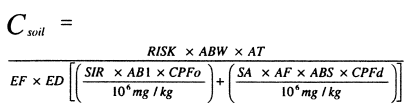 |
| Where: | |
| Csoil = | Soil cleanup level (mg/kg) |
| RISK = | Acceptable cancer risk (1 in 100,000) (unitless) |
| ABW = | Average body weight over the exposure duration (70 kg) |
| AT = | Averaging time (75 years) |
| EF = | Exposure frequency (0.7) (unitless) |
| ED = | Exposure duration (20 years) |
| SIR = | Soil ingestion rate (50 mg/day) |
| AB1 = | Gastrointestinal absorption fraction (1.0)
(unitless). May use 0.6 for mixtures of dioxins and/or furans |
| CPFo = | Oral cancer potency factor as defined in WAC 173-340-708(8) (kg-day/mg) |
| CPFd = | Dermal cancer potency factor (kg-day/mg) derived by CPFo/GI |
| GI = | Gastrointestinal absorption conversion factor (unitless). May use chemical-specific values or the following defaults: |
| • | 0.2 for inorganic hazardous substances |
| • | 0.8 for volatile organic compounds and mixtures of dioxins and/or furans |
| • | 0.5 for other organic hazardous substances |
| SA = | Dermal surface area (2,500 cm2) |
| AF = | Adherence factor (0.2 mg/cm2-day) |
| ABS = | Dermal absorption fraction (unitless). May use chemical-specific values or the following defaults: |
| • | 0.01 for inorganic hazardous substances |
| • | 0.0005 for volatile organic compounds with vapor press > = benzene |
| • | 0.03 for volatile organic compounds substances with vapor press < benzene and for mixtures of dioxins and/or furans |
| • | 0.1 for other organic hazardous substances |
(iv) Soil vapors.
(A) Applicability. The soil to vapor pathway shall be evaluated for volatile organic compounds whenever any of the following conditions exist:
(I) For other than petroleum hydrocarbon mixtures, the proposed changes to the standard Method C equations (Equations 745-1 and 745-2) or default values would result in a significantly higher soil cleanup level than would be calculated without the proposed changes;
(II) For petroleum hydrocarbon mixtures, the proposed changes to the standard Method C equations (Equations 745-3, 745-4 and 745-5) or default values would result in a significantly higher soil cleanup level than would be calculated without the proposed changes;
(III) For gasoline range organics, whenever the total petroleum hydrocarbon (TPH) concentration is significantly higher than a concentration derived for protection of ground water for drinking water beneficial use under WAC 173-340-747(6) using the default assumptions;
(IV) For diesel range organics, whenever the total petroleum hydrocarbon (TPH) concentration is greater than 10,000 mg/kg;
(V) For other volatile organic compounds, including petroleum components, whenever the concentration is significantly higher than a concentration derived for protection of ground water for drinking water beneficial use under WAC 173-340-747(4).
(B) Evaluation methods. Soil cleanup levels that are protective of the indoor and ambient air shall be determined on a site-specific basis. Soil cleanup levels may be evaluated as being protective of air pathways using any of the following methods:
(I) Measurements of the soil vapor concentrations, using methods approved by the department, demonstrating vapors in the soil would not exceed air cleanup levels established under WAC 173-340-750.
(II) Measurements of ambient air concentrations and/or indoor air vapor concentrations throughout buildings, using methods approved by the department, demonstrating air does not exceed cleanup levels established under WAC 173-340-750. Such measurements must be representative of current and future site conditions when vapors are likely to enter and accumulate in structures. Measurement of ambient air may be excluded if it can be shown that indoor air is the most protective point of exposure.
(III) Use of modeling methods approved by the department to demonstrate the air cleanup standards established under WAC 173-340-750 will not be exceeded. When this method is used, the department may require soil vapor and/or air monitoring to be conducted to verify the calculations and compliance with air cleanup standards.
(IV) Other methods as approved by the department demonstrating the air cleanup standards established under WAC 173-340-750 will not be exceeded.
(d) Using modified Method C to evaluate industrial soil remediation levels. In addition to the adjustments allowed under subsection (5)(c) of this section, other adjustments to the reasonable maximum exposure scenario or default exposure assumptions are allowed when using a quantitative site-specific risk assessment to evaluate the protectiveness of a remedy. See WAC 173-340-355, 173-340-357, and 173-340-708 (3)(d) and (10)(b).
(6) Adjustments to industrial soil cleanup levels.
(a) Total site risk adjustments. Soil cleanup levels for individual hazardous substances developed in accordance with subsection (5) of this section, including cleanup levels based on state and federal laws, shall be adjusted downward to take into account exposure to multiple hazardous substances and/or exposure resulting from more than one pathway of exposure. These adjustments need to be made only if, without these adjustments, the hazard index would exceed one (1) or the total excess cancer risk would exceed one in one hundred thousand (1 x 10⁻⁵). These adjustments shall be made in accordance with the procedures specified in WAC 173-340-708 (5) and (6). In making these adjustments, the hazard index shall not exceed one (1) and the total excess cancer risk shall not exceed one in one hundred thousand (1 x 10⁻⁵).
(b) Adjustments to applicable state and federal laws. Where a cleanup level developed under subsection (3) or (5) of this section is based on an applicable state or federal law and the level of risk upon which the standard is based exceeds an excess cancer risk of one in one hundred thousand (1 x 10⁻⁵) or a hazard index of one (1), the cleanup level shall be adjusted downward so that total excess cancer risk does not exceed one in one hundred thousand (1 x 10⁻⁵) and the hazard index does not exceed one (1) at the site.
(c) Natural background and analytical considerations. Cleanup levels determined under subsection (3) or (5) of this section, including cleanup levels adjusted under subsection (6)(a) and (b) of this section, shall not be set at levels below the practical quantitation limit or natural background concentration, whichever is higher. See WAC 173-340-707 and 173-340-709 for additional requirements pertaining to practical quantitation limits and natural background.
(7) Point of compliance. The point of compliance for industrial property soil cleanup levels shall be established in accordance with WAC 173-340-740(6).
(8) Compliance monitoring. Compliance monitoring and data analysis and evaluation for industrial property soil cleanup levels shall be performed in accordance with WAC 173-340-410 and 173-340-740(7).
[Statutory Authority: Chapter 70.105D RCW. 01-05-024 (Order 97-09A), § 173-340-745, filed 2/12/01, effective 8/15/01; 96-04-010 (Order 94-37), § 173-340-745, filed 1/26/96, effective 2/26/96; 91-04-019, § 173-340-745, filed 1/28/91, effective 2/28/91.]
Reviser's note: The brackets and enclosed material in the text of the above section occurred in the copy filed by the agency and appear in the Register pursuant to the requirements of RCW 34.08.040.
AMENDATORY SECTION(Amending Order 97-09A, filed 2/12/01,
effective 8/15/01)
WAC 173-340-900
Tables.
| CAS Number | Hazardous Substance | Toxicity Equivalency Factor (unitless)(1) | ||
| Dioxin Congeners | ||||
| 1746-01-6 | 2,3,7,8-Tetrachloro dibenzo-p-dioxin | 1 | ||
| 40321-76-4 | 1,2,3,7,8-Pentachloro dibenzo-p-dioxin | 1 | ||
| 39227-28-6 | 1,2,3,4,7,8-Hexachloro dibenzo-p-dioxin | 0.1 | ||
| 57653-85-7 | 1,2,3,6,7,8-Hexachloro dibenzo-p-dioxin | 0.1 | ||
| 19408-74-3 | 1,2,3,7,8,9-Hexachloro dibenzo-p-dioxin | 0.1 | ||
| 35822-46-9 | 1,2,3,4,6,7,8-Heptachloro dibenzo-p-dioxin | 0.01 | ||
| 3268-87-9 | 1,2,3,4,6,7,8,9-Octachloro dibenzo-p-dioxin | 0.0003 | ||
| Furan Congeners | ||||
| 51207-31-9 | 2,3,7,8-Tetrachloro dibenzofuran | 0.1 | ||
| 57117-41-6 | 1,2,3,7,8-Pentachloro dibenzofuran | 0.03 | ||
| 57117-31-4 | 2,3,4,7,8-Pentachloro dibenzofuran | 0.3 | ||
| 70648-26-9 | 1,2,3,4,7,8-Hexachloro dibenzofuran | 0.1 | ||
| 57117-44-9 | 1,2,3,6,7,8-Hexachloro dibenzofuran | 0.1 | ||
| 72918-21-9 | 1,2,3,7,8,9-Hexachloro dibenzofuran | 0.1 | ||
| 60851-34-5 | 2,3,4,6,7,8-Hexachloro dibenzofuran | 0.1 | ||
| 67562-39-4 | 1,2,3,4,6,7,8-Heptachloro dibenzofuran | 0.01 | ||
| 55673-89-7 | 1,2,3,4,7,8,9-Heptachloro dibenzofuran | 0.01 | ||
| 39001-02-0 | 1,2,3,4,6,7,8,9-Octachloro dibenzofuran | 0.0003 | ||
| (1) Source: Van den Berg et al. 2006. The 2005 World Health Organization Re-evaluation of Human and Mammalian Toxic
Equivalency Factors for Dioxins and Dioxin-like Compounds. Toxicological Sciences 2006 93(2):223-241; doi:10.1093/toxsci/kfl055. |
||||
| CAS Number | Hazardous Substance | TEF (unitless)(1) | |
| 50-32-08 | benzo[a]pyrene | 1 | |
| 56-55-3 | benzo[a]anthracene | 0.1 | |
| 205-99-2 | benzo[b]fluoranthene | 0.1 | |
| 207-08-9 | benzo[k]fluoranthene | 0.1 | |
| 218-01-9 | chrysene | 0.01 | |
| 53-70-3 | dibenz[a, h]anthracene | 0.1 | |
| 193-39-5 | indeno[1,2,3-cd]pyrene | 0.1 | |
| (1) Source: Cal-EPA, 2005. Air Toxics Hot Spots Program Risk Assessment Guidelines, Part II Technical Support Document for Describing Available Cancer Potency Factors. Office of Environmental Health Hazard Assessment, California Environmental Protection Agency. May 2005. | |||
| CAS Number | Hazardous Substance | TEF (unitless)(1) | |
| 205-82-3 | benzo(j)fluoranthene | 0.1 | |
| 224-42-0 | dibenz[a, j]acridine | 0.1 | |
| 226-36-8 | dibenz[a, h]acridine | 0.1 | |
| 194-59-2 | 7H-dibenzo[c, g]carbazole | 1 | |
| 192-65-4 | dibenzo[a, e]pyrene | 1 | |
| 189-64-0 | dibenzo[a, h]pyrene | 10 | |
| 189-55-9 | dibenzo[a, i]pyrene | 10 | |
| 191-30-0 | dibenzo[a, l]pyrene | 10 | |
| 3351-31-3 | 5-methylchrysene | 1 | |
| 5522-43-0 | 1-nitropyrene | 0.1 | |
| 57835-92-4 | 4-nitropyrene | 0.1 | |
| 42397-64-8 | 1,6-dinitropyrene | 10 | |
| 42397-65-9 | 1,8-dinitropyrene | 1 | |
| 7496-02-8 | 6-nitrochrysene | 10 | |
| 607-57-8 | 2-nitrofluorene | 0.01 | |
| 57-97-6 | 7,12-dimethylbenzanthracene | 10 | |
| 56-49-5 | 3-methylcholanthrene | 1 | |
| 602-87-9 | 5-nitroacenaphthene | 0.01 | |
| (1)Source: Cal-EPA, 2005. Air Toxics Hot Spots Program Risk Assessment Guidelines, Part II Technical Support Document for Describing Available Cancer Potency Factors. Office of Environmental Health Hazard Assessment, California Environmental Protection Agency. May 2005. | |||
| CAS Number | Hazardous Substance | TEF (unitless)(1) | |
| Dioxin-Like PCBs | |||
| 32598-13-3 | 3,3',4,4'-Tetrachlorobiphenyl (PCB 77) | 0.0001 | |
| 70362-50-4 | 3,4,4',5- Tetrachlorobiphenyl (PCB 81) | 0.0003 | |
| 32598-14-4 | 2,3,3',4,4'-Pentachlorobiphenyl (PCB 105) | 0.00003 | |
| 74472-37-0 | 2,3,4,4',5-Pentachlorobiphenyl (PCB 114) | 0.00003 | |
| 31508-00-6 | 2,3',4,4',5-Pentachlorobiphenyl (PCB 118) | 0.00003 | |
| 65510-44-3 | 2',3,4,4',5-Pentachlorobiphenyl (PCB 123) | 0.00003 | |
| 57465-28-8 | 3,3',4,4',5-Pentachlorobiphenyl (PCB 126) | 0.1 | |
| 38380-08-4 | 2,3,3',4,4',5-Hexachlorobiphenyl (PCB 156) | 0.00003 | |
| 69782-90-7 | 2,3,3',4,4',5'-Hexachlorobiphenyl (PCB 157) | 0.00003 | |
| 52663-72-6 | 2,3',4,4',5,5'-Hexachlorobiphenyl (PCB 167) | 0.00003 | |
| 32774-16-6 | 3,3',4,4',5,5'-Hexachlorobiphenyl (PCB 169) | 0.03 | |
| 39635-31-9 | 2,3,3',4,4',5,5'-Heptachlorobiphenyl (PCB 189) | 0.00003 | |
| (1)Source: Van den Berg et al. 2006. The 2005 World Health Organization Re-evaluation of Human and Mammalian Toxic Equivalency Factors for Dioxins and Dioxin-like Compounds. Toxicological Sciences 2006 93(2):223-241; doi:10.1093/toxsci/kfl055. | |||
Table 720-1
Method A Cleanup Levels for Ground Water.a
| Hazardous Substance | CAS Number | Cleanup Level |
| Arsenic | 7440-38-2 | 5 ug/literb |
| Benzene | 71-43-2 | 5 ug/literc |
| Benzo(a)pyrene | 50-32-8 | 0.1 ug/literd |
| Cadmium | 7440-43-9 | 5 ug/litere |
| Chromium (Total) | 7440-47-3 | 50 ug/literf |
| DDT | 50-29-3 | 0.3 ug/literg |
| 1,2 Dichloroethane (EDC) | 107-06-2 | 5 ug/literh |
| Ethylbenzene | 100-41-4 | 700 ug/literi |
| Ethylene dibromide (EDB) | 106-93-4 | 0.01 ug/literj |
| Gross Alpha Particle Activity | 15 pCi/literk | |
| Gross Beta Particle Activity | 4 mrem/yrl | |
| Lead | 7439-92-1 | 15 ug/literm |
| Lindane | 58-89-9 | 0.2 ug/litern |
| Methylene chloride | 75-09-2 | 5 ug/litero |
| Mercury | 7439-97-6 | 2 ug/literp |
| MTBE | 1634-04-4 | 20 ug/literq |
| Naphthalenes | 91-20-3 | 160 ug/literr |
| PAHs (carcinogenic) | See benzo(a)pyrened | |
| PCB mixtures | 0.1 ug/liters | |
| Radium 226 and 228 | 5 pCi/litert | |
| Radium 226 | 3 pCi/literu | |
| Tetrachloroethylene | 127-18-4 | 5 ug/literv |
| Toluene | 108-88-3 | 1,000 ug/literw |
| Total Petroleum Hydrocarbonsx | ||
| [Note: Must also test for and meet cleanup levels for other petroleum components--see footnotes!] | ||
| Gasoline Range Organics | ||
| Benzene present in ground water | 800 ug/liter | |
| No detectable benzene in ground water | 1,000 ug/liter | |
| Diesel Range Organics | 500 ug/liter | |
| Heavy Oils | 500 ug/liter | |
| Mineral Oil | 500 ug/liter | |
| 1,1,1 Trichloroethane | 71-55-6 | 200 ug/litery |
| Trichloroethylene | 79-01-6 | 5 ug/literz |
| Vinyl chloride | 75-01-4 | 0.2 ug/literaa |
| Xylenes | 1330-20-7 | 1,000 ug/literbb |
| Footnotes: |
| a | Caution on misusing this table. This table has been developed for specific purposes. It is intended to provide conservative cleanup levels for drinking water beneficial uses at sites undergoing routine cleanup actions or those sites with relatively few hazardous substances. This table may not be appropriate for defining cleanup levels at other sites. For these reasons, the values in this table should not automatically be used to define cleanup levels that must be met for financial, real estate, insurance coverage or placement, or similar transactions or purposes. Exceedances of the values in this table do not necessarily mean the ground water must be restored to those levels at all sites. The level of restoration depends on the remedy selected under WAC 173-340-350 through 173-340-390. |
| b | Arsenic. Cleanup level based on background concentrations for state of Washington. |
| c | Benzene. Cleanup level based on applicable state and federal law (WAC 246-290-310 and 40 C.F.R. 141.61). |
| d | Benzo(a)pyrene. Cleanup level based on applicable state and federal law (WAC 246-290-310 and 40 C.F.R. 141.61), adjusted to a 1 x 10⁻⁵ risk. If other carcinogenic PAHs are suspected of being present at the site, test for them and use this value as the total concentration that all carcinogenic PAHs must meet using the toxicity equivalency methodology in WAC 173-340-708(8). |
| e | Cadmium. Cleanup level based on applicable state and federal law (WAC 246-290-310 and 40 C.F.R. 141.62). |
| f | Chromium (Total). Cleanup level based on concentration derived using Equation 720-1 for hexavalent chromium. This is a total value for chromium III and chromium VI. If just chromium III is present at the site, a cleanup level of 100 ug/l may be used (based on WAC 246-290-310 and 40 C.F.R. 141.62). |
| g | DDT (dichlorodiphenyltrichloroethane). Cleanup levels based on concentration derived using Equation 720-2. |
| h | 1,2 Dichloroethane (ethylene dichloride or EDC). Cleanup level based on applicable state and federal law (WAC 246-290-310 and 40 C.F.R. 141.61). |
| i | Ethylbenzene. Cleanup level based on applicable state and federal law (WAC 246-290-310 and 40 C.F.R. 141.61). |
| j | Ethylene dibromide (1,2 dibromoethane or EDB). Cleanup level based on concentration derived using Equation 720-2, adjusted for the practical quantitation limit. |
| k | Gross Alpha Particle Activity, excluding uranium. Cleanup level based on applicable state and federal law (WAC 246-290-310 and 40 C.F.R. 141.15). |
| l | Gross Beta Particle Activity, including gamma activity. Cleanup level based on applicable state and federal law (WAC 246-290-310 and 40 C.F.R. 141.15). |
| m | Lead. Cleanup level based on applicable state and federal law (40 C.F.R. 141.80). |
| n | Lindane. Cleanup level based on applicable state and federal law (WAC 246-290-310 and 40 C.F.R. 141.61). |
| o | Methylene chloride (dichloromethane). Cleanup level based on applicable state and federal law (WAC 246-290-310 and 40 C.F.R. 141.61). |
| p | Mercury. Cleanup level based on applicable state and federal law (WAC 246-290-310 and 40 C.F.R. 141.62). |
| q | Methyl tertiary-butyl ether (MTBE). Cleanup level based on federal drinking water advisory level (EPA-822-F-97-009, December 1997). |
| r | Naphthalenes. Cleanup level based on concentration derived using Equation 720-1. This is a total value for naphthalene, 1-methyl naphthalene and 2-methyl naphthalene. |
| s | PCB mixtures. Cleanup level based on concentration derived using Equation 720-2, adjusted for the practical quantitation limit. This cleanup level is a total value for all PCBs. |
| t | Radium 226 and 228. Cleanup level based on applicable state and federal law (WAC 246-290-310 and 40 C.F.R. 141.15). |
| u | Radium 226. Cleanup level based on applicable state law (WAC 246-290-310). |
| v | Tetrachloroethylene. Cleanup level based on applicable state and federal law (WAC 246-290-310 and 40 C.F.R. 141.61). |
| w | Toluene. Cleanup level based on applicable state and federal law (WAC 246-290-310 and 40 C.F.R. 141.61). |
| x | Total Petroleum Hydrocarbons (TPH). TPH cleanup values have been provided for the most common petroleum products encountered at contaminated sites. Where there is a mixture of products or the product composition is unknown, samples must be tested using both the NWTPH-Gx and NWTPH-Dx methods and the lowest applicable TPH cleanup level must be met. |
| • | Gasoline range organics means organic compounds measured using method NWTPH-Gx. Examples are aviation and automotive gasoline. The cleanup level is based on protection of ground water for noncarcinogenic effects during drinking water use. Two cleanup levels are provided. The higher value is based on the assumption that no benzene is present in the ground water sample. If any detectable amount of benzene is present in the ground water sample, then the lower TPH cleanup level must be used. No interpolation between these cleanup levels is allowed. The ground water cleanup level for any carcinogenic components of the petroleum [such as benzene, EDB and EDC] and any noncarcinogenic components [such as ethylbenzene, toluene, xylenes and MTBE], if present at the site, must also be met. See Table 830-1 for the minimum testing requirements for gasoline releases. |
| • | Diesel range organics means organic compounds measured using NWTPH-Dx. Examples are diesel, kerosene, and #1 and #2 heating oil. The cleanup level is based on protection from noncarcinogenic effects during drinking water use. The ground water cleanup level for any carcinogenic components of the petroleum [such as benzene and PAHs] and any noncarcinogenic components [such as ethylbenzene, toluene, xylenes and naphthalenes], if present at the site, must also be met. See Table 830-1 for the minimum testing requirements for diesel releases. |
| • | Heavy oils means organic compounds measured using NWTPH-Dx. Examples are #6 fuel oil, bunker C oil, hydraulic oil and waste oil. The cleanup level is based on protection from noncarcinogenic effects during drinking water use, assuming a product composition similar to diesel fuel. The ground water cleanup level for any carcinogenic components of the petroleum [such as benzene, PAHs and PCBs] and any noncarcinogenic components [such as ethylbenzene, toluene, xylenes and naphthalenes], if present at the site, must also be met. See Table 830-1 for the minimum testing requirements for heavy oil releases. |
| • | Mineral oil means non-PCB mineral oil, typically used as an insulator and coolant in electrical devices such as transformers and capacitors measured using NWTPH-Dx. The cleanup level is based on protection from noncarcinogenic effects during drinking water use. Sites using this cleanup level must analyze ground water samples for PCBs and meet the PCB cleanup level in this table unless it can be demonstrated that: (1) The release originated from an electrical device manufactured after July 1, 1979; or (2) oil containing PCBs was never used in the equipment suspected as the source of the release; or (3) it can be documented that the oil released was recently tested and did not contain PCBs. Method B (or Method C, if applicable) must be used for releases of oils containing greater than 50 ppm PCBs. See Table 830-1 for the minimum testing requirements for mineral oil releases. |
| y | 1,1,1 Trichloroethane. Cleanup level based on applicable state and federal law (WAC 246-290-310 and 40 C.F.R. 141.61). |
| z | Trichloroethylene. Cleanup level based on applicable state and federal law (WAC 246-290-310 and 40 C.F.R. 141.61). |
| aa | Vinyl chloride. Cleanup level based on applicable state and federal law (WAC 246-290-310 and 40 C.F.R. 141.61), adjusted to a 1 x 10⁻⁵ risk. |
| bb | Xylenes. Cleanup level based on xylene not exceeding the maximum allowed cleanup level in this table for total petroleum hydrocarbons and on prevention of adverse aesthetic characteristics. This is a total value for all xylenes. |
Table 740-1
Method A Soil Cleanup Levels for Unrestricted Land Uses.a
| Hazardous Substance | CAS Number | Cleanup Level |
Arsenic |
7440-38-2 |
20 mg/kgb |
| Benzene | 71-43-2 | 0.03 mg/kgc |
| Benzo(a)pyrene | 50-32-8 | 0.1 mg/kgd |
| Cadmium | 7440-43-9 | 2 mg/kge |
| Chromium | ||
| Chromium VI | 18540-29-9 | 19 mg/kgf1 |
| Chromium III | 16065-83-1 | 2,000 mg/kgf2 |
| DDT | 50-29-3 | 3 mg/kgg |
| Ethylbenzene | 100-41-4 | 6 mg/kgh |
| Ethylene dibromide (EDB) | 106-93-4 | 0.005 mg/kgi |
| Lead | 7439-92-1 | 250 mg/kgj |
| Lindane | 58-89-9 | 0.01 mg/kgk |
| Methylene chloride | 75-09-2 | 0.02 mg/kgl |
| Mercury (inorganic) | 7439-97-6 | 2 mg/kgm |
| MTBE | 1634-04-4 | 0.1 mg/kgn |
| Naphthalenes | 91-20-3 | 5 mg/kgo |
| PAHs (carcinogenic) | See benzo(a)pyrened | |
| PCB Mixtures | 1 mg/kgp | |
| Tetrachloroethylene | 127-18-4 | 0.05 mg/kgq |
| Toluene | 108-88-3 | 7 mg/kgr |
| Total Petroleum Hydrocarbonss | ||
| [Note: Must also test for and meet cleanup levels for other petroleum components--see footnotes!] | ||
| Gasoline Range Organics | ||
| Gasoline mixtures without benzene and the total of ethylbenzene, toluene and xylene are less than 1% of the gasoline mixture | 100 mg/kg | |
| All other gasoline mixtures | 30 mg/kg | |
| Diesel Range Organics | 2,000 mg/kg | |
| Heavy Oils | 2,000 mg/kg | |
| Mineral Oil | 4,000 mg/kg | |
| 1,1,1 Trichloroethane | 71-55-6 | 2 mg/kgt |
| Trichloroethylene | 79-01-6 | 0.03 mg/kgu |
| Xylenes | 1330-20-7 | 9 mg/kgv |
| Footnotes: |
| a | Caution on misusing this table. This table has been developed for specific purposes. It is intended to provide conservative cleanup levels for sites undergoing routine cleanup actions or for sites with relatively few hazardous substances, and the site qualifies under WAC 173-340-7491 for an exclusion from conducting a simplified or site-specific terrestrial ecological evaluation, or it can be demonstrated using a terrestrial ecological evaluation under WAC 173-340-7492 or 173-340-7493 that the values in this table are ecologically protective for the site. This table may not be appropriate for defining cleanup levels at other sites. For these reasons, the values in this table should not automatically be used to define cleanup levels that must be met for financial, real estate, insurance coverage or placement, or similar transactions or purposes. Exceedances of the values in this table do not necessarily mean the soil must be restored to these levels at a site. The level of restoration depends on the remedy selected under WAC 173-340-350 through 173-340-390. |
| b | Arsenic. Cleanup level based on direct contact using Equation 740-2 and protection of ground water for drinking water use using the procedures in WAC 173-340-747(4), adjusted for natural background for soil. |
| c | Benzene. Cleanup level based on protection of ground water for drinking water use, using the procedures in WAC 173-340-747 (4) and (6). |
| d | Benzo(a)pyrene. Cleanup level based on direct contact using Equation 740-2. If other carcinogenic PAHs are suspected of being present at the site, test for them and use this value as the total concentration that all carcinogenic PAHs must meet using the toxicity equivalency methodology in WAC 173-340-708(8). |
| e | Cadmium. Cleanup level based on protection of ground water for drinking water use, using the procedures described in WAC 173-340-747(4), adjusted for the practical quantitation limit for soil. |
| f1 | Chromium VI. Cleanup level based on protection of ground water for drinking water use, using the procedures described in WAC 173-340-747(4). |
| f2 | Chromium III. Cleanup level based on protection of ground water for drinking water use, using the procedures described in WAC 173-340-747(4). Chromium VI must also be tested for and the cleanup level met when present at a site. |
| g | DDT (dichlorodiphenyltrichloroethane). Cleanup level based on direct contact using Equation 740-2. |
| h | Ethylbenzene. Cleanup level based on protection of ground water for drinking water use, using the procedures described in WAC 173-340-747(4). |
| i | Ethylene dibromide (1,2 dibromoethane or EDB). Cleanup level based on protection of ground water for drinking water use, using the procedures described in WAC 173-340-747(4), adjusted for the practical quantitation limit for soil. |
| j | Lead. Cleanup level based on preventing unacceptable blood lead levels. |
| k | Lindane. Cleanup level based on protection of ground water for drinking water use, using the procedures described in WAC 173-340-747(4), adjusted for the practical quantitation limit. |
| l | Methylene chloride (dichloromethane). Cleanup level based on protection of ground water for drinking water use, using the procedures described in WAC 173-340-747(4). |
| m | Mercury. Cleanup level based on protection of ground water for drinking water use, using the procedures described in WAC 173-340-747(4). |
| n | Methyl tertiary-butyl ether (MTBE). Cleanup level based on protection of ground water for drinking water use, using the procedures described in WAC 173-340-747(4). |
| o | Naphthalenes. Cleanup level based on protection of ground water for drinking water use, using the procedures described in WAC 173-340-747(4). This is a total value for naphthalene, 1-methyl naphthalene and 2-methyl naphthalene. |
| p | PCB Mixtures. Cleanup level based on applicable federal law (40 C.F.R. 761.61). This is a total value for all PCBs. |
| q | Tetrachloroethylene. Cleanup level based on protection of ground water for drinking water use, using the procedures described in WAC 173-340-747(4). |
| r | Toluene. Cleanup level based on protection of ground water for drinking water use, using the procedures described in WAC 173-340-747(4). |
| s | Total Petroleum Hydrocarbons (TPH). TPH cleanup values have been provided for the most common petroleum products encountered at contaminated sites. Where there is a mixture of products or the product composition is unknown, samples must be tested using both the NWTPH-Gx and NWTPH-Dx methods and the lowest applicable TPH cleanup level must be met. |
| • | Gasoline range organics means organic compounds measured using method NWTPH-Gx. Examples are aviation and automotive gasoline. The cleanup level is based on protection of ground water for noncarcinogenic effects during drinking water use using the procedures described in WAC 173-340-747(6). Two cleanup levels are provided. The lower value of 30 mg/kg can be used at any site. When using this lower value, the soil must also be tested for and meet the benzene soil cleanup level. The higher value of 100 mg/kg can only be used if the soil is tested and found to contain no benzene and the total of ethylbenzene, toluene and xylene are less than 1% of the gasoline mixture. No interpolation between these cleanup levels is allowed. In both cases, the soil cleanup level for any other carcinogenic components of the petroleum [such as EDB and EDC], if present at the site, must also be met. Also, in both cases, soil cleanup levels for any noncarcinogenic components [such as toluene, ethylbenzene, xylenes, naphthalene, and MTBE], also must be met if these substances are found to exceed ground water cleanup levels at the site. See Table 830-1 for the minimum testing requirements for gasoline releases. |
| • | Diesel range organics means organic compounds measured using method NWTPH-Dx. Examples are diesel, kerosene, and #1 and #2 heating oil. The cleanup level is based on preventing the accumulation of free product on the ground water, as described in WAC 173-340-747(10). The soil cleanup level for any carcinogenic components of the petroleum [such as benzene and PAHs], if present at the site, must also be met. Soil cleanup levels for any noncarcinogenic components [such as toluene, ethylbenzene, xylenes and naphthalenes], also must be met if these substances are found to exceed the ground water cleanup levels at the site. See Table 830-1 for the minimum testing requirements for diesel releases. |
| • | Heavy oils means organic compounds measured using NWTPH-Dx. Examples are #6 fuel oil, bunker C oil, hydraulic oil and waste oil. The cleanup level is based on preventing the accumulation of free product on the ground water, as described in WAC 173-340-747(10) and assuming a product composition similar to diesel fuel. The soil cleanup level for any carcinogenic components of the petroleum [such as benzene, PAHs and PCBs], if present at the site, must also be met. Soil cleanup levels for any noncarcinogenic components [such as toluene, ethylbenzene, xylenes and naphthalenes], also must be met if found to exceed the ground water cleanup levels at the site. See Table 830-1 for the minimum testing requirements for heavy oil releases. |
| • | Mineral oil means non-PCB mineral oil, typically used as an insulator and coolant in electrical devices such as transformers and capacitors, measured using NWTPH-Dx. The cleanup level is based on preventing the accumulation of free product on the ground water, as described in WAC 173-340-747(10). Sites using this cleanup level must also analyze soil samples and meet the soil cleanup level for PCBs, unless it can be demonstrated that: (1) The release originated from an electrical device that was manufactured after July 1, 1979; or (2) oil containing PCBs was never used in the equipment suspected as the source of the release; or (3) it can be documented that the oil released was recently tested and did not contain PCBs. Method B must be used for releases of oils containing greater than 50 ppm PCBs. See Table 830-1 for the minimum testing requirements for mineral oil releases. |
| t | 1,1,1 Trichloroethane. Cleanup level based on protection of ground water for drinking water use, using the procedures described in WAC 173-340-747(4). |
| u | Trichloroethylene. Cleanup level based on protection of ground water for drinking water use, using the procedures described in WAC 173-340-747(4). |
| v | Xylenes. Cleanup level based on protection of ground water for drinking water use, using the procedures described in WAC 173-340-747(4). This is a total value for all xylenes. |
Table 745-1
Method A Soil Cleanup Levels for Industrial Properties.a
| Hazardous Substance | CAS Number | Cleanup Level |
| Arsenic | 7440-38-2 | 20 mg/kgb |
| Benzene | 71-43-2 | 0.03 mg/kgc |
| Benzo(a)pyrene | 50-32-8 | 2 mg/kgd |
| Cadmium | 7440-43-9 | 2 mg/kge |
| Chromium | ||
| Chromium VI | 18540-29-9 | 19 mg/kgf1 |
| Chromium III | 16065-83-1 | 2,000 mg/kgf2 |
| DDT | 50-29-3 | 4 mg/kgg |
| Ethylbenzene | 100-41-4 | 6 mg/kgh |
| Ethylene dibromide (EDB) | 106-93-4 | 0.005 mg/kgi |
| Lead | 7439-92-1 | 1,000 mg/kgj |
| Lindane | 58-89-9 | 0.01 mg/kgk |
| Methylene chloride | 75-09-2 | 0.02 mg/kgl |
| Mercury (inorganic) | 7439-97-6 | 2 mg/kgm |
| MTBE | 1634-04-4 | 0.1 mg/kgn |
| Naphthalene | 91-20-3 | 5 mg/kgo |
| PAHs (carcinogenic) | See benzo(a)pyrened | |
| PCB Mixtures | 10 mg/kgp | |
| Tetrachloroethylene | 127-18-4 | 0.05 mg/kgq |
| Toluene | 108-88-3 | 7 mg/kgr |
| Total Petroleum Hydrocarbonss | ||
| [Note: Must also test for and meet cleanup levels for other petroleum components--see footnotes!] | ||
| Gasoline Range Organics | ||
| Gasoline mixtures without benzene and the total of ethylbenzene, toluene and xylene are less than 1% of the gasoline mixture | 100 mg/kg | |
| All other gasoline mixtures | 30 mg/kg | |
| Diesel Range Organics | 2,000 mg/kg | |
| Heavy Oils | 2,000 mg/kg | |
| Mineral Oil | 4,000 mg/kg | |
| 1,1,1 Trichloroethane | 71-55-6 | 2 mg/kgt |
| Trichloroethylene | 79-01-6 | 0.03 mg/kgu |
| Xylenes | 1330-20-7 | 9 mg/kgv |
| Footnotes: |
| a | Caution on misusing this table. This table has been developed for specific purposes. It is intended to provide conservative cleanup levels for sites undergoing routine cleanup actions or for industrial properties with relatively few hazardous substances, and the site qualifies under WAC 173-340-7491 for an exclusion from conducting a simplified or site-specific terrestrial ecological evaluation, or it can be demonstrated using a terrestrial ecological evaluation under WAC 173-340-7492 or 173-340-7493 that the values in this table are ecologically protective for the site. This table may not be appropriate for defining cleanup levels at other sites. For these reasons, the values in this table should not automatically be used to define cleanup levels that must be met for financial, real estate, insurance coverage or placement, or similar transactions or purposes. Exceedances of the values in this table do not necessarily mean the soil must be restored to these levels at a site. The level of restoration depends on the remedy selected under WAC 173-340-350 through 173-340-390. |
| b | Arsenic. Cleanup level based on protection of ground water for drinking water use, using the procedures in WAC 173-340-747(4), adjusted for natural background for soil. |
| c | Benzene. Cleanup level based on protection of ground water for drinking water use, using the procedures described in WAC 173-340-747 (4) and (6). |
| d | Benzo(a)pyrene. Cleanup level based on protection of ground water for drinking water use, using the procedures described in WAC 173-340-747(4). If other carcinogenic PAHs are suspected of being present at the site, test for them and use this value as the total concentration that all carcinogenic PAHs must meet using the toxicity equivalency methodology in WAC 173-340-708(8). |
| e | Cadmium. Cleanup level based on protection of ground water for drinking water use, using the procedures described in WAC 173-340-747(4), adjusted for the practical quantitation limit for soil. |
| f1 | Chromium VI. Cleanup level based on protection of ground water for drinking water use, using the procedures described in WAC 173-340-747(4). |
| f2 | Chromium III. Cleanup level based on protection of ground water for drinking water use, using the procedures described in WAC 173-340-747(4). Chromium VI must also be tested for and the cleanup level met when present at a site. |
| g | DDT (dichlorodiphenyltrichloroethane). Cleanup level based on protection of ground water for drinking water use, using the procedures described in WAC 173-340-747(4). |
| h | Ethylbenzene. Cleanup level based on protection of ground water for drinking water use, using the procedures described in WAC 173-340-747(4). |
| i | Ethylene dibromide (1,2 dibromoethane or EDB). Cleanup level based on protection of ground water for drinking water use, using the procedures described in WAC 173-340-747(4), adjusted for the practical quantitation limit for soil. |
| j | Lead. Cleanup level based on direct contact. |
| k | Lindane. Cleanup level based on protection of ground water for drinking water use, using the procedures described in WAC 173-340-747(4), adjusted for the practical quantitation limit. |
| l | Methylene chloride (dichloromethane). Cleanup level based on protection of ground water for drinking water use, using the procedures described in WAC 173-340-747(4). |
| m | Mercury. Cleanup level based on protection of ground water for drinking water use, using the procedures described in WAC 173-340-747(4). |
| n | Methyl tertiary-butyl ether (MTBE). Cleanup level based on protection of ground water for drinking water use, using the procedures described in WAC 173-340-747(4). |
| o | Naphthalenes. Cleanup level based on protection of ground water for drinking water use, using the procedures described in WAC 173-340-747(4). This is a total value for naphthalene, 1-methyl naphthalene and 2-methyl naphthalene. |
| p | PCB Mixtures. Cleanup level based on applicable federal law (40 C.F.R. 761.61). This is a total value for all PCBs. This value may be used only if the PCB contaminated soils are capped and the cap maintained as required by 40 C.F.R. 761.61. If this condition cannot be met, the value in Table 740-1 must be used. |
| q | Tetrachloroethylene. Cleanup level based on protection of ground water for drinking water use, using the procedures described in WAC 173-340-747(4). |
| r | Toluene. Cleanup level based on protection of ground water for drinking water use, using the procedure described in WAC 173-340-747(4). |
| s | Total Petroleum Hydrocarbons (TPH). TPH cleanup values have been provided for the most common petroleum products encountered at contaminated sites. Where there is a mixture of products or the product composition is unknown, samples must be tested using both the NWTPH-Gx and NWTPH-Dx methods and the lowest applicable TPH cleanup level must be met. |
| • | Gasoline range organics means organic compounds measured using method NWTPH-Gx. Examples are aviation and automotive gasoline. The cleanup level is based on protection of ground water for noncarcinogenic effects during drinking water use using the procedures described in WAC 173-340-747(6). Two cleanup levels are provided. The lower value of 30 mg/kg can be used at any site. When using this lower value, the soil must also be tested for and meet the benzene soil cleanup level. The higher value of 100 mg/kg can only be used if the soil is tested and found to contain no benzene and the total of ethylbenzene, toluene and xylene are less than 1% of the gasoline mixture. No interpolation between these cleanup levels is allowed. In both cases, the soil cleanup level for any other carcinogenic components of the petroleum [such as EDB and EDC], if present at the site, must also be met. Also, in both cases, soil cleanup levels for any noncarcinogenic components [such as toluene, ethylbenzene, xylenes, naphthalene, and MTBE], also must be met if these substances are found to exceed ground water cleanup levels at the site. See Table 830-1 for the minimum testing requirements for gasoline releases. |
| • | Diesel range organics means organic compounds measured using method NWTPH-Dx. Examples are diesel, kerosene, and #1 and #2 heating oil. The cleanup level is based on preventing the accumulation of free product on the ground water, as described in WAC 173-340-747(10). The soil cleanup level for any carcinogenic components of the petroleum [such as benzene, and PAHs], if present at the site, must also be met. Soil cleanup levels for any noncarcinogenic components [such as toluene, ethylbenzene, xylenes and naphthalenes], also must be met if these substances are found to exceed the ground water cleanup levels at the site. See Table 830-1 for the minimum testing requirements for diesel releases. |
| • | Heavy oils means organic compounds measured using NWTPH-Dx. Examples are #6 fuel oil, bunker C oil, hydraulic oil and waste oil. The cleanup level is based on preventing the accumulation of free product on the ground water, as described in WAC 173-340-747(10) and assuming a product composition similar to diesel fuel. The soil cleanup level for any carcinogenic components of the petroleum [such as benzene, PAHs and PCBs], if present at the site, must also be met. Soil cleanup levels for any noncarcinogenic components [such as toluene, ethylbenzene, xylenes and naphthalenes], also must be met if found to exceed the ground water cleanup levels at the site. See Table 830-1 for the minimum testing requirements for heavy oil releases. |
| • | Mineral oil means non-PCB mineral oil, typically used as an insulator and coolant in electrical devices such as transformers and capacitors, measured using NWTPH-Dx. The cleanup level is based on preventing the accumulation of free product on the ground water, as described in WAC 173-340-747(10). Sites using this cleanup level must also analyze soil samples and meet the soil cleanup level for PCBs, unless it can be demonstrated that: (1) The release originated from an electrical device that was manufactured after July 1, 1979; or (2) oil containing PCBs was never used in the equipment suspected as the source of the release; or (3) it can be documented that the oil released was recently tested and did not contain PCBs. Method B or C must be used for releases of oils containing greater than 50 ppm PCBs. See Table 830-1 for the minimum testing requirements for mineral oil releases. |
| t | 1,1,1 Trichloroethane. Cleanup level based on protection of ground water for drinking water use, using the procedures described in WAC 173-340-747(4). |
| u | Trichloroethylene. Cleanup level based on protection of ground water for drinking water use, using the procedures described in WAC 173-340-747(4). |
| v | Xylenes. Cleanup level based on protection of ground water for drinking water use, using the procedure in WAC 173-340-747(4). This is a total value for all xylenes. |
Table 747-1
Soil Organic Carbon-Water Partitioning Coefficient (Koc)
Values: Nonionizing Organics.
| Hazardous Substance | Koc (ml/g) |
| ACENAPHTHENE | 4,898 |
| ALDRIN | 48,685 |
| ANTHRACENE | 23,493 |
| BENZ(a)ANTHRACENE | 357,537 |
| BENZENE | 62 |
| BENZO(a)PYRENE | 968,774 |
| BIS(2-CHLOROETHYL)ETHER | 76 |
| BIS(2-ETHYLHEXYL)PHTHALATE | 111,123 |
| BROMOFORM | 126 |
| BUTYL BENZYL PHTHALATE | 13,746 |
| CARBON TETRACHLORIDE | 152 |
| CHLORDANE | 51,310 |
| CHLOROBENZENE | 224 |
| CHLOROFORM | 53 |
| DDD | 45,800 |
| DDE | 86,405 |
| DDT | 677,934 |
| DIBENZO(a,h)ANTHRACENE | 1,789,101 |
| 1,2-DICHLOROBENZENE (o) | 379 |
| 1,4-DICHLOROBENZENE (p) | 616 |
| DICHLOROETHANE-1,1 | 53 |
| DICHLOROETHANE-1,2 | 38 |
| DICHLOROETHYLENE-1,1 | 65 |
| trans-1,2 DICHLOROETHYLENE | 38 |
| DICHLOROPROPANE-1,2 | 47 |
| DICHLOROPROPENE-1,3 | 27 |
| DIELDRIN | 25,546 |
| DIETHYL PHTHALATE | 82 |
| DI-N-BUTYLPHTHALATE | 1,567 |
| EDB | 66 |
| ENDRIN | 10,811 |
| ENDOSULFAN | 2,040 |
| ETHYL BENZENE | 204 |
| FLUORANTHENE | 49,096 |
| FLUORENE | 7,707 |
| HEPTACHLOR | 9,528 |
| HEXACHLOROBENZENE | 80,000 |
| α-HCH (α-BHC) | 1,762 |
| &bgr;-HCH (&bgr;-BHC) | 2,139 |
| &ggr;-HCH (LINDANE) | 1,352 |
| MTBE | 11 |
| METHOXYCHLOR | 80,000 |
| METHYL BROMIDE | 9 |
| METHYL CHLORIDE | 6 |
| METHYLENE CHLORIDE | 10 |
| NAPHTHALENE | 1,191 |
| NITROBENZENE | 119 |
| PCB-Arochlor 1016 | 107,285 |
| PCB-Arochlor 1260 | 822,422 |
| PENTACHLOROBENZENE | 32,148 |
| PYRENE | 67,992 |
| STYRENE | 912 |
| 1,1,2,2,-TETRACHLOROETHANE | 79 |
| TETRACHLOROETHYLENE | 265 |
| TOLUENE | 140 |
| TOXAPHENE | 95,816 |
| 1,2,4-TRICHLOROBENZENE | 1,659 |
| TRICHLOROETHANE -1,1,1 | 135 |
| TRICHLOROETHANE-1,1,2 | 75 |
| TRICHLOROETHYLENE | 94 |
| o-XYLENE | 241 |
| m-XYLENE | 196 |
| p-XYLENE | 311 |
| Sources: | Except as noted below, the source of the Koc values is the 1996 EPA Soil Screening Guidance: Technical Background Document. The values obtained from this document represent the geometric mean of a survey of values published in the scientific literature. Sample populations ranged from 1-65. EDB value from ATSDR Toxicological Profile (TP 91/13). MTBE value from USGS Final Draft Report on Fuel Oxygenates (March 1996). PCB-Arochlor values from 1994 EPA Draft Soil Screening Guidance. |
| Hazardous Substance | Koc Value (ml/g) | ||
| pH = 4.9 | pH = 6.8 | pH = 8.0 | |
| Benzoic acid | 5.5 | 0.6 | 0.5 |
| 2-Chlorophenol | 398 | 388 | 286 |
| 2-4-Dichlorophenol | 159 | 147 | 72 |
| 2-4-Dinitrophenol | 0.03 | 0.01 | 0.01 |
| Pentachlorophenol | 9,055 | 592 | 410 |
| 2,3,4,5-Tetrachlorophenol | 17,304 | 4,742 | 458 |
| 2,3,4,6-Tetrachlorophenol | 4,454 | 280 | 105 |
| 2,4,5-Trichlorophenol | 2,385 | 1,597 | 298 |
| 2,4,6-Trichlorophenol | 1,040 | 381 | 131 |
| Source: | 1996 EPA Soil Screening Guidance: Technical Background Document. The predicted Koc values in this table were derived using a relationship from thermodynamic equilibrium considerations to predict the total sorption of an ionizable organic compound from the partitioning of its ionized and neutral forms. |
Table 747-3
Metals Distribution Coefficients (Kd).
| Hazardous Substance | Kd (L/kg) |
| Arsenic | 29 |
| Cadmium | 6.7 |
| Total Chromium | 1,000 |
| Chromium VI | 19 |
| Copper | 22 |
| Mercury | 52 |
| Nickel | 65 |
| Lead | 10,000 |
| Selenium | 5 |
| Zinc | 62 |
| Source: | Multiple sources compiled by the department of ecology. |
| Fuel Fraction |
Equivalent Carbon Number1 |
Water Solubility2 (mg/L) |
Mol. Wt.3 (g/mol) |
Henry's Constant4 (cc/cc) |
GFW5 (mg/mol) |
Density6 (mg/l) |
Soil Organic Carbon-Water Partitioning Coefficient Koc7 (L/kg) |
| ALIPHATICS | |||||||
| EC 5 - 6 | 5.5 | 36.0 | 81.0 | 33.0 | 81,000 | 670,000 | 800 |
| EC > 6 - 8 | 7.0 | 5.4 | 100.0 | 50.0 | 100,000 | 700,000 | 3,800 |
| EC > 8 - 10 | 9.0 | 0.43 | 130.0 | 80.0 | 130,000 | 730,000 | 30,200 |
| EC > 10 - 12 | 11.0 | 0.034 | 160.0 | 120.0 | 160,000 | 750,000 | 234,000 |
| EC > 12 - 16 | 14.0 | 7.6E-04 | 200.0 | 520.0 | 200,000 | 770,000 | 5.37E+06 |
| EC > 16 - 21 | 19.0 | 1.3E-06 | 270.0 | 4,900 | 270,000 | 780,000 | 9.55E+09 |
| EC > 21 - 34 | 28.0 | 1.5E-11 | 400.0 | 100,000 | 400,000 | 790,000 | 1.07E+10 |
| AROMATICS | |||||||
| EC > 8 - 10 | 9.0 | 65.0 | 120.0 | 0.48 | 120,000 | 870,000 | 1,580 |
| EC > 10 - 12 | 11.0 | 25.0 | 130.0 | 0.14 | 130,000 | 900,000 | 2,510 |
| EC > 12 - 16 | 14.0 | 5.8 | 150.0 | 0.053 | 150,000 | 1,000,000 | 5,010 |
| EC > 16 - 21 | 19.0 | 0.51 | 190.0 | 0.013 | 190,000 | 1,160,000 | 15,800 |
| EC > 21 - 34 | 28.0 | 6.6E-03 | 240.0 | 6.7E-04 | 240,000 | 1,300,000 | 126,000 |
| TPH COMPONENTS | |||||||
| Benzene | 6.5 | 1,750 | 78.0 | 0.228 | 78,000 | 876,500 | 62.0 |
| Toluene | 7.6 | 526.0 | 92.0 | 0.272 | 92,000 | 866,900 | 140.0 |
| Ethylbenzene | 8.5 | 169.0 | 106.0 | 0.323 | 106,000 | 867,000 | 204.0 |
| Total Xylenes8 (average of 3) | 8.67 | 171.0 | 106.0 | 0.279 | 106,000 | 875,170 | 233.0 |
| n-Hexane9 | 6.0 | 9.5 | 86.0 | 74.0 | 86,000 | 659,370 | 3,410 |
| MTBE10 | 50,000 | 88.0 | 0.018 | 88,000 | 744,000 | 10.9 | |
| Naphthalenes | 11.69 | 31.0 | 128.0 | 0.0198 | 128,000 | 1,145,000 | 1,191 |
| Sources: |
| 1 | Equivalent Carbon Number. Gustafson, J.B. et al., Selection of Representative TPH Fractions Based on Fate and Transport Considerations. Total Petroleum Hydrocarbon Criteria Working Group Series, Volume 3 (1997) [hereinafter Criteria Working Group]. |
| 2 | Water Solubility. For aliphatics and aromatics EC groups, Criteria Working Group. For TPH components except n-hexane and MTBE, 1996 EPA Soil Screening Guidance: Technical Background Document. |
| 3 | Molecular Weight. Criteria Working Group. |
| 4 | Henry's Constant. For aliphatics and aromatics EC groups, Criteria Working Group. For TPH components except n-hexane and MTBE, 1996 EPA Soil Screening Guidance: Technical Background Document. |
| 5 | Gram Formula Weight (GFW). Based on 1000 x Molecular Weight. |
| 6 | Density. For aliphatics and aromatics EC groups, based on correlation between equivalent carbon number and data on densities of individual hazardous substances provided in Criteria Working Group. For TPH components except n-hexane and MTBE, 1996 EPA Soil Screening Guidance: Technical Background Document. |
| 7 | Soil Organic Carbon-Water Partitioning Coefficient. For aliphatics and aromatics EC groups, Criteria Working Group. For TPH components except n-hexane and MTBE, 1996 EPA Soil Screening Guidance: Technical Background Document. |
| 8 | Total Xylenes. Values for total xylenes are a weighted average of m, o and p xylene based on gasoline composition data from the Criteria Working Group (m= 51% of total xylene; o= 28% of total xylene; and p=21% of total xylene). |
| 9 | n-Hexane. For values other than density, Criteria Working Group. For the density value, Hawley's Condensed Chemical Dictionary, 11th ed., revised by N. Irving Sax and Richard J. Lewis (1987). |
| 10 | MTBE. USGS Final Report on Fuel Oxygenates (March 1996). |
| Fuel | Screening Level (mg/kg) |
| Weathered Gasoline | 1,000 |
| Middle Distillates (e.g., Diesel No. 2 Fuel Oil) |
2,000 |
| Heavy Fuel Oils (e.g., No. 6 Fuel Oil) |
2,000 |
| Mineral Oil | 4,000 |
| Unknown Composition or Type | 1,000 |
| Note: | The residual saturation screening levels for petroleum hydrocarbons specified in Table 747-5 are based on coarse sand and gravelly soils; however, they may be used for any soil type. Screening levels are based on the presumption that there are no preferential pathways for NAPL to flow downward to ground water. If such pathways exist, more stringent residual saturation screening levels may need to be established. |
Table 749-1
Simplified Terrestrial Ecological Evaluation - Exposure
Analysis Procedure under WAC 173-340-7492 (2)(a)(ii).a
| Estimate the area of contiguous (connected) undeveloped land on the site or within 500 feet of any area of the site to the nearest 1/2 acre (1/4 acre if the area is less than 0.5 acre). "Undeveloped land" means land that is not covered by existing buildings, roads, paved areas or other barriers that will prevent wildlife from feeding on plants, earthworms, insects or other food in or on the soil. | |||
| 1) From the table below, find the number of points corresponding to the area and enter this number in the box to the right. | |||
| Area (acres) | Points | ||
| 0.25 or less | 4 | ||
| 0.5 | 5 | ||
| 1.0 | 6 | ||
| 1.5 | 7 | ||
| 2.0 | 8 | ||
| 2.5 | 9 | ||
| 3.0 | 10 | ||
| 3.5 | 11 | ||
| 4.0 or more | 12 | ||
| 2) Is this an industrial or commercial property? See WAC 173-340-7490 (3)(c). If yes, enter a score of 3 in the box to the right. If no, enter a score of 1. |
|||
| 3) Enter a score in the box to the right for the habitat quality of the site, using the rating system shown belowb. (High = 1, Intermediate = 2, Low = 3) | |||
| 4) Is the undeveloped land likely to attract wildlife? If yes, enter a score of 1 in the box to the right. If no, enter a score of 2. See footnote c. | |||
| 5) Are there any of the following soil
contaminants present: Chlorinated dibenzo-p-dioxins/dibenzofurans, PCB mixtures, DDT, DDE, DDD, aldrin, chlordane, dieldrin, endosulfan, endrin, heptachlor, benzene hexachloride, toxaphene, hexachlorobenzene, pentachlorophenol, pentachlorobenzene? If yes, enter a score of 1 in the box to the right. If no, enter a score of 4. |
|||
| 6) Add the numbers in the boxes on lines 2 through 5 and enter this number in the box to the right. If this number is larger than the number in the box on line 1, the simplified terrestrial ecological evaluation may be ended under WAC 173-340-7492 (2)(a)(ii). | |||
| Footnotes: |
| a | It is expected that this habitat evaluation will be undertaken by an experienced field biologist. If this is not the case, enter a conservative score (1) for questions 3 and 4. |
| b | Habitat rating system. Rate the quality of the habitat as high, intermediate or low based on your professional judgment as a field biologist. The following are suggested factors to consider in making this evaluation: |
| Low: Early successional vegetative stands; vegetation predominantly noxious, nonnative, exotic plant species or weeds. Areas severely disturbed by human activity, including intensively cultivated croplands. Areas isolated from other habitat used by wildlife. | |
| High: Area is ecologically significant for one or more of the following reasons: Late-successional native plant communities present; relatively high species diversity; used by an uncommon or rare species; priority habitat (as defined by the Washington department of fish and wildlife); part of a larger area of habitat where size or fragmentation may be important for the retention of some species. | |
| Intermediate: Area does not rate as either high or low. | |
| c | Indicate "yes" if the area attracts wildlife or is likely to do so. Examples: Birds frequently visit the area to feed; evidence of high use by mammals (tracks, scat, etc.); habitat "island" in an industrial area; unusual features of an area that make it important for feeding animals; heavy use during seasonal migrations. |
Table 749-2
Priority Contaminants of Ecological Concern for Sites that
Qualify for the Simplified Terrestrial Ecological Evaluation
Procedure.a
| Priority contaminant | Soil concentration (mg/kg) | |
| Unrestricted land useb |
Industrial or commercial site |
|
| METALSC | ||
| Antimony | See note d | See note d |
| Arsenic III | 20 mg/kg | 20 mg/kg |
| Arsenic V | 95 mg/kg | 260 mg/kg |
| Barium | 1,250 mg/kg | 1,320 mg/kg |
| Beryllium | 25 mg/kg | See note d |
| Cadmium | 25 mg/kg | 36 mg/kg |
| Chromium (total) | 42 mg/kg | 135 mg/kg |
| Cobalt | See note d | See note d |
| Copper | 100 mg/kg | 550 mg/kg |
| Lead | 220 mg/kg | 220 mg/kg |
| Magnesium | See note d | See note d |
| Manganese | See note d | 23,500 mg/kg |
| Mercury, inorganic | 9 mg/kg | 9 mg/kg |
| Mercury, organic | 0.7 mg/kg | 0.7 mg/kg |
| Molybdenum | See note d | 71 mg/kg |
| Nickel | 100 mg/kg | 1,850 mg/kg |
| Selenium | 0.8 mg/kg | 0.8 mg/kg |
| Silver | See note d | See note d |
| Tin | 275 mg/kg | See note d |
| Vanadium | 26 mg/kg | See note d |
| Zinc | 270 mg/kg | 570 mg/kg |
| PESTICIDES | ||
| Aldicarb/aldicarb sulfone (total) | See note d | See note d |
| Aldrin | 0.17 mg/kg | 0.17 mg/kg |
| Benzene hexachloride (including lindane) | 10 mg/kg | 10 mg/kg |
| Carbofuran | See note d | See note d |
| Chlordane | 1 mg/kg | 7 mg/kg |
| Chlorpyrifos/chlorpyrifos-methyl (total) | See note d | See note d |
| DDT/DDD/DDE (total) | 1 mg/kg | 1 mg/kg |
| Dieldrin | 0.17 mg/kg | 0.17 mg/kg |
| Endosulfan | See note d | See note d |
| Endrin | 0.4 mg/kg | 0.4 mg/kg |
| Heptachlor/heptachlor epoxide (total) | 0.6 mg/kg | 0.6 mg/kg |
| Hexachlorobenzene | 31 mg/kg | 31 mg/kg |
| Parathion/methyl parathion (total) | See note d | See note d |
| Pentachlorophenol | 11 mg/kg | 11 mg/kg |
| Toxaphene | See note d | See note d |
| OTHER CHLORINATED ORGANICS | ||
| Chlorinated dibenzofurans (total) | 3E-06 mg/kg | 3E-06 mg/kg |
| Chlorinated dibenzo-p-dioxins (total) | 5E-06 mg/kg | 5E-06 mg/kg |
| Hexachlorophene | See note d | See note d |
| PCB mixtures (total) | 2 mg/kg | 2 mg/kg |
| Pentachlorobenzene | 168 mg/kg | See note d |
| OTHER NONCHLORINATED ORGANICS | ||
| Acenaphthene | See note d | See note d |
| Benzo(a)pyrene | 30 mg/kg | 300 mg/kg |
| Bis (2-ethylhexyl) phthalate | See note d | See note d |
| Di-n-butyl phthalate | 200 mg/kg | See note d |
| PETROLEUM | ||
| Gasoline Range Organics | 200 mg/kg | 12,000 mg/kg except that the concentration shall not exceed residual saturation at the soil surface. |
| Diesel Range Organics | 460 mg/kg | 15,000 mg/kg except that the concentration shall not exceed residual saturation at the soil surface. |
| Footnotes: |
| a | Caution on misusing these chemical concentration numbers. These values have been developed for use at sites where a site-specific terrestrial ecological evaluation is not required. They are not intended to be protective of terrestrial ecological receptors at every site. Exceedances of the values in this table do not necessarily trigger requirements for cleanup action under this chapter. The table is not intended for purposes such as evaluating sludges or wastes. |
| This list does not imply that sampling must be conducted for each of these chemicals at every site. Sampling should be conducted for those chemicals that might be present based on available information, such as current and past uses of chemicals at the site. | |
| b | Applies to any site that does not meet the definition of industrial or commercial. |
| c | For arsenic, use the valence state most likely to be appropriate for site conditions, unless laboratory information is available. Where soil conditions alternate between saturated, anaerobic and unsaturated, aerobic states, resulting in the alternating presence of arsenic III and arsenic V, the arsenic III concentrations shall apply. |
| d | Safe concentration has not yet been established. See WAC 173-340-7492 (2)(c). |
Table 749-3
| Ecological Indicator Soil Concentrations (mg/kg) for
Protection of Terrestrial Plants and Animalsa. For
chemicals where a value is not provided, see footnote b. |
|||
| Note: These values represent soil concentrations that are
expected to be protective at any MTCA site and are provided for
use in eliminating hazardous substances from further consideration
under WAC 173-340-7493 (2)(a)(i). Where these values are
exceeded, various options are provided for demonstrating that the
hazardous substance does not pose a threat to ecological receptors
at a site, or for developing site-specific remedial standards for
eliminating threats to ecological receptors. See WAC 173-340-7493 (1)(b)(i), 173-340-7493 (2)(a)(ii) and
173-340-7493(3). |
|||
| Hazardous Substanceb | Plantsc | Soil biotad | Wildlifee |
| METALSf: | |||
| Aluminum (soluble salts) | 50 | ||
| Antimony | 5 | ||
| Arsenic III | 7 | ||
| Arsenic V | 10 | 60 | 132 |
| Barium | 500 | 102 | |
| Beryllium | 10 | ||
| Boron | 0.5 | ||
| Bromine | 10 | ||
| Cadmium | 4 | 20 | 14 |
| Chromium (total) | 42g | 42g | 67 |
| Cobalt | 20 | ||
| Copper | 100 | 50 | 217 |
| Fluorine | 200 | ||
| Iodine | 4 | ||
| Lead | 50 | 500 | 118 |
| Lithium | 35g | ||
| Manganese | 1,100g | 1,500 | |
| Mercury, inorganic | 0.3 | 0.1 | 5.5 |
| Mercury, organic | 0.4 | ||
| Molybdenum | 2 | 7 | |
| Nickel | 30 | 200 | 980 |
| Selenium | 1 | 70 | 0.3 |
| Silver | 2 | ||
| Technetium | 0.2 | ||
| Thallium | 1 | ||
| Tin | 50 | ||
| Uranium | 5 | ||
| Vanadium | 2 | ||
| Zinc | 86g | 200 | 360 |
| PESTICIDES: | |||
| Aldrin | 0.1 | ||
| Benzene hexachloride (including lindane) | 6 | ||
| Chlordane | 1 | 2.7 | |
| DDT/DDD/DDE (total) | 0.75 | ||
| Dieldrin | 0.07 | ||
| Endrin | 0.2 | ||
| Hexachlorobenzene | 17 | ||
| Heptachlor/heptachlor epoxide (total) | 0.4 | ||
| Pentachlorophenol | 3 | 6 | 4.5 |
| OTHER CHLORINATED ORGANICS: | |||
| 1,2,3,4-Tetrachlorobenzene | 10 | ||
| 1,2,3-Trichlorobenzene | 20 | ||
| 1,2,4-Trichlorobenzene | 20 | ||
| 1,2-Dichloropropane | 700 | ||
| 1,4-Dichlorobenzene | 20 | ||
| 2,3,4,5-Tetrachlorophenol | 20 | ||
| 2,3,5,6-Tetrachloroaniline | 20 | 20 | |
| 2,4,5-Trichloroaniline | 20 | 20 | |
| 2,4,5-Trichlorophenol | 4 | 9 | |
| 2,4,6-Trichlorophenol | 10 | ||
| 2,4-Dichloroaniline | 100 | ||
| 3,4-Dichloroaniline | 20 | ||
| 3,4-Dichlorophenol | 20 | 20 | |
| 3-Chloroaniline | 20 | 30 | |
| 3-Chlorophenol | 7 | 10 | |
| Chlorinated dibenzofurans (total) | 2E-06 | ||
| Chloroacetamide | 2 | ||
| Chlorobenzene | 40 | ||
| Chlorinated dibenzo-p-dioxins (total) | 2E-06 | ||
| Hexachlorocyclopentadiene | 10 | ||
| PCB mixtures (total) | 40 | 0.65 | |
| Pentachloroaniline | 100 | ||
| Pentachlorobenzene | 20 | ||
| OTHER NONCHLORINATED ORGANICS: | |||
| 2,4-Dinitrophenol | 20 | ||
| 4-Nitrophenol | 7 | ||
| Acenaphthene | 20 | ||
| Benzo(a)pyrene | 12 | ||
| Biphenyl | 60 | ||
| Diethylphthalate | 100 | ||
| Dimethylphthalate | 200 | ||
| Di-n-butyl phthalate | 200 | ||
| Fluorene | 30 | ||
| Furan | 600 | ||
| Nitrobenzene | 40 | ||
| N-nitrosodiphenylamine | 20 | ||
| Phenol | 70 | 30 | |
| Styrene | 300 | ||
| Toluene | 200 | ||
| PETROLEUM: | |||
| Gasoline Range Organics | 100 | 5,000 mg/kg except that the concentration shall not exceed residual saturation at the soil surface. | |
| Diesel Range Organics | 200 | 6,000 mg/kg except that the concentration shall not exceed residual saturation at the soil surface. | |
| Footnotes: |
| a | Caution on misusing ecological indicator concentrations. Exceedances of the values in this table do not necessarily trigger requirements for cleanup action under this chapter. Natural background concentrations may be substituted for ecological indicator concentrations provided in this table. The table is not intended for purposes such as evaluating sludges or wastes. |
| This list does not imply that sampling must be conducted for each of these chemicals at every site. Sampling should be conducted for those chemicals that might be present based on available information, such as current and past uses of chemicals at the site. | |
| b | For hazardous substances where a value is not provided, plant and soil biota indicator concentrations shall be based on a literature survey conducted in accordance with WAC 173-340-7493(4) and calculated using methods described in the publications listed below in footnotes c and d. Methods to be used for developing wildlife indicator concentrations are described in Tables 749-4 and 749-5. |
| c | Based on benchmarks published in Toxicological Benchmarks for Screening Potential Contaminants of Concern for Effects on Terrestrial Plants: 1997 Revision, Oak Ridge National Laboratory, 1997. |
| d | Based on benchmarks published in Toxicological Benchmarks for Potential Contaminants of Concern for Effects on Soil and Litter Invertebrates and Heterotrophic Process, Oak Ridge National Laboratory, 1997. |
| e | Calculated using the exposure model provided in Table 749-4 and chemical-specific values provided in Table 749-5. Where both avian and mammalian values are available, the wildlife value is the lower of the two. |
| f | For arsenic, use the valence state most likely to be appropriate for site conditions, unless laboratory information is available. Where soil conditions alternate between saturated, anaerobic and unsaturated, aerobic states, resulting in the alternating presence of arsenic III and arsenic V, the arsenic III concentrations shall apply. |
| g | Benchmark replaced by Washington state natural background concentration. |
Table 749-4
Wildlife Exposure Model for Site-specific Evaluations.a
| Plant | |
| KPlant | Plant uptake coefficient (dry weight basis) |
| Units: mg/kg plant/mg/kg soil | |
| Value: chemical-specific (see Table 749-5) | |
| Soil biota | |
| Surrogate receptor: Earthworm | |
| BAFWorm | Earthworm bioaccumulation factor (dry weight basis) |
| Units: mg/kg worm/mg/kg soil | |
| Value: chemical-specific (see Table 749-5) | |
| Mammalian predator | |
| Surrogate receptor: Shrew (Sorex) | |
| PSB (shrew) | Proportion of contaminated food (earthworms) in shrew diet |
| Units: unitless | |
| Value: 0.50 | |
| FIRShrew,DW | Food ingestion rate (dry weight basis) |
| Units: kg dry food/kg body weight - day | |
| Value: 0.45 | |
| SIRShrew,DW | Soil ingestion rate (dry weight basis) |
| Units: kg dry soil/kg body weight - day | |
| Value: 0.0045 | |
| RGAFSoil, shrew | Gut absorption factor for a hazardous substance in soil expressed relative to the gut absorption factor for the hazardous substance in food. |
| Units: unitless | |
| Value: chemical-specific (see Table 749-5) | |
| TShrew | Toxicity reference value for shrew |
| Units: mg/kg - day | |
| Value: chemical-specific (see Table 749-5) | |
| Home range | 0.1 Acres |
| Avian predator | |
| Surrogate receptor: American robin (Turdus migratorius) | |
| PSB (Robin) | Proportion of contaminated food (soil biota) in robin diet |
| Unit: unitless | |
| Value: 0.52 | |
| FIRRobin,DW | Food ingestion rate (dry weight basis) |
| Units: kg dry food/kg body weight - day | |
| Value: 0.207 | |
| SIRRobin,DW | Soil ingestion rate (dry weight basis) |
| Units: kg dry soil/kg body weight - day | |
| Value: 0.0215 | |
| RGAFSoil, robin | Gut absorption factor for a hazardous substance in soil expressed relative to the gut absorption factor for the hazardous substance in food. |
| Units: unitless | |
| Value: chemical-specific (see Table 749-5) | |
| TRobin | Toxicity reference value for robin |
| Units: mg/kg - day | |
| Value: chemical-specific (see Table 749-5) | |
| Home range | 0.6 Acres |
| Mammalian herbivore | |
| Surrogate receptor: Vole (Microtus) | |
| PPlant, vole | Proportion of contaminated food (plants) in vole diet |
| Units: unitless | |
| Value: 1.0 | |
| FIRVole,DW | Food ingestion rate (dry weight basis) |
| Units: kg dry food/kg body weight - day | |
| Value: 0.315 | |
| SIRVole,DW | Soil ingestion rate (dry weight basis) |
| Units: kg dry soil/kg body weight - day | |
| Value: 0.0079 | |
| RGAFSoil, vole | Gut absorption factor for a hazardous substance in soil expressed relative to the gut absorption factor for the hazardous substance in food. |
| Units: unitless | |
| Value: chemical-specific (see Table 749-5) | |
| TVole | Toxicity reference value for vole |
| Units: mg/kg - day | |
| Value: chemical-specific (see Table 749-5) | |
| Home range | 0.08 Acres |
| Soil concentrations for wildlife protectionb | |
| (1) Mammalian predator: | |
| SCMP = (TShrew)/[(FIRShrew,DW x PSB (shrew) x BAFWorm) + (SIRShrew,DW x RGAFSoil, shrew)] | |
| (2) Avian predator: | |
| SCAP = (TRobin)/[(FIRRobin,DW x PSB (Robin) x BAFWorm) + (SIRRobin,DW x RGAFSoil, robin)] | |
| (3) Mammalian herbivore: | |
| SCMH = (TVole)/[(FIRVole,DW x PPlant, vole x KPlant) + (SIRVole,DW x RGAFSoil, vole)] | |
| Footnotes: |
| a | Substitutions for default receptors may be made as provided for in WAC 173-340-7493(7). If a substitute species is used, the values for food and soil ingestion rates, and proportion of contaminated food in the diet, may be modified to reasonable maximum exposure estimates for the substitute species based on a literature search conducted in accordance with WAC 173-340-7493(4). |
| Additional species may be added on a site-specific basis as provided in WAC 173-340-7493 (2)(a). | |
| The department shall consider proposals for modifications to default values provided in this table based on new scientific information in accordance with WAC 173-340-702(14). | |
| b | Use the lowest of the three concentrations calculated as the wildlife value. |
Table 749-5
Default Values for Selected Hazardous Substances for use with the Wildlife Exposure Model in Table 749-4.a
| Toxicity reference value (mg/kg - d) | |||||
| Hazardous Substance | BAFWorm | KPlant | Shrew | Vole | Robin |
| METALS: | |||||
| Arsenic III | 1.16 | 0.06 | 1.89 | 1.15 | |
| Arsenic V | 1.16 | 0.06 | 35 | 35 | 22 |
| Barium | 0.36 | 43.5 | 33.3 | ||
| Cadmium | 4.6 | 0.14 | 15 | 15 | 20 |
| Chromium | 0.49 | 35.2 | 29.6 | 5 | |
| Copper | 0.88 | 0.020 | 44 | 33.6 | 61.7 |
| Lead | 0.69 | 0.0047 | 20 | 20 | 11.3 |
| Manganese | 0.29 | 624 | 477 | ||
| Mercury, inorganic | 1.32 | 0.0854 | 2.86 | 2.18 | 0.9 |
| Mercury, organic | 1.32 | 0.352 | 0.27 | 0.064 | |
| Molybdenum | 0.48 | 1.01 | 3.09 | 2.36 | 35.3 |
| Nickel | 0.78 | 0.047 | 175.8 | 134.4 | 107 |
| Selenium | 10.5 | 0.0065 | 0.725 | 0.55 | 1 |
| Zinc | 3.19 | 0.095 | 703.3 | 537.4 | 131 |
| PESTICIDES: | |||||
| Aldrine | 4.77 | 0.007b | 2.198 | 1.68 | 0.06 |
| Benzene hexachloride (including lindane) | 10.1 | 7 | |||
| Chlordane | 17.8 | 0.011b | 10.9 | 8.36 | 10.7 |
| DDT/DDD/DDE | 10.6 | 0.004b | 8.79 | 6.72 | 0.87 |
| Dieldrin | 28.8 | 0.029b | 0.44 | 0.34 | 4.37 |
| Endrin | 3.6 | 0.038b | 1.094 | 0.836 | 0.1 |
| Heptachlor/heptachlor epoxide | 10.9 | 0.027b | 2.857 | 2.18 | 0.48 |
| Hexachlorobenzene | 1.08 | 2.4 | |||
| Pentachlorophenol | 5.18 | 0.043b | 5.275 | 4.03 | |
| OTHER CHLORINATED ORGANICS: | |||||
| Chlorinated dibenzofurans | 48 | 1.0E-05 | |||
| Chlorinated dibenzo-p-dioxins | 48 | 0.005b | 2.2E-05 | 1.7E-05 | 1.4E-04 |
| PCB mixtures | 4.58 | 0.087b | 0.668 | 0.51 | 1.8 |
| OTHER NONCHLORINATED ORGANICS: | |||||
| Benzo(a)pyrene | 0.43 | 0.011 | 1.19 | 0.91 | |
| Footnotes: |
| a | For hazardous substances not shown in this table, use the following default values. Alternatively, use values established from a literature survey conducted in accordance with WAC 173-340-7493(4) and approved by the department. |
| KPlant: | Metals (including metalloid elements): 1.01 |
| Organic chemicals: KPlant=10(1.588-(0.578log Kow)), | |
| where log Kow is the logarithm of the octanol-water partition coefficient. | |
| BAFWorm: | Metals (including metalloid elements): 4.6 |
| Nonchlorinated organic chemicals: | |
| log Kow < 5: 0.7 | |
| log Kow > 5: 0.9 | |
| Chlorinated organic chemicals: | |
| log Kow < 5: 4.7 | |
| log Kow > 5: 11.8 | |
| RGAFSoil | (all receptors): 1.0 |
| Toxicity reference values (all receptors): Values established from a literature survey conducted in accordance with WAC 173-340-7493(4). | |
| Site-specific values may be substituted for default values, as described below: | |
| KPlant | Value from a literature survey conducted in accordance with WAC 173-340-7493(4) or from empirical studies at the site. |
| BAFWorm | Value from a literature survey conducted in accordance with WAC 173-340-7493(4) or from empirical studies at the site. |
| RGAFSoil | (all receptors): Value established from a literature survey conducted in accordance with WAC 173-340-7493(4). |
| Toxicity reference values (all receptors): Default toxicity reference values provided in this table may be replaced by a value established from a literature survey conducted in accordance with WAC 173-340-7493(4). | |
| b | Calculated from log Kow using formula in footnote a. |
| Gasoline Range Organics (GRO) (1) | Diesel Range Organics (DRO) (2) | Heavy Oils (DRO) (3) | Mineral Oils (4) | Waste Oils and Unknown Oils (5) | |
| Volatile Petroleum Compounds | |||||
| Benzene | X (6) | X (7) | X (8) | ||
| Toluene | X (6) | X (7) | X (8) | ||
| Ethyl benzene | X (6) | X (7) | X (8) | ||
| Xylenes | X (6) | X (7) | X (8) | ||
| n-Hexane | X (9) | ||||
| Fuel Additives and Blending Compounds | |||||
| Dibromoethane, 1-2 (EDB); and Dichloroethane, 1-2 (EDC) | X (10) | X (8) | |||
| Methyl tertiary-butyl ether (MTBE) | X (11) | X (8) | |||
| Total lead other additives | X (12) | X (8) | |||
| Other Petroleum Components | |||||
| Carcinogenic PAHs | X (13) | X (13) | X (8) | ||
| Naphthalenes | X (14) | X (14) | X (14) | X (14) | |
| Other Compounds | |||||
| Polychlorinated Biphenyls (PCBs) | X (15) | X (15) | X (8) | ||
| Halogenated Volatile Organic Compounds (VOCs) | X (8) | ||||
| Other | X (16) | X (16) | X (16) | X (16) | X (16) |
| Total Petroleum Hydrocarbons Methods | |||||
| TPH Analytical Method for Total TPH (Method A Cleanup Levels) (17) | NWTPH-Gx | NWTPH-Dx | NWTPH-Dx | NWTPH-Dx | NWTPH-Gx & NWTPH-Dx |
| TPH Analytical Methods for TPH fractions (Methods B or C) (17) | VPH | EPH | EPH | EPH | VPH and EPH |
Footnotes:
| (1) | The following petroleum products are common examples of GRO: automotive and aviation gasolines, mineral spirits, stoddard solvents, and naphtha. To be in this range, 90 percent of the petroleum components need to be quantifiable using the NWTPH-Gx; if NWTPH-HCID results are used for this determination, then 90 percent of the "area under the TPH curve” must be quantifiable using NWTPH-Gx. Products such as jet fuel, diesel No. 1, kerosene, and heating oil may require analysis as both GRO and DRO depending on the range of petroleum components present (range can be measured by NWTPH-HCID). (See footnote 17 on analytical methods.) |
| (2) | The following petroleum products are common examples of DRO: Diesel No. 2, fuel oil No. 2, light oil (including some bunker oils). To be in this range, 90 percent of the petroleum components need to be quantifiable using the NWTPH-Dx quantified against a diesel standard. Products such as jet fuel, diesel No. 1, kerosene, and heating oil may require analysis as both GRO and DRO depending on the range of petroleum components present as measured in NWTPH-HCID. |
| (3) | The following petroleum products are common examples of the heavy oil group: Motor oils, lube oils, hydraulic fluids, etc. Heavier oils may require the addition of an appropriate oil range standard for quantification. |
| (4) | Mineral oil means non-PCB mineral oil, typically used as an insulator and coolant in electrical devices such as transformers and capacitors. |
| (5) | The waste oil category applies to waste oil, oily wastes, and unknown petroleum products and mixtures of petroleum and nonpetroleum substances. Analysis of other chemical components (such as solvents) than those listed may be required based on site-specific information. Mixtures of identifiable petroleum products (such as gasoline and diesel, or diesel and motor oil) may be analyzed based on the presence of the individual products, and need not be treated as waste and unknown oils. |
| (6) | When using Method A, testing soil for benzene is required. Furthermore, testing ground water for BTEX is necessary when a petroleum release to ground water is known or suspected. If the ground water is tested and toluene, ethyl benzene or xylene is in the ground water above its respective Method A cleanup level, the soil must also be tested for that chemical. When using Method B or C, testing the soil for BTEX is required and testing for BTEX in ground water is required when a release to ground water is known or suspected. |
| (7)(a) | For DRO releases from other than home heating oil systems, follow the instructions for GRO releases in Footnote (6). |
| (b) | For DRO releases from typical home heating oil systems (systems of 1,100 gallons or less storing heating oil for residential consumptive use on the premises where stored), testing for BTEX is not usually required for either ground water or soil. Testing of the ground water is also not usually required for these systems; however, if the ground water is tested and benzene is found in the ground water, the soil must be tested for benzene. |
| (8) | Testing is required in a sufficient number of samples to determine whether this chemical is present at concentrations of concern. If the chemical is found to be at levels below the applicable cleanup level, then no further analysis is required. |
| (9) | Testing for n-hexane is required when VPH analysis is performed for Method B or C. In this case, the concentration of n-hexane should be deleted from its respective fraction to avoid double-counting its concentration. n-Hexane's contribution to overall toxicity is then evaluated using its own reference dose. |
| (10) | Volatile fuel additives (such as dibromoethane, 1 - 2 (EDB) (CAS# 106-93-4) and dichloroethane, 1 - 2 (EDC) (CAS# 107-06-2)) must be part of a volatile organics analysis (VOA) of GRO contaminated ground water. If any is found in ground water, then the contaminated soil must also be tested for these chemicals. |
| (11) | Methyl tertiary-butyl ether (MTBE) (CAS# 1634-04-4) must be analyzed in GRO contaminated ground water. If any is found in ground water, then the contaminated soil must also be tested for MTBE. |
| (12)(a) | For automotive gasoline where the release occurred prior to 1996 (when "leaded gasoline" was used), testing for lead is required unless it can be demonstrated that lead was not part of the release. If this demonstration cannot be made, testing is required in a sufficient number of samples to determine whether lead is present at concentrations of concern. Other additives and blending compounds of potential environmental significance may need to be considered for testing, including: tertiary-butyl alcohol (TBA); tertiary-amyl methyl ether (TAME); ethyl tertiary-butyl ether (ETBE); ethanol; and methanol. Contact the department for additional testing recommendations regarding these and other additives and blending compounds. |
| (b) | For aviation gasoline, racing fuels and similar products, testing is required for likely fuel additives (especially lead) and likely blending compounds, no matter when the release occurred. |
| (13) | Testing for carcinogenic PAHs is required for DRO and heavy oils, except for the following products for which adequate information exists to indicate their absence: Diesel No. 1 and 2, home heating oil, kerosene, jet fuels, and electrical insulating mineral oils. The carcinogenic PAHs include benzo(a)pyrene, chrysene, dibenzo(a,h)anthracene, indeno(1,2,3-cd)pyrene, benzo(k)fluoranthene, benzo(a)anthracene, and benzo(b)fluoranthene. |
| (14)(a) | Except as noted in (b) and (c), testing for the noncarcinogenic PAHs, including the "naphthalenes" (naphthalene, 1-methyl-naphthalene, and 2-methyl-naphthalene) is not required when using Method A cleanup levels, because they are included in the TPH cleanup level. |
| (b) | Testing of soil for naphthalenes is required under Methods B and C when the inhalation exposure pathway is evaluated. |
| (c) | If naphthalenes are found in ground water, then the soil must also be tested for naphthalenes. |
| (15) | Testing for PCBs is required unless it can be demonstrated that: (1) the release originated from an electrical device manufactured for use in the United States after July 1, 1979; (2) oil containing PCBs was never used in the equipment suspected as the source of the release (examples of equipment where PCBs are likely to be found include transformers, electric motors, hydraulic systems, heat transfer systems, electromagnets, compressors, capacitors, switches and miscellaneous other electrical devices); or, (3) the oil released was recently tested and did not contain PCBs. |
| (16) | Testing for other possible chemical contaminants may be required based on site-specific information. |
| (17) | The analytical methods NWTPH-Gx, NWTPH-Dx, NWTPH-HCID, VPH, and EPH are methods published by the department of ecology and available on the department's internet web site: http://www.ecy.wa.gov/programs/tcp/cleanup.html. |
[Statutory Authority: Chapter 70.105D RCW. 01-05-024 (Order 97-09A), § 173-340-900, filed 2/12/01, effective 8/15/01.]
Reviser's note: The brackets and enclosed material in the text of the above section occurred in the copy filed by the agency and appear in the Register pursuant to the requirements of RCW 34.08.040.