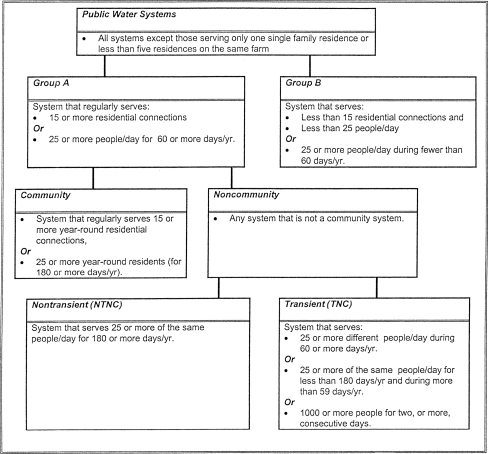
((Table 1))
PROPOSED RULES
Original Notice.
Preproposal statement of inquiry was filed as WSR 05-01-096 and 07-14-146.
Title of Rule and Other Identifying Information: Group A Public Water Supplies, chapter 246-290 WAC, the state board of health delegated rule-making authority to the department of health (the department) for this rule revision on November 10, 2004, (the Municipal Water Law (MWL), Planning and Engineering) and May 10, 2006, (Long Term 2 Enhanced Surface Water Treatment Rule (LT2)).
Hearing Location(s): Lacey Community Center, Woodland Creek Community Park, 6729 Pacific Avenue S.E., Lacey, WA 98503, on November 9, 2007, at 1:00 p.m.; and at Spokane Falls Community College, Student Union Building, Room #17, 3410 West Fort George Wright Drive, Spokane, WA 99224-5288, on November 13, 2007, at 1:00 p.m.
Date of Intended Adoption: November 16, 2007.
Submit Written Comments to: Michelle K. Austin, P.O. Box 47822, Olympia, WA 98504-7822, web site http://www3.doh.wa.gov/policyreview/, fax (360) 236-2253, by October 31, 2007.
Assistance for Persons with Disabilities: Contact Michelle K. Austin by October 26, 2007, TTY (800) 833-6388 or 711.
Purpose of the Proposal and Its Anticipated Effects, Including Any Changes in Existing Rules: This proposal has two purposes: To modify existing rule requirements to clearly establish the planning and engineering requirements of the MWL in the state drinking water rules; and to adopt the United States Environmental Protection Agency's (EPA) LT2 rule. The public health objective of the LT2 rule is to strengthen protection against the disease-causing organism Cryptosporidium, a pathogenic protozoan parasite, which is of particular concern because it is resistant to chlorine.
Reasons Supporting Proposal: The MWL directs changes to the department's planning and engineering review practices. The department is proposing revisions to comply with the law.
The department has a primacy agreement with EPA to assume lead responsibilities for implementation of the federal Safe Drinking Water Act (RCW 43.20.050). The primacy agreement outlines a number of activities the department must do to maintain primacy for Group A public water systems in the state. To maintain primacy, the LT2 rule must be adopted.
Statutory Authority for Adoption: RCW 43.20.050.
Statute Being Implemented: Chapters 70.119A, 90.03, and 43.20 RCW.
Rule is necessary because of federal law, 40 C.F.R. Parts 9, 141, and 142.
Name of Proponent: Department of health, division of environmental health, governmental.
Name of Agency Personnel Responsible for Drafting, Implementation and Enforcement: Kristin Bettridge, Tumwater, (360) 236-3166.
A small business economic impact statement has been prepared under chapter 19.85 RCW.
Is a Small Business Economic Impact Statement (SBEIS) Required for This Proposed Rule?
Yes, an SBEIS is required for portions of this proposed rule.
However, DOH has determined that no SBEIS is required for the portions of the rule listed below because they adopt requirements of the MWL without material change. See RCW 19.85.025(3) and 34.05.310 (4)(c). Costs related to these proposed sections are described in the significant analysis prepared under RCW 34.05.328.
Municipal Water Law Planning and Engineering:
| • | Water system plans (WAC 246-290-100 (4)(a)(iv)): Sets a requirement for a municipal water supplier to define its retail service area and include this on its service area map, to cover the requirements in RCW 43.20.260. |
| • | Duty to provide service (WAC 246-290-106): This section incorporates duty-to-provide-service requirements in RCW 43.20.260. |
| • | Place of use expansion (WAC 246-290-107): Sets the requirements in RCW 90.03.386 that reference and link to chapter 43.20 RCW allowing a municipal water supplier to expand its place of use as defined in a water right. |
| • | Consistency with local plans and regulations (WAC 246-290-108 (1), (2), (3)(a), and (4)): Sets requirements to ensure consistency with local plans and regulations as defined in RCW 90.03.386 that reference and link to chapter 43.20 RCW. This is a prerequisite of a municipal water supplier expanding its place of use. This section also covers the necessity to ensure local consistency with the duty-to-provide-service requirements required in RCW 43.20.260. |
Long Term 2 Enhanced Surface Water Treatment Rule: DOH is adopting this federally-mandated rule by reference. DOH is required to adopt this rule to maintain the state's primacy agreement with the United States Environmental Protection Agency. Because this federal rule is adopted by reference, no SBEIS is required under RCW 19.85.025(3) and 34.05.310 (4)(c).
Minor Clarifications and Corrections: There are numerous clarifications and corrections of typographical errors and citations throughout the document. These changes are exempt because they do not change the substance, meaning, or application of the rule. No SBEIS is required under RCW 19.85.025(3) and 34.05.310 (4)(c).
Requirements that Need a Small Business Economic Impact Statement: The remainder of this SBEIS will focus on three changes to chapter 246-290 WAC that require analysis. The proposed changes are:
1. Definitions (WAC 246-290-010): Add definitions for "retail service area" and "service area" to ensure water systems have a basis for defining their retail service area and to identify where their duty to provide service applies.
2. Water system plans (WAC 246-290-100 (8)(b)): Requires a water system to obtain approval of its water system plan from its governing body before DOH's approval.
3. Consistency with local plans and regulations (WAC 246-290-108 (3)(b)): Requires documentation that a minimum of sixty days was provided to the local government jurisdiction to review a water system plan. It also allows for local government jurisdictions to request an extension and notify DOH if an inconsistency exists in the water system plan.
Which Industries are Affected by This Proposed Rule?
The affected businesses are entities that own water systems that meet the definition of municipal water supplier in RCW 90.03.015 and are small businesses. These are typically small water systems or small companies that own for-profit water systems. The North American Industrial Code System for Washington businesses lists 236 businesses as owning for-profit water systems. Based on our knowledge of this industry, we are certain there are more than 236 for-profit water systems; however, we have no way of knowing how many of these meet the definition of municipal water suppler in RCW 90.03.015.
What are the Costs of Complying With This Rule for Small Businesses and for the Largest 10% of Businesses Affected?
The cost of meeting the requirements for the majority of small water systems is $51 or less. Very few water systems with more than 1,000 connections would qualify as a small business and thus fall into a higher cost category.
The United States Department of Labor and Industry statistics show that the smallest for-profit entities in the water supply industry have an average of one employee and the largest have about twenty employees. To fully evaluate the cost of the rule on small businesses, an evaluation was made based on the size of water system, the cost per connection, and the cost per employee. The following table shows this breakdown.
| Very Small < 100 Connections |
Small 100 – 999 Connections |
Medium 1,000 – 9,999 Connections |
Large 10,000 or More Connections |
|
| Costs | $51 | $51 | $153 | $204 |
| Average Number of Connections | 40 | 324 | 3,218 | 27,014 |
| Cost per Connection | $1.27 | $0.16 | $0.05 | $0.008 |
| Average Number of Employees | 1 | 2 | 15 | 20 |
| Cost per Employee per Hour | $.02 | $0.20 | $0.07 | $0.10 |
All businesses that must comply are "small" as defined in chapter 19.85 RCW. The proposed rule would have a disproportionate impact on smaller small businesses compared with larger small businesses. However, the costs are extremely low for all businesses that must comply.
If the Rule Imposes a Disproportionate Impact on Small Businesses, What Efforts Were Taken to Reduce That Impact?
DOH staff consulted with interested stakeholders, including small businesses, through mailings, newsletter articles, web postings, and meetings. The proposed rule was designed to minimize the cost to small water systems, while still ensuring the rule meets the intent of the MWL. Keeping the cost down was done by:
| • | Minimizing the requirements for municipal water suppliers that are not expanding, but are required to complete a small water system management program; |
| • | Integrating planning requirements to the maximum extent possible with current planning requirements; and |
| • | Working with stakeholders to ensure the rule was written to be as flexible as possible. |
How are Small Businesses Involved in the Development of This Rule?
Beginning in 2003, DOH staff worked closely with stakeholders, including small water systems, to minimize the burden of this rule. DOH developed preliminary briefing papers in July 2005 on the requirements and sent them out to stakeholders and interested parties for comment. Several stakeholder meetings were held to discuss these requirements. The comments we received resulted in the development of discussion papers in June 2006. The discussion papers outlined alternatives to the requirements. DOH attended several meetings of various interest groups over the summer and early fall of 2006 to solicit comments. The briefing papers were revised in October 2006 based on comments received on the discussion papers. The final briefing papers served as the basis for writing the rule language. The draft rule was then sent out for informal comments during June 2007.
DOH staff made several presentations targeted toward small water systems during the development of the regulation. Presentations were made to the 2006 Drinking Water Seminars attendees, the Association of Washington Business, the Washington Water and Sewer Districts, the Washington Water Utility Council, and the Washington Water Supply Advisory Committee, which was legislatively created to advise DOH on drinking water issues.
DOH made additional efforts to obtain input from the Washington Public Utility District Association. PUDs typically manage many small water systems and they provided us with insight into the challenges facing small water systems.
Will Compliance with the Proposed Rule Cause Affected Businesses to Create or Lose Jobs?
The per employee costs to comply with the portions of the proposed rule that are not specifically required by law are very low and should not result in any businesses creating or losing jobs. The estimated compliance costs range from $51 per year, per water system (.02 cents per employee hour) for the smallest businesses to $153 per year, per water systems (.10 cents per employee hour) for the largest small business that must comply.
Conclusion: The impacts to the majority of small water systems are less than $51 and below the minor threshold amount of $100 for the proposed rule sections requiring preparation of an SBEIS. There are a few small water systems that will have costs exceeding $100. DOH staff consulted with stakeholders, including small water system owners, throughout the rule development process. DOH incorporated provisions to minimize the cost of the rule for small water systems while still ensuring it meets the intent of the MWL.
A copy of the statement may be obtained by contacting Michelle K. Austin, P.O. Box 47822, Olympia, WA 98504-7822, phone (360) 236-3156, fax (360) 236-2253, e-mail michelle.austin@doh.wa.gov.
A cost-benefit analysis is required under RCW 34.05.328. A preliminary cost-benefit analysis may be obtained by contacting Michelle K. Austin, P.O. Box 47822, Olympia, WA 98504-7822, phone (360) 236-3156, fax (360) 236-2253, e-mail michelle.austin@doh.wa.gov.
September 24, 2007
Mary C. Selecky
Secretary
OTS-9741.13
AMENDATORY SECTION(Amending WSR 03-08-037, filed 3/27/03,
effective 4/27/03)
WAC 246-290-002
Guidance.
(1) The department has
numerous guidance documents available to help purveyors comply
with state and federal rules regarding drinking water. These
include documents on the following subjects:
(a) Compliance;
(b) ((System management and financial assistance;
(c) Ground water protection;
(d) Growth management;
(e) Operations/maintenance;
(f) Operator certification;
(g) Water system planning;
(h) Monitoring and water quality;
(i) System approval;
(j) Small water systems;
(k) Water resources;
(l) Water system design; and
(m) General information.)) Consumer and public education;
(c) Contaminants;
(d) Cross-connection control and backflow prevention;
(e) Emergency response and drinking water security;
(f) Engineering design and water treatment;
(g) Financial assistance and state revolving fund (SRF);
(h) General information;
(i) Ground water protection;
(j) Growth management;
(k) Operations and maintenance;
(l) Operator certification;
(m) Planning and financial viability;
(n) Regulations;
(o) Small water systems;
(p) System approval;
(q) Water quality monitoring and source protection;
(r) Water system planning; and
(s) Water use efficiency.
(2) The department's guidance documents are available at
minimal or no cost by contacting the ((division)) office of
drinking water's publication service at (((360) 236-3099))
360-236-3100 or ((())800(()))-521-0323. Individuals can also
request the documents via the internet at
http://www.doh.wa.gov/ehp/dw or through conventional mail at
P.O. Box 47822, Olympia, Washington 98504-7822.
(3) Federal guidance documents are available from the Environmental Protection Agency (EPA) for a wide range of topics. These are available from the EPA Office of Ground Water and Drinking Water web site at www.epa.gov/safewater/index.html.
[Statutory Authority: RCW 43.20.050 (2) and (3) and 70.119A.080. 03-08-037, § 246-290-002, filed 3/27/03, effective 4/27/03. Statutory Authority: RCW 43.02.050 [43.20.050]. 99-07-021, § 246-290-002, filed 3/9/99, effective 4/9/99.]
ADD - average day demand;
AG - air gap;
ANSI - American National Standards Institute;
((APWA - American Public Works Association;
ASCE - American Society of Civil Engineers;))
AVB - atmospheric vacuum breaker;
AWWA - American Water Works Association;
((BAT - best available technology;))
BAT - backflow assembly tester (for WAC ((246-29-490))
246-290-490);
C - residual disinfectant concentration in mg/L;
CCS - cross-connection control specialist;
CFR - code of federal regulations;
CPE - comprehensive performance evaluation;
CT - the mathematical product in mg/L - minutes of "C" and "T";
CTA - comprehensive technical assistance;
CWSSA - critical water supply service area;
DBPs - disinfection by-products;
DCDA - double check detector assembly;
DCVA - double check valve assembly;
DVGW - Deutsche Vereinigung des Gas und Wasserfaches;
EPA - Environmental Protection Agency;
ERU - equivalent residential unit;
gph - gallons per hour;
gpm - gallons per minute;
GAC - granular activated carbon;
GAC10 - granular activated carbon with ten-minute empty bed contact time based on average daily flow and one hundred eighty-day reactivation frequency;
GWI - ground water under the direct influence of surface water;
HAA5 - haloacetic acids (five);
HPC - heterotrophic plate count;
IAPMO - International Association of Plumbing and Mechanical Officials;
IBC - International Building Code (formerly known as the Uniform Building Code (UBC));
kPa - kilo pascal (SI units of pressure);
MCL - maximum contaminant level;
MDD - maximum day demand;
mg/L - milligrams per liter (1 mg/L = 1 ppm);
mL - milliliter;
mm - millimeter;
MRDL - maximum residual disinfectant level;
MRDLG - maximum residual disinfectant level goal;
MTTP - maximum total trihalomethane potential;
NSF - NSF International (formerly known as the National Sanitation Foundation (NSF));
NTNC - nontransient noncommunity;
NTU - nephelometric turbidity unit;
ONORM - Osterreichisches Normungsinstitut;
PAA - project approval application;
pCi/L - picocuries per liter;
PHD - peak hourly demand;
ppm - parts per million (1 ppm = 1 mg/L);
psi - pounds per square inch;
PVBA - pressure vacuum breaker assembly;
RPBA - reduced pressure backflow assembly;
RPDA - reduced pressure detector assembly;
SAL - state advisory level;
SCA - sanitary control area;
SDWA - Safe Drinking Water Act;
SEPA - State Environmental Policy Act;
SOC - synthetic organic chemical;
SMA - satellite management agency;
SPI - special purpose investigation;
SRF - state revolving fund;
SUVA - specific ultraviolet absorption;
SVBA - spill resistant vacuum breaker assembly;
SWTR - surface water treatment rule;
T - disinfectant contact time in minutes;
TTHM - total trihalomethane;
TNC - transient noncommunity;
TNTC - too numerous to count;
TOC - total organic carbon;
((UBC - Uniform Building Code;))
ug/L - micrograms per liter;
UL - Underwriters Laboratories, Inc.;
umhos/cm - micromhos per centimeter;
UPC - Uniform Plumbing Code;
UTC - utilities and transportation commission;
VOC - volatile organic chemical;
WAC - Washington Administrative Code;
WFI - water facilities inventory ((and report)) form;
WHPA - wellhead protection area; and
WUE - water use efficiency.
"Acute" means posing an immediate risk to human health.
"((Alternate)) Alternative filtration technology" means a
filtration process for substantial removal of particulates
(generally > 2 log Giardia lamblia cysts and ≥ 2-log removal
of Cryptosporidium oocysts) by other than conventional,
direct, diatomaceous earth, or slow sand filtration processes.
"Analogous treatment system" means an existing water treatment system that has unit processes and source water quality characteristics that are similar to a proposed treatment system.
"Approved air gap" means a physical separation between the free-flowing end of a potable water supply pipeline and the overflow rim of an open or nonpressurized receiving vessel. To be an air gap approved by the department, the separation must be at least:
Twice the diameter of the supply piping measured vertically from the overflow rim of the receiving vessel, and in no case be less than one inch, when unaffected by vertical surfaces (sidewalls); and:
Three times the diameter of the supply piping, if the horizontal distance between the supply pipe and a vertical surface (sidewall) is less than or equal to three times the diameter of the supply pipe, or if the horizontal distance between the supply pipe and intersecting vertical surfaces (sidewalls) is less than or equal to four times the diameter of the supply pipe and in no case less than one and one-half inches.
"Approved atmospheric vacuum breaker (AVB)" means an AVB
of make, model, and size that is approved by the department.
AVBs that appear on the current approved backflow prevention
assemblies list developed by the University of Southern
California Foundation for Cross-Connection Control and
Hydraulic Research or that are listed or approved by other
nationally recognized testing agencies (such as IAPMO, ANSI,
or UL) acceptable to the ((local administrative)) authority
having jurisdiction are considered approved by the department.
"Approved backflow preventer" means an approved air gap, an approved backflow prevention assembly, or an approved AVB. The terms "approved backflow preventer," "approved air gap," or "approved backflow prevention assembly" refer only to those approved backflow preventers relied upon by the purveyor for the protection of the public water system. The requirements of WAC 246-290-490 do not apply to backflow preventers installed for other purposes.
"Approved backflow prevention assembly" means an RPBA, RPDA, DCVA, DCDA, PVBA, or SVBA of make, model, and size that is approved by the department. Assemblies that appear on the current approved backflow prevention assemblies list developed by the University of Southern California Foundation for Cross-Connection Control and Hydraulic Research or other entity acceptable to the department are considered approved by the department.
"As-built drawing" means the drawing created by an engineer from the collection of the original design plans, including changes made to the design or to the system, that reflects the actual constructed condition of the water system.
"Authority having jurisdiction" (formerly known as local administrative authority) means the local official, board, department, or agency authorized to administer and enforce the provisions of the Uniform Plumbing Code as adopted under chapter 19.27 RCW.
"Authorized agent" means any person who:
Makes decisions regarding the operation and management of a public water system whether or not he or she is engaged in the physical operation of the system;
Makes decisions whether to improve, expand, purchase, or sell the system; or
Has discretion over the finances of the system.
"Authorized consumption" means the volume of metered and unmetered water used for municipal water supply purposes by consumers, the purveyor, and others authorized to do so by the purveyor, including, but not limited to, fire fighting and training, flushing of mains and sewers, street cleaning, and watering of parks and landscapes. These volumes may be billed or unbilled.
"Average day demand (ADD)" means the total quantity of
water use from all sources of supply as measured or estimated
over a calendar year divided by three hundred sixty-five. ADD
is typically expressed as gallons per day (gpd) per equivalent
residential unit (ERU) (((gpd/ERU))).
"Backflow" means the undesirable reversal of flow of water or other substances through a cross-connection into the public water system or consumer's potable water system.
"Backflow assembly tester" means a person holding a valid
BAT certificate issued ((in accordance with)) under chapter 246-292 WAC.
"Backflow preventers" means either:
(a) A premises isolation backflow preventer; or
(b) An in-premises backflow preventer or preventers, when no premises isolation backflow preventer is installed.
"Backpressure" means a pressure (caused by a pump, elevated tank or piping, boiler, or other means) on the consumer's side of the service connection that is greater than the pressure provided by the public water system and which may cause backflow.
"Backsiphonage" means backflow due to a reduction in system pressure in the purveyor's distribution system and/or consumer's water system.
"Bag filter" means a pressure-driven separation device that removes particulate matter larger than 1 micrometer using an engineered porous filtration media. They are typically constructed of a nonrigid, fabric filtration media housed in a pressure vessel in which the direction of flow is from the inside of the bag to outside.
"Bank filtration" means a water treatment process that uses a well to recover surface water that has naturally infiltrated into ground water through a river bed or bank(s). Infiltration is typically enhanced by the hydraulic gradient imposed by a nearby pumping water supply or other well(s).
"Best available technology (((BAT)))" means the best
technology, treatment techniques, or other means that EPA
finds, after examination for efficacy under field conditions,
are available, taking cost into consideration.
"Blended sample" means a sample collected from two or more individual sources at a point downstream of the confluence of the individual sources and prior to the first connection.
"C" means the residual disinfectant concentration in mg/L at a point before or at the first consumer.
"Cartridge filter" means a pressure-driven separation device that removes particulate matter larger than 1 micrometer using an engineered porous filtration media. They are typically constructed as rigid or semi-rigid, self-supporting filter elements housed in pressure vessels in which flow is from the outside of the cartridge to the inside.
"Category red operating permit" means an operating permit identified under chapter 246-294 WAC. Placement in this category results in permit issuance with conditions and a determination that the system is inadequate.
"Chemical contaminant treatment facility" means a treatment facility specifically used for the purpose of removing chemical contaminants.
"Clarification" means a treatment process that uses gravity (sedimentation) or dissolved air (flotation) to remove flocculated particles.
"Closed system" means any water system or portion of a water system in which water is transferred to a higher pressure zone closed to the atmosphere, such as when no gravity storage is present.
"Coagulant" means a chemical used in water treatment to destabilize particulates and accelerate the rate at which they aggregate into larger particles.
"Coagulation" means a process using coagulant chemicals and rapid mixing to destabilize colloidal and suspended particles and agglomerate them into flocs.
"Combination fire protection system" means a fire sprinkler system that:
Is supplied only by the purveyor's water;
Does not have a fire department pumper connection; and
Is constructed of approved potable water piping and materials that serve both the fire sprinkler system and the consumer's potable water system.
"Completely treated water" means water from a surface or ground water under the direct influence of surface water (GWI) source that receives filtration or disinfection treatment that fully complies with the treatment technique requirements of Part 6 of this chapter as determined by the department.
"Composite sample" means a sample in which more than one source is sampled individually by the water system and then composited by a certified laboratory by mixing equal parts of water from each source (up to five different sources) and then analyzed as a single sample.
"Comprehensive monitoring plan" means a schedule that describes both the frequency and appropriate locations for sampling of drinking water contaminants as required by state and federal rules.
"Comprehensive performance evaluation (CPE)" means a thorough review and analysis of a treatment plant's performance-based capabilities and associated administrative, operation and maintenance practices. It is conducted to identify factors that may be adversely impacting a plant's capability to achieve compliance and emphasizes approaches that can be implemented without significant capital improvements. The comprehensive performance evaluation must consist of at least the following components: Assessment of plant performance; evaluation of major unit processes; identification and prioritization of performance limiting factors; assessment of the applicability of comprehensive technical assistance; and preparation of a CPE report.
"Comprehensive technical assistance (CTA)" means technical assistance intended to identify specific steps that may help a water treatment plant overcome operational or design limitations identified during a comprehensive performance evaluation.
"Confirmation" means to demonstrate the accuracy of results of a sample by analyzing another sample from the same location within a reasonable period of time, generally not to exceed two weeks. Confirmation is when analysis results fall within plus or minus thirty percent of the original sample results.
"Confluent growth" means a continuous bacterial growth covering a portion or the entire filtration area of a membrane filter in which bacterial colonies are not discrete.
"Construction completion report" means a form provided by the department and completed for each specific construction project to document:
• Project construction in accordance with this chapter and general standards of engineering practice;
• Physical capacity changes; and
• Satisfactory test results.
The completed form must be stamped with an engineer's seal, and signed and dated by a professional engineer.
"Consumer" means any person receiving water from a public water system from either the meter, or the point where the service line connects with the distribution system if no meter is present. For purposes of cross-connection control, "consumer" means the owner or operator of a water system connected to a public water system through a service connection.
"Consumer's water system," as used in WAC 246-290-490, means any potable and/or industrial water system that begins at the point of delivery from the public water system and is located on the consumer's premises. The consumer's water system includes all auxiliary sources of supply, storage, treatment, and distribution facilities, piping, plumbing, and fixtures under the control of the consumer.
"Contaminant" means a substance present in drinking water that may adversely affect the health of the consumer or the aesthetic qualities of the water.
"Contingency plan" means that portion of the wellhead protection program section of the water system plan or small water system management program that addresses the replacement of the major well(s) or wellfield in the event of loss due to ground water contamination.
"Continuous monitoring" means determining water quality with automatic recording analyzers that operate without interruption twenty-four hours per day.
"Conventional filtration treatment" means a series of processes including coagulation, flocculation, clarification, and filtration that together result in substantial particulate removal in compliance with Part 6 of this chapter.
"Cost-effective" means the benefits exceed the costs.
"Council" means the Washington state building code council under WAC 51-04-015(2).
"Critical water supply service area (CWSSA)" means a geographical area which is characterized by a proliferation of small, inadequate water systems, or by water supply problems which threaten the present or future water quality or reliability of service in a manner that efficient and orderly development may best be achieved through coordinated planning by the water utilities in the area.
"Cross-connection" means any actual or potential physical connection between a public water system or the consumer's water system and any source of nonpotable liquid, solid, or gas that could contaminate the potable water supply by backflow.
"Cross-connection control program" means the administrative and technical procedures the purveyor implements to protect the public water system from contamination via cross-connections as required in WAC 246-290-490.
"Cross-connection control specialist" means a person
holding a valid CCS certificate issued ((in accordance with))
under chapter 246-292 WAC.
"Cross-connection control summary report" means the annual report that describes the status of the purveyor's cross-connection control program.
"CT" or "CTcalc" means the product of "residual disinfectant concentration" (C) and the corresponding "disinfectant contact time" (T) i.e., "C" x "T."
"CT99.9" means the CT value required for 99.9 percent (3 log) inactivation of Giardia lamblia cysts.
"CTreq" means the CT value a system shall provide to achieve a specific percent inactivation of Giardia lamblia cysts or other pathogenic organisms of health concern as directed by the department.
"Curtailment" means short-term, infrequent actions by a purveyor and its consumers to reduce their water use during or in anticipation of a water shortage.
"Dead storage" means the volume of stored water not
available to all consumers at the minimum design pressure ((in
accordance with)) under WAC 246-290-230 (5) and (6).
"Demand forecast" means an estimate of future water system water supply needs assuming historically normal weather conditions and calculated using numerous parameters, including population, historic water use, local land use plans, water rates and their impacts on consumption, employment, projected water use efficiency savings from implementation of a water use efficiency program, and other appropriate factors.
"Department" means the Washington state department of
health or health officer as identified in a joint plan of
operation ((in accordance with)) under WAC 246-290-030(1).
"Design and construction standards" means department design guidance and other peer reviewed documents generally accepted by the engineering profession as containing fundamental criteria for design and construction of water facility projects. Design and construction standards are comprised of performance and sizing criteria and reference general construction materials and methods.
"Diatomaceous earth filtration" means a filtration process for substantial removal of particulates (> 2 log Giardia lamblia cysts) in which:
A precoat cake of graded diatomaceous earth filter media is deposited on a support membrane (septum); and
Water is passed through the cake on the septum while additional filter media, known as body feed, is continuously added to the feed water to maintain the permeability of the filter cake.
"Direct filtration" means a series of processes including coagulation, flocculation, and filtration (but excluding sedimentation) that together result in substantial particulate removal in compliance with Part 6 of this chapter.
"Direct service connection" means a service hookup to a property that is contiguous to a water distribution main and where additional distribution mains or extensions are not needed to provide service.
"Disinfectant contact time (T in CT)" means: When measuring the first or only C, the time in minutes it takes water to move from the point of disinfectant application to a point where the C is measured; and
For subsequent measurements of C, the time in minutes it takes water to move from one C measurement point to the C measurement point for which the particular T is being calculated.
"Disinfection" means the use of chlorine or other agent or process the department approves for killing or inactivating microbiological organisms, including pathogenic and indicator organisms.
"Disinfection profile" means a summary of Giardia lamblia inactivation through a surface water treatment plant.
"Distribution coliform sample" means a sample of water collected from a representative location in the distribution system at or after the first service and analyzed for coliform presence in compliance with this chapter.
"Distribution-related projects" means distribution projects such as storage tanks, booster pump facilities, transmission mains, pipe linings, and tank coating. It does not mean source of supply (including interties) or water quality treatment projects.
(("Distribution reservoir" means a water storage
structure that is integrated with a water system's
distribution network to provide for variable system demands
including, but not limited to, daily equalizing storage,
standby storage, or fire reserves, or to provide for
disinfectant contact time.))
"Distribution system" means all piping components of a public water system that serve to convey water from transmission mains linked to source, storage and treatment facilities to the consumer excluding individual services.
"Domestic or other nondistribution system plumbing problem," means contamination of a system having more than one service connection with the contamination limited to the specific service connection from which the sample was taken.
(("Drinking water state revolving fund (DWSRF)" means the
revolving loan program financed by the state and federal
governments and managed by the state for the purpose of
assisting water systems to meet their capital needs associated
with complying with the federal Safe Drinking Water Act.))
"Duplicate (verification) sample" means a second sample collected at the same time and location as the first sample and used for verification.
"Elected governing board" means the elected officers with ultimate legal responsibility for operational, technical, managerial, and financial decisions for a public water system.
"Emergency" means an unforeseen event that causes damage or disrupts normal operations and requires immediate action to protect public health and safety.
"Emergency source" means any source that is approved by the department for emergency purposes only, is not used for routine or seasonal water demands, is physically disconnected, and is identified in the purveyor's emergency response plan.
"Engineering design review report" means a form provided by the department and completed for a specific distribution-related project to document:
• Engineering review of a project report and/or
construction documents under the submittal exception process
in ((accordance with)) WAC 246-290-125(3); and
• Design in accordance with this chapter and general standards of engineering practice.
The completed form must be stamped with engineer's seal, and signed and dated by a professional engineer.
"Equalizing storage" means the volume of storage needed to supplement supply to consumers when the peak hourly demand exceeds the total source pumping capacity.
"Equivalent residential unit (ERU)" means a system-specific unit of measure used to express the amount of water consumed by a typical full-time single family residence.
"Existing service area" means a specific area within which direct service or retail service connections to customers of a public water system are currently available.
"Expanding public water system" means a public water system installing additions, extensions, changes, or alterations to their existing source, transmission, storage, or distribution facilities that will enable the system to increase in size its existing service area and/or its number of approved service connections. Exceptions:
A system that connects new approved individual retail or direct service connections onto an existing distribution system within an existing service area; or
A distribution system extension in an existing service area identified in a current and approved water system plan or project report.
"Filter profile" means a graphical representation of individual filter performance in a direct or conventional surface water filtration plant, based on continuous turbidity measurements or total particle counts versus time for an entire filter run, from startup to backwash inclusively, that includes an assessment of filter performance while another filter is being backwashed.
"Filtration" means a process for removal of particulate matter from water by passage through porous media.
"Financial viability" means the capability of a water system to obtain sufficient funds to construct, operate, maintain, and manage a public water system, on a continuing basis, in full compliance with federal, state, and local requirements.
"Finished water" means the water that is introduced into the distribution system of a public water system and is intended for distribution and consumption without further treatment, except as treatment necessary to maintain water quality in the distribution system (e.g., booster disinfection, addition of corrosion control chemicals).
"Finished water storage facility" means a water storage structure that is integrated with a water system's distribution network to provide for variable system demands including, but not limited to, daily equalizing storage, standby storage, or fire reserves, or to provide for disinfectant contact time.
"Fire flow" means the maximum rate and duration of water flow needed to suppress a fire under WAC 246-293-640 or as required under local fire protection authority standards.
"Fire suppression storage" means the volume of stored water available during fire suppression activities to satisfy minimum pressure requirements per WAC 246-290-230.
"First consumer" means the first service connection associated with any source (i.e., the point where water is first withdrawn for human consumption, excluding connections where water is delivered to another water system covered by these regulations).
"Flocculation" means a process enhancing agglomeration and collection of colloidal and suspended particles into larger, more easily settleable or filterable particles by gentle stirring.
"Flowing stream" means a course of running water flowing in a definite channel.
"Flow-through fire protection system" means a fire sprinkler system that:
Is supplied only by the purveyor's water;
Does not have a fire department pumper connection;
Is constructed of approved potable water piping and materials to which sprinkler heads are attached; and
Terminates at a connection to a toilet or other plumbing fixture to prevent the water from becoming stagnant.
"Forecasted demand characteristics" means the factors that may affect a public water system's projected water needs.
"Future service area" means a specific area for which water service is planned by a public water system, as determined by written agreement between purveyors provided for in WAC 246-293-250.
"Governing body" means the individual or group of individuals with ultimate legal responsibility for operational, technical, managerial, and financial decisions for a public water system.
"Grab sample" means a water quality sample collected at a specific instant in time and analyzed as an individual sample.
"Ground water under the direct influence of surface water (GWI)" means any water beneath the surface of the ground that the department determines has the following characteristics:
Significant occurrence of insects or other macroorganisms, algae, or large-diameter pathogens such as Giardia lamblia or, Cryptosporidium; or
Significant and relatively rapid shifts in water characteristics such as turbidity, temperature, conductivity, or pH closely correlating to climatological or surface water conditions where natural conditions cannot prevent the introduction of surface water pathogens into the source at the system's point of withdrawal.
"Guideline" means a department document assisting the purveyor in meeting a rule requirement.
"Health officer" means the health officer of the city, county, city-county health department or district, or an authorized representative.
"Heterotrophic Plate Count (HPC)" means a procedure to measure a class of bacteria that use organic nutrients for growth. The density of these bacteria in drinking water is measured as colony forming units per milliliter and is referred to as the HPC.
"High health cross-connection hazard" means a
cross-connection ((which)) involving any substance that could
impair the quality of potable water and create an actual
public health hazard through injury, poisoning, or spread of
disease ((by sewage, industrial liquids or waste)).
"Human consumption" means the use of water for drinking, bathing or showering, hand washing, food preparation, cooking, or oral hygiene.
"Hydraulic analysis" means the study of a water system's distribution main and storage network to determine present or future adequacy for provision of service to consumers within the established design parameters for the system under peak flow conditions, including fire flow. The analysis is used to establish any need for improvements to existing systems or to substantiate adequacy of design for distribution system components such as piping, elevated storage, booster stations or similar facilities used to pump and convey water to consumers.
"Inactivation" means a process which renders pathogenic microorganisms incapable of producing disease.
"Inactivation ratio" means the ratio obtained by dividing CTcalc by CTreq.
"Incompletely treated water" means water from a surface or GWI source that receives filtration and/or disinfection treatment that does not fully comply with the treatment technique requirements of Part 6 of this chapter as determined by the department.
"In-line filtration" means a series of processes, including coagulation and filtration (but excluding flocculation and sedimentation) that together result in particulate removal.
"In-premises protection" means a method of protecting the health of consumers served by the consumer's potable water system, located within the property lines of the consumer's premises by the installation of an approved air gap or backflow prevention assembly at the point of hazard, which is generally a plumbing fixture.
"Intertie" means an interconnection between public water systems permitting the exchange or delivery of water between those systems.
"Lake or reservoir" means a natural or man-made basin or hollow on the earth's surface in which water collects or is stored that may or may not have a current or single direction of flow.
"Legionella" means a genus of bacteria containing species which cause a type of pneumonia called Legionnaires' Disease.
"Limited alternative to filtration" means a process that ensures greater removal and/or inactivation efficiencies of pathogenic organisms than would be achieved by the combination of filtration and chlorine disinfection.
(("Local administrative authority" means the local
official, board, department, or agency authorized to
administer and enforce the provisions of the Uniform Plumbing
Code as adopted under chapter 19.27 RCW.))
"Low ((health)) cross-connection hazard" means a
cross-connection that could cause an impairment of the quality
of potable water to a degree that does not create a hazard to
the public health, but does adversely and unreasonably affect
the aesthetic qualities of potable waters for domestic use.
"Major project" means all construction projects subject
to ((SEPA in accordance with)) the State Environmental Policy
Act (SEPA) under WAC 246-03-030 (3)(a) and include all surface
water source development, all water system storage facilities
greater than one-half million gallons, new transmission lines
longer than one thousand feet and larger than eight inches in
diameter located in new rights of way and major extensions to
existing water distribution systems involving use of pipes
greater than eight inches in diameter, that are designed to
increase the existing service area by more than one square
mile.
"Mandatory curtailment" means curtailment required by a public water system of specified water uses and consumer classes for a specified period of time.
"Marginal costs" means the costs incurred by producing the next increment of supply.
"Maximum contaminant level (MCL)" means the maximum permissible level of a contaminant in water the purveyor delivers to any public water system user, measured at the locations identified under WAC 246-290-300, Table 3.
"Maximum contaminant level violation" means a confirmed measurement above the MCL and for a duration of time, where applicable, as outlined under WAC 246-290-310.
"Maximum day demand (MDD)" means the highest actual or estimated quantity of water that is, or is expected to be, used over a twenty-four hour period, excluding unusual events or emergencies. MDD is typically expressed as gallons per day per ERU (gpd/ERU).
"Membrane filtration" means a pressure or vacuum driven separation process in which particulate matter larger than 1 micrometer is rejected by an engineered barrier, primarily through a size-exclusion mechanism, and which has a measurable removal efficiency of a target organism that can be verified through the application of a direct integrity test. This definition includes the common membrane technologies of microfiltration, ultrafiltration, nanofiltration, and reverse osmosis.
"Monitoring waiver" means an action taken by the
department under WAC 246-290-300 (4)(g) or (((7))) (8)(f) to
allow a water system to reduce specific monitoring
requirements based on a determination of low source
vulnerability to contamination.
"Municipal water supplier" means an entity that supplies water for municipal water supply purposes.
"Municipal water supply purposes" means a beneficial use of water:
(a) For residential purposes through fifteen or more residential service connections or for providing residential use of water for a nonresidential population that is, on average, at least twenty-five people for at least sixty days a year;
(b) For governmental or governmental proprietary purposes by a city, town, public utility, district, county, sewer district, or water district; or
(c) Indirectly for the purposes in (a) or (b) of this
definition through the delivery of treated or raw water to a
public water system for ((such)) beneficial use.
(i) If water is beneficially used under a water right for the purposes listed in (a), (b), or (c) of this definition, any other beneficial use of water under the right generally associated with the use of water within a municipality is also for "municipal water supply purposes," including, but not limited to, beneficial use for commercial, industrial, irrigation of parks and open spaces, institutional, landscaping, fire flow, water system maintenance and repair, or related purposes; and
(ii) If a governmental entity holds a water right that is for the purposes listed in (a), (b), or (c) of this definition, its use of water or its delivery of water for any other beneficial use generally associated with the use of water within a municipality is also for "municipal water supply purposes," including, but not limited to, beneficial use for commercial, industrial, irrigation of parks and open spaces, institutional, landscaping, fire flow, water system maintenance and repair, or related purposes.
"Nested storage" means one component of storage is contained within the component of another.
"Nonacute" means posing a possible or less than immediate risk to human health.
"Nonresident" means a person having access to drinking water from a public water system, but who lives elsewhere. Examples include travelers, transients, employees, students, etc.
"Normal operating conditions" means those conditions associated with the designed, day-to-day provision of potable drinking water that meets regulatory water quality standards and the routine service expectations of the system's consumers at all times, including meeting fire flow demands. Operation under conditions such as power outages, floods, or unscheduled transmission or distribution disruptions, even if considered in the system design, are considered abnormal.
"Operational storage" means the volume of distribution storage associated with source or booster pump normal cycling times under normal operating conditions and is additive to the equalizing and standby storage components, and to fire flow storage if this storage component exists for any given tank.
"Peak hourly demand (PHD)" means the maximum rate of water use, excluding fire flow, that can be expected to occur within a defined service area over a continuous sixty minute time period. PHD is typically expressed in gallons per minute (gpm).
"Peak hourly flow" means, for the purpose of CT calculations, the greatest volume of water passing through the system during any one hour in a day.
"Performance criteria" means the level at which a system shall operate in order to maintain system reliability compliance, in accordance with WAC 246-290-420, and to meet consumers' reasonable expectations.
"Permanent residence" means any dwelling that is, or could reasonably be expected to be, occupied on a continuous basis.
"Permanent source" means a public water system supply source that is used regularly each year, and based on expected operational requirements of the system, will be used more than three consecutive months in any twelve-month period. For seasonal water systems that are in operation for less than three consecutive months per year, their sources shall also be considered to be permanent.
"Plant intake" means the works or structures at the head of a conduit through which water is diverted from a source (e.g., river or lake) into the treatment plant.
"Point of disinfectant application" means the point where the disinfectant is added, and where water downstream of that point is not subject to contamination by untreated surface water.
"Population served" means the number of persons, resident and nonresident, having immediate access to drinking water from a public water system, whether or not persons have actually consumed water from that system. The number of nonresidents shall be the average number of persons having immediate access to drinking water on days access was provided during that month. In the absence of specific population data, the number of residents shall be computed by multiplying the number of active services by two and one-half.
"Potable" means water suitable for drinking by the public.
"Potential GWI" means a source identified by the department as possibly under the influence of surface water, and includes, but is not limited to, all wells with a screened interval fifty feet or less from the ground surface at the wellhead and located within two hundred feet of a surface water, and all Ranney wells, infiltration galleries, and springs.
"Premises isolation" means a method of protecting a public water system by installation of approved air gaps or approved backflow prevention assemblies at or near the service connection or alternative location acceptable to the purveyor to isolate the consumer's water system from the purveyor's distribution system.
"Presedimentation" means a preliminary treatment process used to remove gravel, sand, and other particulate material from the source water through settling before the water enters the primary clarification and filtration processes in a treatment plant.
"Pressure filter" means an enclosed vessel containing properly sized and graded granular media through which water is forced under greater than atmospheric pressure.
"Primary disinfection" means a treatment process for achieving inactivation of Giardia lamblia cysts, viruses, or other pathogenic organisms of public health concern to comply with the treatment technique requirements of Part 6 of this chapter.
"Primary standards" means standards based on chronic, nonacute, or acute human health effects.
"Primary turbidity standard" means an accurately prepared formazin solution or commercially prepared polymer solution of known turbidity (prepared in accordance with "standard methods") that is used to calibrate bench model and continuous turbidimeters (instruments used to measure turbidity).
"Project approval application (PAA)" means a department form documenting ownership of water system, design engineer for the project, and type of project.
"Protected ground water source" means a ground water source the purveyor shows to the department's satisfaction as protected from potential sources of contamination on the basis of hydrogeologic data and/or satisfactory water quality history.
"Public forum" means a meeting open to the general public that allows for their participation.
"Public water system" is defined and referenced under WAC 246-290-020.
"Purchased source" means water a purveyor purchases from a public water system not under the control of the purveyor for distribution to the purveyor's consumers.
"Purveyor" means an agency, subdivision of the state, municipal corporation, firm, company, mutual or cooperative association, institution, partnership, or person or other entity owning or operating a public water system. Purveyor also means the authorized agents of these entities.
"Reclaimed water" means effluent derived in any part from sewage from a wastewater treatment system that has been adequately and reliably treated, so that as a result of that treatment, it is suitable for beneficial use or a controlled use that would not otherwise occur, and it is no longer considered wastewater.
"Record drawings" means the drawings bearing the seal and signature of a professional engineer that reflect the modifications made to construction documents, documenting actual constructed conditions of the water system facilities.
"Recreational tract" means an area that is clearly defined for each occupant, but has no permanent structures with internal plumbing, and the area has been declared in the covenants or on the recorded plat in order to be eligible for reduced design considerations.
"Regional public water supplier" means a water system that provides drinking water to one, or more, other public water systems.
"Regularly" means four hours or more per day for four days or more per week.
"Removal credit" means the level (expressed as a percent or log) of Giardia and virus removal the department grants a system's filtration process.
"Repeat sample" means a sample collected to confirm the results of a previous analysis.
"Resident" means an individual living in a dwelling unit served by a public water system.
"Residual disinfectant concentration" means the analytical level of a disinfectant, measured in milligrams per liter, that remains in water following the application (dosing) of the disinfectant after some period of contact time.
"Retail service area" means the specific area defined by the municipal water supplier where the municipal water supplier has a duty to provide service to all new service connections.
"Same farm" means a parcel of land or series of parcels that are connected by covenants and devoted to the production of livestock or agricultural commodities for commercial purposes and does not qualify as a Group A public water system.
"Sanitary survey" means a review, inspection, and assessment of a public water system by the department or department designee including, but not limited to: Source, facilities, equipment, administration and operation, maintenance procedures, monitoring, recordkeeping, planning documents and schedules, and management practices. The purpose of the survey is to evaluate the adequacy of the water system for producing and distributing safe and adequate drinking water.
"Satellite management agency (SMA)" means a person or entity that is approved by the department to own or operate public water systems on a regional or county-wide basis without the necessity for a physical connection between the systems.
"Seasonal source" means a public water system source used on a regular basis, that is not a permanent or emergency source.
"Secondary standards" means standards based on factors other than health effects.
"Service area" means the specific area or areas a water system currently serves or plans to provide water service. This may be comprised of the existing, retail, future, and wholesale service areas.
"Service connection" means a connection to a public water system designed to provide potable water to a single family residence, or other residential or nonresidential population. When the connection provides water to a residential population without clearly defined single family residences, the following formulas shall be used in determining the number of services to be included as residential connections on the WFI form:
Divide the average population served each day by two and one-half; or
Using actual water use data, calculate the total ERUs represented by the service connection in accordance with department design guidance.
In no case shall the calculated number of services be less than one.
"Severe health cross-connection hazard" means a cross-connection which could impair the quality of potable water and create an immediate, severe public health hazard through poisoning or spread of disease by contaminants from radioactive material processing plants, nuclear reactors, or wastewater treatment plants.
"Significant noncomplier" means a system that is violating or has violated department rules, and the violations may create, or have created an imminent or a significant risk to human health. The violations include, but are not limited to, repeated violations of monitoring requirements, failure to address an exceedance of permissible levels of regulated contaminants, or failure to comply with treatment technique standards or requirements.
"Simple disinfection" means any form of disinfection that requires minimal operational control in order to maintain the disinfection at proper functional levels, and that does not pose safety concerns that would require special care, equipment, or expertise. Examples include hypochlorination, UV-light, contactor chlorination, or any other form of disinfection practice that is safe to use and easy to routinely operate and maintain.
"Slow sand filtration" means a process involving passage of source water through a bed of sand at low velocity (generally less than 0.10 gpm/ft2) that results in substantial particulate removal (> 2 log Giardia lamblia cysts) by physical and biological mechanisms.
"Societal perspective" means a point of view that includes a broad spectrum of public benefits, including, but not limited to, enhanced system reliability; savings that result from delaying, deferring, or minimizing capital costs; and environmental benefits such as increased water in streams, improvements in aquifer recharge and other environmental factors.
"Source meter" means a meter that measures total output of a water source over specific time periods.
"Source water" means untreated water that is not subject to recontamination by surface runoff and:
For unfiltered systems, enters the system immediately before the first point of disinfectant application; and
For filtered systems, enters immediately before the first treatment unit of a water treatment facility.
"Special purpose investigation (SPI)" means on-site inspection of a public water system by the department or designee to address a potential public health concern, regulatory violation, or consumer complaint.
"Special purpose sample" means a sample collected for reasons other than the monitoring compliance specified in this chapter.
"Spring" means a source of water where an aquifer comes in contact with the ground surface.
"Standard methods" means ((the 18th edition of)) the
book, titled Standard Methods for the Examination of Water and
Waste Water, jointly published by the American Public Health
Association, American Water Works Association (AWWA), and
Water Pollution Control Federation. This book is available
through public libraries or may be ordered from AWWA, 6666
West Quincy Avenue, Denver, Colorado 80235. The edition to be
used is that specified by EPA for the relevant drinking water
parameter in 40 CFR Part 141.
"Standby storage" means the volume of stored water available for use during a loss of source capacity, power, or similar short-term emergency.
"State advisory level (SAL)" means a level established by the department and state board of health for a contaminant without an existing MCL. The SAL represents a level that when exceeded, indicates the need for further assessment to determine if the chemical is an actual or potential threat to human health.
"State board of health" and "board" means the board created by RCW 43.20.030.
"State building code" means the codes adopted by and referenced in chapter 19.27 RCW; the state energy code; and any other codes so designated by the Washington state legislature as adopted and amended by the council.
"State revolving fund (SRF)" means the revolving loan program financed by the state and federal governments and managed by the state for the purpose of assisting water systems to meet their capital needs associated with complying with the federal Safe Drinking Water Act under chapter 246-296 WAC.
"Subpart H System" see definition for "surface water system."
"Surface water" means a body of water open to the atmosphere and subject to surface runoff.
"Surface water system" means a public water system that
uses in whole, or in part, source water from a surface supply,
or ((ground water under the direct influence of surface water
())GWI(())) supply. This includes systems that operate
surface water treatment facilities, and systems that purchase
"completely treated water" (as defined in this subsection). A
"surface water system" is also referred to as a "Subpart H
System" in some federal regulatory language adopted by
reference and the two terms are considered equivalent for the
purposes of this chapter.
"Susceptibility assessment" means the completed Susceptibility Assessment Survey Form developed by the department to evaluate the hydrologic setting of the water source and assess its contribution to the source's overall susceptibility to contamination from surface activities.
"Synthetic organic chemical (SOC)" means a manufactured carbon-based chemical.
"System capacity" means the system's operational, technical, managerial, and financial capability to achieve and maintain compliance with all relevant local, state, and federal plans and regulations.
"System physical capacity" means the maximum number of service connections or equivalent residential units (ERUs) that the system can serve when considering the limitation of each system component such as source, treatment, storage, transmission, or distribution, individually and in combination with each other.
"Time-of-travel" means the time required for ground water to move through the water bearing zone from a specific point to a well.
"Too numerous to count (TNTC)" means the total number of bacterial colonies exceeds 200 on a 47-mm diameter membrane filter used for coliform detection.
"Tracer study" means a field study conducted to determine the disinfectant contact time, T, provided by a water system component, such as a clearwell or storage reservoir, used for Giardia lamblia cyst and virus inactivation. The study involves introducing a tracer chemical at the inlet of the contact basin and measuring the resulting outlet tracer concentration as a function of time.
"Transmission line" means pipes used to convey water from source, storage, or treatment facilities to points of distribution or distribution mains, and from source facilities to treatment or storage facilities. This also can include transmission mains connecting one section of distribution system to another section of distribution system as long as this transmission main is clearly defined on the plans and no service connections are allowed along the transmission main.
"Treatment technique requirement" means a department-established requirement for a public water system to provide treatment, such as filtration or disinfection, as defined by specific design, operating, and monitoring requirements. A "treatment technique requirement" is established in lieu of a primary MCL when monitoring for the contaminant is not economically or technologically feasible.
"Trihalomethane (THM)" means one of a family of organic compounds, named as derivatives of methane, where three of the four hydrogen atoms in methane are each substituted by a halogen atom in the molecular structure. THMs may occur when chlorine, a halogen, is added to water containing organic material and are generally found in water samples as disinfection by-products.
"Turbidity event" means a single day or series of consecutive days, not to exceed fourteen, when one or more turbidity measurement each day exceeds 5 NTU.
"Two-stage lime softening" means a process in which chemical addition and hardness precipitation occur in each of two distinct unit clarification processes in series prior to filtration.
"T10" means the time it takes ten percent of the water passing through a system contact tank intended for use in the inactivation of Giardia lamblia cysts, viruses, and other microorganisms of public health concern, as determined from a tracer study conducted at peak hourly flow or from published engineering reports or guidance documents for similarly configured tanks.
"Unapproved auxiliary water supply" means a water supply (other than the purveyor's water supply) on or available to the consumer's premises that is either not approved for human consumption by the health agency having jurisdiction or is not otherwise acceptable to the purveyor.
(("Uncovered distribution reservoir" means a distribution
reservoir that is open, without a suitable water-tight roof or
cover, where the potable water supply is exposed to external
contaminants, including but not limited to people, birds,
animals, and insects and will undergo no further treatment
except for residual disinfection.)) "Uncovered finished water
storage facility" means a tank, reservoir, or other facility
used to store water that will undergo no further treatment to
reduce microbial pathogens except residual disinfection and is
directly open to the atmosphere without a suitable water-tight
roof or cover.
"Uniform Plumbing Code" means the code adopted under RCW 19.27.031(4) and ((amended)) implemented under chapter
((51-46)) 51-56 WAC. This code establishes statewide minimum
plumbing standards applicable within the property lines of the
consumer's premises.
"Used water" means water which has left the control of the purveyor.
"Verification" means to demonstrate the results of a sample to be precise by analyzing a duplicate sample. Verification occurs when analysis results fall within plus or minus thirty percent of the original sample.
"Virus" means a virus of fecal origin which is infectious to humans and transmitted through water.
"Volatile organic chemical (VOC)" means a manufactured carbon-based chemical that vaporizes quickly at standard pressure and temperature.
"Voluntary curtailment" means a curtailment of water use requested, but not required of consumers.
"Waterborne disease outbreak" means the significant occurrence of acute infectious illness, epidemiologically associated with drinking water from a public water system, as determined by the appropriate local health agency or the department.
"Water demand efficiency" means minimizing water use by the public water system's consumers through purveyor sponsored activities that may include, but are not limited to distributing water saving devices, providing rebates or incentives to promote water efficient technologies or by providing water audits to homes, businesses, or landscapes.
"Water facilities inventory (WFI) form" means the department form summarizing each public water system's characteristics.
"Water right" means a permit, claim, or other authorization, on record with or accepted by the department of ecology, authorizing the beneficial use of water in accordance with all applicable state laws.
"Water right self-assessment" means an evaluation of the legal ability of a water system to use water for existing or proposed usages in conformance with state water right laws. The assessment may be done by a water system, a purveyor, the department of ecology, or any combination thereof.
"Watershed" means the region or area that:
Ultimately drains into a surface water source diverted for drinking water supply; and
Affects the physical, chemical, microbiological, and radiological quality of the source.
"Water shortage" means a situation during which the water supplies of a system cannot meet normal water demands for the system, including peak periods.
"Water shortage response plan" means a plan outlining policies and activities to be implemented to reduce water use on a short-term basis during or in anticipation of a water shortage.
"Water supply characteristics" means the factors related to a public water system's source of water supply that may affect its availability and suitability to provide for both short-term and long-term needs. Factors include, but are not limited to, source location, name of any body of water and water resource inventory area from which water is diverted or withdrawn, production capacity, the source's natural variability, the system's water rights for the source, and other legal demands on the source such as water rights for other uses, conditions established to protect species listed under the Endangered Species Act in 50 CFR 17.11; instream flow restrictions established under TITLE 173 WAC, and any conditions established by watershed plans approved under chapter 90.82 RCW and RCW 90.54.040(1) or salmon recovery plans under chapter 77.85 RCW.
"Water supply efficiency" means increasing a public water system's transmission, storage and delivery potential through activities that may include, but are not limited to system-wide water audits, documenting authorized uses, conducting leak surveys and repairs on meters, lines, storage facilities, and valves.
"Water use efficiency (WUE)" means increasing water supply efficiency and water demand efficiency to minimize water withdrawals and water use.
"Water use efficiency program" means policies and activities focusing on increasing water supply efficiency and water demand efficiency to minimize water withdrawals and water use.
"Well field" means a group of wells one purveyor owns or controls that:
Draw from the same aquifer or aquifers as determined by comparable inorganic chemical analysis and comparable static water level and top of the open interval elevations; and
Discharge water through a common pipe and the common pipe shall allow for collection of a single sample before the first distribution system connection.
"Wellhead protection area (WHPA)" means the portion of a
well's, wellfield's or spring's zone of contribution defined
((as such)) using WHPA criteria established by the department.
"Zone of contribution" means the area surrounding a pumping well or spring that encompasses all areas or features that supply ground water recharge to the well or spring.
[Statutory Authority: RCW 70.119A.180. 07-02-025B, § 246-290-010, filed 12/22/06, effective 1/22/07. Statutory Authority: RCW 43.20.050 and 70.119A.080. 04-04-056, § 246-290-010, filed 1/30/04, effective 3/1/04. Statutory Authority: RCW 43.20.050 (2) and (3) and 70.119A.080. 03-08-037, § 246-290-010, filed 3/27/03, effective 4/27/03. Statutory Authority: RCW 43.02.050 [43.20.050]. 99-07-021, § 246-290-010, filed 3/9/99, effective 4/9/99. Statutory Authority: RCW 43.20.050. 94-14-001, § 246-290-010, filed 6/22/94, effective 7/23/94; 93-08-011 (Order 352B), § 246-290-010, filed 3/25/93, effective 4/25/93; 92-04-070 (Order 241B), § 246-290-010, filed 2/4/92, effective 3/6/92. Statutory Authority: Chapter 43.20 RCW. 91-07-031 (Order 150B), § 246-290-010, filed 3/15/91, effective 4/15/91. Statutory Authority: RCW 43.20.050. 91-02-051 (Order 124B), recodified as § 246-290-010, filed 12/27/90, effective 1/31/91. Statutory Authority: P.L. 99-339. 89-21-020 (Order 336), § 248-54-015, filed 10/10/89, effective 11/10/89. Statutory Authority: RCW 34.04.045. 88-05-057 (Order 307), § 248-54-015, filed 2/17/88. Statutory Authority: RCW 43.20.050. 83-19-002 (Order 266), § 248-54-015, filed 9/8/83.]
(a) Collection, treatment, storage, and/or distribution
facilities under control of the purveyor and used primarily in
connection with ((such)) the system; and
(b) Collection or pretreatment storage facilities not
under control of the purveyor, but primarily used in
connection with ((such)) the system.
(2) The rules of this chapter shall apply to all Group A public water systems except those systems meeting all of the following conditions:
(a) Consists only of distribution and/or storage facilities and does not have any source or treatment facilities;
(b) Obtains all water from, but is not owned by, a public water system where the rules of this chapter apply;
(c) Does not sell water directly to any person; and
(d) Is not a passenger-conveying carrier in interstate commerce.
(3) Group A public water systems meeting all of the provisions under subsection (2) of this section may be required by the department to comply with such provisions of this chapter as are necessary to resolve a public health concern if the department determines a public health threat exists or is suspected.
(4) A Group A system shall be defined as a public water system providing service such that it meets the definition of a public water system provided in the 1996 amendments to the federal Safe Drinking Water Act (Public Law 104-182, Section 101, subsection b).
(5) Group A water systems are further defined as community and noncommunity water systems.
(a) Community water system means any Group A water system providing service to fifteen or more service connections used by year-round residents for one hundred eighty or more days within a calendar year, regardless of the number of people, or regularly serving at least twenty-five year-round (i.e., more than one hundred eighty days per year) residents.
Examples of a community water system might include a municipality, subdivision, mobile home park, apartment complex, college with dormitories, nursing home, or prison.
(b) Noncommunity water system means a Group A water system that is not a community water system. Noncommunity water systems are further defined as:
(i) Nontransient (NTNC) water system that provides service opportunity to twenty-five or more of the same nonresidential people for one hundred eighty or more days within a calendar year.
Examples of a NTNC water system might include a school, day care center, or a business, factory, motel, or restaurant with twenty-five or more employees on-site.
(ii) Transient (TNC) water system that serves:
(A) Twenty-five or more different people each day for sixty or more days within a calendar year;
(B) Twenty-five or more of the same people each day for sixty or more days, but less than one hundred eighty days within a calendar year; or
(C) One thousand or more people for two or more consecutive days within a calendar year.
Examples of a TNC water system might include a restaurant, tavern, motel, campground, state or county park, an RV park, vacation cottages, highway rest area, fairground, public concert facility, special event facility, or church.
(c) A Group B water system is a public water system that does not meet the definition of a Group A water system. (See Table 1 and chapter 246-291 WAC for further explanation of a Group B water system.)
(6) A Group A system meeting more than one of the categories described in this section shall be classified by the department in the following order:
(a) Community water system;
(b) NTNC water system; or
(c) TNC water system.
| (( |
|
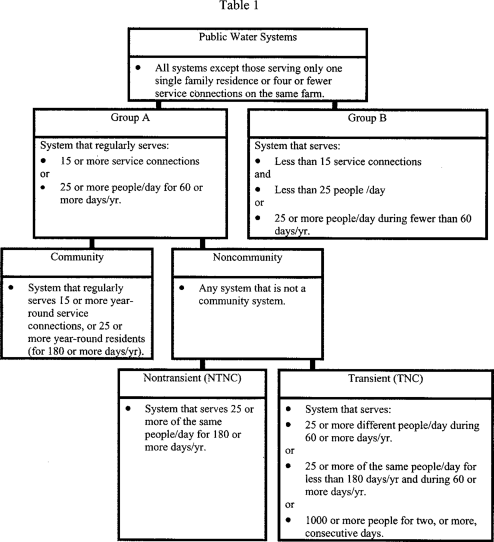
[Statutory Authority: RCW 43.02.050 [43.20.050]. 99-07-021, § 246-290-020, filed 3/9/99, effective 4/9/99. Statutory Authority: RCW 43.20.050. 94-14-001, § 246-290-020, filed 6/22/94, effective 7/23/94; 93-08-011 (Order 352B), § 246-290-020, filed 3/25/93, effective 4/25/93; 91-02-051 (Order 124B), recodified as § 246-290-020, filed 12/27/90, effective 1/31/91. Statutory Authority: P.L. 99-339. 89-21-020 (Order 336), § 248-54-006, filed 10/10/89, effective 11/10/89.]
141.2 Definitions. Only those definitions listed as follows:
| Action level; | |
| Corrosion inhibitor; | |
| Effective corrosion inhibitor residual; | |
| Enhanced coagulation; | |
| Enhanced softening; | |
| Granular activated carbon (GAC10); | |
| Haloacetic acids (five) (HAA5); | |
| First draw sample; | |
| Large water system; | |
| Lead service line; | |
| Maximum residual disinfectant level (MRDL); | |
| Maximum residual disinfectant level goal (MRDLG); | |
| Medium-size water system; | |
| Optimal corrosion control treatment; | |
| Service line sample; | |
| Single family structure; | |
| Small water system; | |
| Specific ultraviolet absorption (SUVA); and | |
| Total Organic Carbon (TOC). | |
| 141.12 | Maximum contaminant levels for organic chemicals. |
| 141.13 | Maximum contaminant levels for turbidity. |
| 141.21 | Coliform monitoring. |
| 141.22 | Turbidity sampling and analytical requirements. |
| 141.23(a) - excluding (i)(2) | 141.23(j), Inorganic chemical sampling. |
| 141.23(m) - | 141.23(o) |
| 141.24(a) - | 141.24(d), Organic chemicals other than total trihalomethanes. |
| 141.24 (f)(1) - 141.24 (f)(15), | |
| 141.24 (f)(18), 141.24 (f)(19), | |
| 141.24 (f)(21), 141.24 (f)(22) | |
| 141.24 (g)(1) - 141.24 (g)(9), | |
| 141.24 (g)(12) - 141.24 (g)(14), | |
| 141.24 (h)(1) - 141.24 (h)(11), | |
| 141.24 (h)(14) - 141.24 (h)(17) | |
| 141.24 (h)(20) | |
| 141.25(a), | 141.25 (c) - (d), Analytical methods for radioactivity. |
| 141.26 | Monitoring frequency and compliance for radioactivity in community water systems. |
| 141.31(d) | Reporting of public notices and compliance certifications. |
| 141.33(e) | Record maintenance of public notices and certifications. |
| 141.40(a) - | 141.40(e), Special monitoring for inorganic and organic chemicals. |
| 141.40(g), 141.40(i) - 141.40(n) | |
| 141.61 | Maximum contaminant levels for organic contaminants. |
| 141.62, excluding (b) | Maximum contaminant levels for inorganic chemical and physical contaminants. |
| 141.64(c) | Best Available Technologies (BATs) for Disinfection By-Products. |
| 141.65(c) | Best Available Technologies (BATs) for Maximum Residual Disinfectant Levels. |
| 141.66 | Maximum contaminant levels for radionuclides. |
| Control of Lead and Copper | |
| 141.80 | General requirements. |
| 141.81 | Applicability of corrosion control treatment steps to small, medium-size and large water systems. |
| 141.82(a) - | 141.82(h) Description of corrosion control treatment requirements. |
| 141.83 | Source water treatment requirements. |
| 141.84 | Lead service line replacement requirements. |
| 141.85 | Public education and supplemental monitoring requirements. |
| 141.86 (a) - (f) |
Monitoring requirements for lead and copper in tap water. |
| 141.87 | Monitoring requirements for water quality parameters. |
| 141.88 | Monitoring requirements for lead and copper in source water. |
| 141.89 | Analytical methods for lead and copper testing. |
| 141.90, excluding (a)(4) | Reporting requirements. |
| 141.91 | Recordkeeping requirements. |
| Disinfectants and Disinfection By-Products (D/DBP) | |
| 141.130 | General requirements. |
| 141.131 | Analytical requirements. |
| 141.132 | Monitoring requirements. |
| 141.133 | Compliance. |
| 141.134 | Reporting and recordkeeping. |
| 141.135 | Treatment technique for control of disinfection by-product precursors. |
| Enhanced Filtration - Reporting and Recordkeeping | |
| 141.175(b) | Individual filter reporting and follow-up action requirements for systems treating surface water with conventional, direct, or in-line filtration and serving at least 10,000 people. |
| Subpart Q - Public Notification | |
| 141.201, excluding (3)(ii) of Table 1 | General public notification requirements. |
| 141.202,
excluding (3) of Table 1 |
Tier 1 Public Notice - Form, manner, and frequency of notice. |
| 141.203 | Tier 2 Public Notice - Form, manner, and frequency of notice. |
| 141.204 | Tier 3 Public Notice - Form, manner, and frequency of notice. |
| 141.205 | Content of the public notice. |
| 141.206 | Notice to new billing units or new customers. |
| 141.207 | Special notice of the availability of unregulated contaminant monitoring results. |
| 141.208 | Special notice for exceedances of the SMCL for fluoride. |
| (( |
|
| 141.211 | Special notice for Cryptosporidium monitoring failure. |
| Appendix A - NPDWR violations and situations requiring PN | |
| Appendix B - Standard health effects language for PN | |
| Subpart T - Enhanced Filtration and Disinfection - Systems Serving Fewer Than 10,000 People | |
| 141.530 - 141.544 | Disinfection profile and benchmark. |
| 141.563 | Follow-up actions required. |
| 141.570, excluding (c) | Reporting requirements. |
| Subpart W - Enhanced Treatment for Cryptosporidium | |
| 141.700-723 Enhanced Treatment for Cryptosporidium | |
| Part 143 - National Secondary Drinking Water Regulations | |
| 143.1(( 143.4 |
|
| 143.2 | Definitions. |
| 143.3 | Secondary maximum contaminant levels. |
| 143.4 | Monitoring. |
[Statutory Authority: RCW 43.20.050 and 70.119A.080. 04-04-056, § 246-290-025, filed 1/30/04, effective 3/1/04. Statutory Authority: RCW 43.20.050 (2) and (3) and RCW 70.119A.080. 03-08-037, § 246-290-025, filed 3/27/03, effective 4/27/03. Statutory Authority: RCW 43.02.050 [43.20.050]. 99-07-021, § 246-290-025, filed 3/9/99, effective 4/9/99. Statutory Authority: RCW 43.20.050. 94-14-001, § 246-290-025, filed 6/22/94, effective 7/23/94.]
(a) Demonstrate the system's operational, technical, managerial, and financial capability to achieve and maintain compliance with relevant local, state, and federal plans and regulations;
(b) Demonstrate how the system will address present and future needs in a manner consistent with other relevant plans and local, state, and federal laws, including applicable land use plans;
(c) Establish eligibility for funding under ((the
drinking water state revolving fund (SRF))) chapter 246-296 WAC.
(2) Purveyors of the following categories of community public water systems shall submit a water system plan for review and approval by the department:
(a) Systems having one thousand or more services;
(b) Systems required to develop water system plans under the Public Water System Coordination Act of 1977 (chapter 70.116 RCW);
(c) Any system experiencing problems related to planning, operation, and/or management as determined by the department;
(d) All new systems;
(e) Any expanding system; and
(f) Any system proposing to use the document submittal exception process in WAC 246-290-125.
(3) The purveyor shall work with the department ((and
other parties)) to establish the level of detail for a water
system plan. In general, the scope and detail of the plan
will be related to size, complexity, water supply
characteristics, forecasted demand characteristics, past
performance, and use of the water system. Project reports may
be combined with a water system plan.
(4) In order to demonstrate system capacity, the water system plan shall address the following elements, as a minimum, for a period of at least twenty years into the future:
(a) Description of the water system, including:
(i) Ownership and management, including the current names, addresses, and telephone numbers of the owners, operators, and emergency contact persons for the system;
(ii) System history and background;
(iii) Related plans, such as coordinated water system plans, abbreviated coordinated water system plans, local land use plans, ground water management plans, and basin plans;
(iv) Service area maps, characteristics, agreements, and policies. Water systems must include their existing service area and future service area, if applicable. Municipal water suppliers must define their retail service area and meet the requirements under WAC 246-290-106. Municipal water suppliers must identify where their water rights place of use will be expanded to their service area if the requirements under WAC 246-290-107 for the expanded area have been met; and
(v) Satellite management, if applicable.
(b) Basic planning data, including:
(i) Current population, service connections, water use, and equivalent residential units; and
(ii) Sufficient water production and consumption data to identify trends including the following elements:
(A) Monthly and annual production totals for each source, including water purchased from another public water system;
(B) Annual usage totals for each customer class as determined by the purveyor;
(C) Annual usage totals for water supplied to other public water systems; and
(D) For systems serving one thousand or more total connections, a description of the seasonal variations in consumption patterns of each customer class defined by the purveyor.
(iii) ((Projected)) Designated land use, future
population, and water demand for a consecutive six-year and
twenty-year planning period within the system's retail service
area and future service area, if applicable.
(c) Demand forecasts, developed under WAC 246-290-221, for a consecutive six-year and twenty-year planning period. These shall show future use with and without savings expected from the system's water use efficiency program.
(d) For systems serving one thousand or more total connections, a demand forecast projecting demand if the measures deemed cost-effective per WAC 246-290-810 were implemented.
(e) System analysis, including:
(i) System design standards;
(ii) Water quality analysis;
(iii) System inventory description and analysis; and
(iv) Summary of system deficiencies.
(f) Water resource analysis, including:
(i) A water use efficiency program. Municipal water suppliers must meet the requirements in WAC 246-290-810;
(ii) Source of supply analysis, which includes:
(A) An evaluation of water supply alternatives if additional water rights will be pursued within twenty years; and
(B) A narrative description of the system's water supply characteristics and the foreseeable effect from current and future use on the water quantity and quality of any body of water from which its water is diverted or withdrawn based on existing data and studies;
(iii) A water shortage response plan ((if a water system
experiences a water shortage, or anticipates it will
experience a water shortage within the next six-year planning
period)) as a component of the reliability and emergency
response requirements under WAC 246-290-420;
(iv) Water right self assessment;
(v) Water supply reliability analysis;
(vi) Interties; and
(vii) For systems serving one thousand or more total connections, an evaluation of opportunities for the use of reclaimed water, where they exist, as defined in RCW 90.46.010(4).
(g) Source water protection ((in accordance with)) under
WAC 246-290-135.
(h) Operation and maintenance program ((in accordance
with)) under WAC 246-290-415 and 246-290-654(5), as
applicable.
(i) Improvement program, including a six-year capital improvement schedule.
(j) Financial program, including demonstration of financial viability by providing:
(i) A summary of past income and expenses;
(ii) A one-year balanced operational budget for systems serving one thousand or more connections or a six-year balanced operational budget for systems serving less than one thousand connections;
(iii) A plan for collecting the revenue necessary to maintain cash flow stability and to fund the capital improvement program and emergency improvements; and
(iv) An evaluation that has considered:
(A) The affordability of water rates; and
(B) The feasibility of adopting and implementing a rate structure that encourages water demand efficiency.
(k) Other documents, such as:
(i) Documentation of SEPA compliance;
(ii) Agreements; and
(iii) Comments from the county and adjacent utilities.
(5) Purveyors intending to implement the project report and construction document submittal exceptions authorized under WAC 246-290-125 must include:
(a) Standard construction specifications for distribution mains; and/or
(b) Design and construction standards for distribution-related projects, including:
(i) Description of project report and construction document internal review procedures, including engineering design review and construction completion reporting requirements;
(ii) Construction-related policies and requirements for external parties, including consumers and developers;
(iii) Performance and sizing criteria; and
(iv) General reference to construction materials and methods.
(6) The department, at its discretion, may require reports from purveyors identifying the progress in developing their water system plans.
(7) Purveyors shall transmit water system plans to adjacent utilities and local governments having jurisdiction, to assess consistency with ongoing and adopted planning efforts.
(8) ((For community systems, the purveyor shall hold an
informational meeting for system consumers prior to
departmental approval of a water system plan or a water system
plan update. The purveyor shall notify consumers in a way
that is appropriate to the size of the system.)) Prior to
department approval of a water system plan or a water system
plan update, the purveyor must:
(a) Hold an informational meeting for the water system consumers and notify consumers in a way that is appropriate to the size of the water system; and
(b) Obtain the approval of the water system plan from the governing body or elected governing board.
(9) Department approval of a water system plan shall be in effect for six years from the date of written approval unless:
(a) Major projects subject to SEPA as defined in WAC 246-03-030 (3)(a) are proposed that are not addressed in the plan;
(b) Changes occur in the basic planning data significantly affecting system improvements identified; or
(c) The department requests an updated plan or plan amendment.
(10) The purveyor shall update the plan and ((submit it
for)) obtain department approval at least every six years. If
the system no longer meets the conditions of subsection (2) of
this section, the purveyor shall as directed by the
department, either:
(a) Submit ((either)) a water system plan amendment for
review and approval by the department with the scope ((of
which will)) to be determined by the department((,)); or ((a
small water system management program))
(b) Meet the requirements under WAC 246-290-105.
[Statutory Authority: RCW 70.119A.180. 07-02-025B, § 246-290-100, filed 12/22/06, effective 1/22/07. Statutory Authority: RCW 43.20.050 (2) and (3) and 70.119A.080. 03-08-037, § 246-290-100, filed 3/27/03, effective 4/27/03. Statutory Authority: RCW 43.02.050 [43.20.050]. 99-07-021, § 246-290-100, filed 3/9/99, effective 4/9/99. Statutory Authority: RCW 43.20.050. 94-14-001, § 246-290-100, filed 6/22/94, effective 7/23/94; 93-08-011 (Order 352B), § 246-290-100, filed 3/25/93, effective 4/25/93; 91-02-051 (Order 124B), recodified as § 246-290-100, filed 12/27/90, effective 1/31/91. Statutory Authority: RCW 34.04.045. 88-05-057 (Order 307), § 248-54-065, filed 2/17/88. Statutory Authority: RCW 43.20.050. 83-19-002 (Order 266), § 248-54-065, filed 9/8/83.]
(a) Demonstrate the system's operational, technical, managerial, and financial capability to achieve and maintain compliance with all relevant local, state, and federal plans and regulations; and
(b) Establish eligibility for funding under ((the
drinking water state revolving fund (SRF))) chapter 246-296 WAC.
(2) All noncommunity and all community systems not required to complete a water system plan as described under WAC 246-290-100(2) shall develop and implement a small water system management program.
(3) The purveyor shall submit this program for review and approval to the department when:
(a) A new NTNC public water system is created; ((or))
(b) An existing system has operational, technical, managerial, or financial problems, as determined by the department; or
(c) A system applies for funding under chapter 246-296 WAC.
(4) Content and detail shall be consistent with the size, complexity, past performance, and use of the public water system. General content topics shall include, but not be limited to, the following elements:
(a) System management;
(b) Annual operating permit;
(c) Water facilities inventory form;
(d) Service area and facility map. Municipal water suppliers must identify where their water rights place of use will be expanded to their service area if the requirements under WAC 246-290-107 for the expanded area have been met;
(e) Water right self assessment;
(f) Description of the system's source(s) including the name and location of any body of water from which its water is diverted or withdrawn;
(g) A water use efficiency program. Municipal water suppliers must meet the requirements in WAC 246-290-810;
(h) Water production and consumption data including each of the following:
(i) Monthly and annual production for each source, including water purchased from another public water system;
(ii) Annual consumption totals for residential and nonresidential connections;
(iii) Total annual volume of water supplied to other public water systems;
(i) Average daily demand;
(j) Current population served;
(k) The forecast of average daily demand based on the system's approved number of connections that considers:
(i) Water use trends based on actual water use records; and
(ii) Applicable land use plans;
(l) An evaluation that has considered the feasibility of adopting and implementing a rate structure that encourages water demand efficiency;
(m) Source protection;
(n) Component inventory and assessment;
(o) List of planned system improvements;
(p) Water quality monitoring program;
(q) Operation and maintenance program under WAC 246-290-415(2) and 246-290-654(5) as applicable;
(r) Cross-connection control program;
(s) Emergency response plan; and
(t) Budget.
(5) The department may require changes be made to a small water system management program if necessary to effectively accomplish the program's purpose.
[Statutory Authority: RCW 70.119A.180. 07-02-025B, § 246-290-105, filed 12/22/06, effective 1/22/07. Statutory Authority: RCW 43.20.050 (2) and (3) and 70.119A.080. 03-08-037, § 246-290-105, filed 3/27/03, effective 4/27/03. Statutory Authority: RCW 43.02.050 [43.20.050]. 99-07-021, § 246-290-105, filed 3/9/99, effective 4/9/99.]
(1) A municipal water supplier has a duty to provide retail water service to all new service connections within its retail service area if:
(a) Its service can be available in a timely and reasonable manner;
(b) The municipal water supplier has sufficient water rights to provide service;
(c) The municipal water supplier has sufficient capacity to serve the water in a safe and reliable manner as determined by the department; and
(d) It is consistent with the requirements of:
(i) Any comprehensive plans or development regulations adopted under chapter 36.70A RCW; or
(ii) Any other applicable comprehensive plan, land use plan, or development regulation adopted by a city, town, or county for the service area and for water service by the water utility of a city or town, with the utility service extension ordinances of the city or town.
(2) Municipal water suppliers must provide a retail service area map.
At a minimum, the retail service area must include the municipal water supplier's existing service area and may also include areas where future water service is planned if the requirements of subsection (1) of this section can be met. Municipal water suppliers may provide temporary service to another water system if a written agreement with the water system is in place.
(3) Municipal water suppliers must meet the requirements of WAC 246-290-108 for their retail service area.
(4) Municipal water suppliers must provide their service policies and conditions of service including how new service will be provided in a timely and reasonable manner.
(5) To resolve a significant public health and safety concern, the department may allow water service to be extended prior to meeting the requirements of this section.
[]
(1) The following conditions must be met:
(a) The municipal water supplier is in compliance with the terms of the water system plan or small water system management program, including those regarding water use efficiency.
(b) The alteration of the place of use is not inconsistent regarding an area added to the place of use with any comprehensive plans or development regulations adopted under chapter 36.70A RCW, or any other applicable comprehensive plan, land use plan, or development regulation adopted by a city, town, or county.
(c) The alteration of the place of use is not inconsistent regarding an area added to the place of use with any watershed plan approved under chapter 90.82 RCW or a comprehensive watershed plan approved under RCW 90.54.040(1) after September 3, 2003, if such a watershed plan has been approved for the area.
(2) Municipal water suppliers must:
(a) Identify the portions of the service area where the place of use will be expanded.
(b) Document that subsection (1) of this section is met.
[]
(1) Local plans and regulations include any comprehensive plans or development regulations adopted under chapter 36.70A RCW or any other applicable comprehensive plan, land use plan, or development regulation adopted by a city, town, or county for the applicable service area and for water service by the water utility of a city or town, with the utility service extension ordinance of the city or town.
(2) A municipal water supplier must include a consistency review and supporting documentation in its planning or engineering document describing how it has considered consistency with local plans and regulations. This review must include elements of local plans and regulations, as they reasonably relate to water service to be provided by a municipal water supplier for any new connection, including:
(a) Land use within the applicable service area;
(b) Six-year growth projections used in the demand forecast;
(c) Utility service extension ordinances of a city or town when water service is provided by the water utility of the city or town;
(d) Provisions of water service for new service connections for the planning period identified in the document; and
(e) Other relevant elements related to water supply planning as determined by the department.
(3) Municipal water suppliers must request each local government jurisdiction with authority over the applicable service area to provide a consistency review.
(a) Local government jurisdictions shall have a minimum of sixty days to review the planning or engineering document unless another state statute or state regulation requires a different time frame. A local government jurisdiction may provide notice that an additional thirty days are needed to review the planning or engineering document. Within the sixty-day time frame, or the thirty-day time frame, local government jurisdictions must document any inconsistency with local plans and regulations as provided in this section and provide this information to the department and the municipal water supplier.
(b) If the applicable local government jurisdiction documents in writing an inconsistency exists with local plans and regulations as provided in this section, the department will require the municipal water supplier to address the inconsistency. The local government jurisdiction shall have sixty days to review any revisions or responses that address the inconsistency.
(4) If a local government jurisdiction does not provide a consistency review, the municipal water supplier shall complete the consistency review. The municipal water supplier must document:
(a) The amount of time provided to each local government jurisdiction with authority to review the planning and engineering documents as defined in subsection (3) of this section; and
(b) What efforts were taken to request a consistency review from the local government jurisdiction.
[]
(2) ((The)) Purveyors shall submit project reports to the
department and ((receive)) obtain written approval prior to
installation or construction of any new water system, water
system extension, or improvement. The department may require
the submittal of a project report for the purpose of resolving
a system operational problem. Exceptions to this requirement
are listed in WAC 246-290-125.
(3) Project reports submitted for approval by purveyors who are required to have a water system plan will not be considered for approval unless a current, approved water system plan that adequately addresses the project is on file with the department. In the event that a purveyor of an existing system does not have such a water system plan, the department may enter into a compliance agreement with the purveyor that grants a time extension to complete the water system plan.
(4) Project reports shall be consistent with the standards identified in Part 3 of this chapter. Depending on the complexity and type of project or problem, shall include the following elements (information contained in a current water system plan or other engineering document previously approved by the department need not be duplicated, but must be specifically referenced):
(a) Project description, including:
(i) Why the project is being proposed, how problem(s) (if any) are to be addressed, and the relationship of the project to other system components;
(ii) A statement of ((State Environmental Policy Action
())SEPA(())) determination of nonsignificance or justification
of why SEPA does not apply to project;
(iii) ((If applicable,)) Source development information
(((refer to)) under WAC 246-290-130, ((Source approval, WAC))
246-290-132, ((Interties,)) and ((WAC)) 246-290-135, ((Source
protection))) if applicable;
(iv) ((If applicable,)) Type of treatment (((refer to))
under WAC 246-290-250, ((Water treatment and Part 6, Surface
water treatment))) if applicable; and
(v) A summary of consumer and user complaints.
(b) Planning data. If a purveyor has a water system plan or small water system management program, the project report shall indicate the proposed project's relationship to the plan. If the purveyor is not required by WAC 246-290-100 to have a water system plan, planning related information shall include:
(i) General project background with population and water demand forecasts;
(ii) How the project will impact neighboring water systems;
(iii) Local requirements, such as fire flow;
(iv) Additional management responsibilities ((in
accordance with)) under WAC 246-290-105, ((Small water system
management program, WAC)) 246-290-415, ((Operations and
maintenance,)) and chapter 246-292 WAC((, Waterworks operator
certification regulations));
(v) Implementation strategies or proposed construction schedule;
(vi) Estimated capital and annual operating cost, and method of financing, if applicable.
(c) An analysis of alternatives, including description of options and rationale for selecting the proposed option.
(d) A review of water quality as it relates to the
purpose of the proposed project. If a project involves
treatment and/or a filtration facility pilot study, refer to
((departmental)) department guidance, reporting requirements
for corrosion control under 40 CFR 141.90, and tracer studies
under WAC 246-290-636(5).
(e) When the project involves a new source or an increase
in system physical capacity, a review of water quantity,
including a water rights assessment, unless ((such an)) the
assessment has previously been submitted in a water system
plan or small water system management program that has been
approved by the department. The purveyor shall take any
follow-up action as directed by the department, to determine
conformance with applicable state water rights laws.
(f) Engineering calculations including sizing justification, hydraulic analysis, physical capacity analysis, and other relevant technical considerations necessary to support the project.
(g) Design and construction standards, including performance standards, construction materials and methods, and sizing criteria, if applicable.
(h) Project reports for the design of treatment facilities shall include the following:
(i) Detailed design criteria and calculations to support the proposed treatment processes, process control, and process utilities; and
(ii) Proposed methods and schedules for start up, testing, and operation of the completed treatment facility.
(i) Legal considerations, such as ownership, right of
way, sanitary control area (SCA), restrictive covenants,
restrictions related to water use that are recorded on titles
or deeds to properties, and relationship with the boundary
review board and ((the utilities and transportation commission
())UTC(())).
(j) Other necessary department-determined considerations.
[Statutory Authority: RCW 43.02.050 [43.20.050]. 99-07-021, § 246-290-110, filed 3/9/99, effective 4/9/99. Statutory Authority: RCW 43.20.050. 94-14-001, § 246-290-110, filed 6/22/94, effective 7/23/94; 93-08-011 (Order 352B), § 246-290-110, filed 3/25/93, effective 4/25/93; 91-02-051 (Order 124B), recodified as § 246-290-110, filed 12/27/90, effective 1/31/91. Statutory Authority: P.L. 99-339. 89-21-020 (Order 336), § 248-54-086, filed 10/10/89, effective 11/10/89. Statutory Authority: RCW 34.04.045. 88-05-057 (Order 307), § 248-54-086, filed 2/17/88.]
(2) Purveyors shall submit construction documents to the
department ((for)) and obtain written approval prior to
((installation)) construction of any new water system, or
water system extension or improvement. Exceptions to this
requirement are listed in WAC 246-290-125.
(3) Construction documents submitted for approval by
purveyors who are required to have a water system plan will
not be considered for approval unless a current, approved
water system plan that adequately addresses the project is on
file with the department. In the event that a purveyor of an
existing system does not have ((such)) a water system plan,
the department may enter into a compliance agreement with the
purveyor that grants a time extension to complete the water
system plan.
(4) Construction documents shall be consistent with the standards identified in Part 3 of this chapter and shall include, at a minimum, the following:
(a) Drawings. Include detailed drawings of each project component;
(b) Material specifications. List detailed material specifications for each project component;
(c) Construction specifications.
(i) List detailed construction specifications and assembly techniques for carrying out the project;
(ii) Testing. Identify testing criteria and procedures for each applicable portion of the project;
(iii) Disinfection. Identify specific disinfection
procedures that shall conform with ((American Water Works
Association ())AWWA(())) standards or other standards
acceptable to the department;
(iv) Inspection. Identify provisions for inspection of the installation of each project component. See WAC 246-290-040 and subsection (5) of this section for construction reporting requirements;
(d) Change orders. All significant changes shall be
submitted to and approved by the department in writing. The
change order must identify who will be responsible for
obtaining ((departmental)) department approval and how change
orders will be reported to the department. Significant means
a change in materials used, deviations from original intent of
project, or changes made to the physical capacity of the
project;
(e) Record drawings. Record drawings provided to the purveyor following the completion of the project shall be maintained and available to the department upon request.
(5) Purveyors shall submit a construction completion
report (((departmental)) department form) to the department
within sixty days of completion and before use of
distribution-related projects in accordance with WAC 246-290-125 (3)(f), or other project approved for construction
by the department. Exceptions to this requirement are
projects listed in WAC 246-290-125(1). The form shall:
(a) Bear the seal, date, and signature of a professional engineer licensed in the state of Washington;
(b) State the project is constructed and is completed in accordance with department regulations and principles of standard engineering practice, including physical testing procedures, water quality tests, and disinfection practices; and
(c) Document system physical capacity to serve consumers if the project results in a change (increase or decrease) in physical capacity.
(6) The purveyor shall submit a new or updated water
facilities inventory (WFI) form (((departmental)) department
form) with the construction completion report
(((departmental)) department form) for a new water system,
whenever there are changes or additions to an existing water
system that would change information of the WFI, or when
required by the department.
(7) If the project results in an increase in the water
system's physical capacity, the purveyor shall submit a water
right self-assessment, unless ((such an)) the assessment has
previously been submitted in a project report, water system
plan, or small water system management program, that has been
approved by the department. The purveyor shall take any
follow-up action, as directed by the department, to determine
conformance with applicable state water rights laws.
(8) Approval of construction documents shall be in effect for two years unless the department determines a need to withdraw the approval. An extension of the approval may be obtained by submitting a status report and a written schedule for completion. Extensions may be subject to additional terms and conditions imposed by the department.
(9) ((The purveyor shall fulfill the requirements of this
section before the use of any completed project.
(10))) Purveyors of new water systems must meet the ownership requirements of WAC 246-290-035 and the water system planning requirements of WAC 246-290-100 or 246-290-105 before the department will review and approve the purveyors' construction documents.
[Statutory Authority: RCW 43.02.050 [43.20.050]. 99-07-021, § 246-290-120, filed 3/9/99, effective 4/9/99. Statutory Authority: RCW 43.20.050. 93-08-011 (Order 352B), § 246-290-120, filed 3/25/93, effective 4/25/93; 91-02-051 (Order 124B), recodified as § 246-290-120, filed 12/27/90, effective 1/31/91. Statutory Authority: RCW 34.04.045. 88-05-057 (Order 307), § 248-54-096, filed 2/17/88.]
(a) Installation of valves, fittings, and meters, including backflow prevention assemblies;
(b) Installation of hydrants ((in accordance with)) under
WAC 246-290-230 (3) and (6);
(c) Repair of a system component or replacement with a
component of a similar capacity and material in accordance
with the original construction specifications of the approved
design((; or)). For the purposes of replacing existing pipe,
similar capacity includes one standard pipe size larger.
(d) Maintenance or painting of surfaces not contacting potable water.
(2) Purveyors may elect to not submit to the department
for review and approval project reports ((in accordance with))
under WAC 246-290-110 and construction documents ((in
accordance with)) under WAC 246-290-120 for new distribution
mains if:
(a) The purveyor has on file with the department a current department-approved water system plan that includes standard construction specifications for distribution mains; and
(b) The purveyor maintains on file a completed
construction completion report (((departmental)) department
form) in accordance with WAC 246-290-120(5) and makes it
available for review upon request by the department.
(3) Purveyors may elect to not submit to the department
for review and approval project reports ((in accordance with))
under WAC 246-290-110 and construction documents ((in
accordance with)) under WAC 246-290-120 for review and
approval of other distribution-related projects as defined in
WAC 246-290-010 providing:
(a) The purveyor has on file with the department a current department-approved water system plan, in accordance with WAC 246-290-100(5);
(b) The purveyor submits a written request with a new water system plan or an amendment to a water system plan, and updates the request with each water system plan update. The written request should specifically identify the types of projects or facilities for which the submittal exception procedure is requested;
(c) The purveyor has documented that they have employed or hired under contract the services of a professional engineer licensed in the state of Washington to review distribution-related projects not submitted to the department for review and approval. The review engineer and design engineer shall not be the same individual. The purveyor shall provide written notification to the department whenever they propose to change their designated review engineer;
(d) If the project is a new transmission main, storage tank, or booster pump station, it must be identified in the capital improvement program of the utility's water system plan. If not, either the project report must be submitted to the department for review and approval, or the water system plan must be amended;
(e) A project summary file is maintained by the purveyor for each project and made available for review upon request by the department, and includes:
(i) Descriptive project summary;
(ii) Anticipated completion schedule;
(iii) Consistency with utility's water system plan;
(iv) Water right self-assessment, where applicable;
(v) Change in system physical capacity;
(vi) Copies of original design and record drawings;
(vii) Engineering design review report (((departmental))
department form). The form shall:
(A) Bear the seal, date, and signature of a professional engineer licensed in the state of Washington prior to the start of construction;
(B) Provide a descriptive reference to completed project report and/or construction documents reviewed, including date of design engineer's seal and signature; and
(C) State the project report and/or construction documents have been reviewed, and the design is in accordance with department regulations and principles of standard engineering practice;
(f) The construction completion report is submitted to the department in accordance with WAC 246-290-120(5) for new storage tanks and booster pump stations, and maintained on file with the water system for all other distribution-related projects;
(g) A WFI is completed in accordance with WAC 246-290-120(6); and
(h) The purveyor meets the requirements of chapter 246-294 WAC to have a category "green" operating permit.
(4) Source of supply (including interties) and water quality treatment-related projects shall not be eligible for the submittal exception procedure.
(5) Purveyors not required to prepare a water system plan under WAC 246-290-100 shall be eligible for the submittal exception procedure if the purveyor:
(a) Has a department-approved water system plan meeting the requirements of WAC 246-290-100; and
(b) Complies with all other requirements in this
section((.)); and
(((6))) (c) Ensures that all work required to be prepared
under the direction of a professional engineer be accomplished
per WAC 246-290-040 and chapter 18.43 RCW.
[Statutory Authority: RCW 43.20.050 (2) and (3) and 70.119A.080. 03-08-037, § 246-290-125, filed 3/27/03, effective 4/27/03. Statutory Authority: RCW 43.02.050 [43.20.050]. 99-07-021, § 246-290-125, filed 3/9/99, effective 4/9/99.]
(2) Before initiating source development or modification, the purveyor shall contact the department to identify submittal requirements.
(3) Any party seeking source approval shall provide the department sufficient documentation, in a project report, construction documents, or in supplemental documents, that the source:
(a) Is reasonable and feasible for the type and size of the system;
(b) May legally be used in conformance with state water rights laws;
(c) Supplies water that is physically and reliably available in the necessary quantities, as shown in:
(i) A hydrogeologic assessment of the proposed source;
(ii) A general description of the watershed, spring, and/or aquifer recharge area affecting the quantity or quality of flow, which includes seasonal variation and upstream water uses that may significantly affect the proposed source;
(iii) For ground water and spring sources, well source development data that are available from a pump test at the maximum design rate and duration, or are available from other sources of information, that establish pump settings (depth) in the well and demonstrate adequacy of water quantity to meet design criteria while not leading to water quality problems;
(iv) For ground water and spring sources, installation of a source meter or other equivalent device that reliably measures volume of flow into the system;
(d) Is, or is not, a GWI under WAC 246-290-640, and meets or can meet the applicable requirements for GWI sources as described in that section including treatment;
(e) Adequately provides for source protection, as shown in:
(i) For surface water and GWI sources, the watershed control program identified under WAC 246-290-135 and Part 6 of this chapter;
(ii) For wells, a preliminary department susceptibility assessment or equivalent information, and preliminary WHPA delineation and contaminant inventory, under the requirements for sanitary control and wellhead protection under WAC 246-290-135;
(f) Is designed and constructed in conformance with this chapter, and relevant requirements of chapter 173-160 WAC (department of ecology well construction standards);
(g) Meets water quality standards under WAC 246-290-310, as shown in an initial water quality analysis that includes, at a minimum, the following:
(i) Bacteriological;
(ii) Complete inorganic chemical and physical except that the MCL for arsenic under WAC 246-290-310 does not apply to TNC systems;
(iii) Complete VOC;
(iv) Radionuclides, if source approval is requested for a community system;
(v) SOC, except where waived or not required under WAC 246-290-310; and
(vi) Any other information required by the department relevant to the circumstances of the particular source.
Sources that otherwise would not meet water quality standards may be approved if treatment is provided.
(4) The required documentation under subsection (3) of this section shall include, at a minimum:
(a) A ((copy of the water right, or other written
evidence of the existence of the right)) water right
self-assessment;
(b) A map showing the project location and vicinity;
(c) A map depicting topography, distances to the surface water intake, well or spring from existing property lines, buildings, potential sources of contamination, ditches, drainage patterns, and any other natural or man-made features affecting the quality or quantity of water;
(d) The dimensions, location, and legal documentation of
the ((sanitary control area ())SCA(())) under WAC 246-290-135;
(e) A copy of the on-site inspection form completed by the department or local health department representative;
(f) A copy of the water well report including the unique well identification tag number, depth to open interval or top of screened interval, overall depth of well from the top of the casing, vertical elevation, and location (both plat location and latitude/longitude); and
(g) Documentation of source meter installation. The
purveyor may utilize other documents, such as a water system
plan, susceptibility assessment, wellhead protection program,
project report, or construction documents, to provide ((such))
the documentation and information to the department, provided
that ((such)) the documents are current, and the purveyor
indicates the location in the document of the relevant
information.
(5) If treatment of a source is necessary to meet water quality standards, the purveyor may be required to meet the provisions of WAC 246-290-250 and Part 6 of this chapter, if applicable, prior to or as a condition of approval.
(6) An intertie must be adequately described in a written agreement between the purveyor and the supplier of the water, and otherwise meet the requirements of WAC 246-290-132.
(7) The purveyor shall not construct facilities for source development and use without prior approval of the department pursuant to the provisions of WAC 246-290-120.
(8) ((The purveyor shall receive a written source
approval when:
(a) The purveyor has complied with the relevant provisions of subsections (1) through (7) of this section; and
(b) The developed source provides water complying with this chapter.
(9))) The purveyor may ((receive)) request a conditional
source approval, such as one that sets limits on use or
requires interim treatment, if further analysis of the quality
of the source is required before final approval.
(((10))) (9) For sources or supplies of water used by
bottled water or ice plants to produce bottled water or ice:
(a) If the bottled water or ice plant is a Group A community water system and the plant uses the system's source for the water that is bottled or made into ice, the source and supply used for the bottled water and ice shall meet the applicable Group A requirements;
(b) If the bottled water or ice plant uses its own source for the water that is bottled or made into ice, and the plant is not a Group A community water system, the owner or operator shall obtain source approval from the department, and the source water shall meet the ongoing source water quality monitoring requirements for a Group A community system;
(c) If the bottled water or ice plant purchases the water
for bottling or making ice from another source or supply, the
water shall meet the minimum requirements for a Group A
community water system, and the owner or operator of the plant
shall ensure that the water meets ((such)) the requirements;
(d) The source or supply for the water that is bottled or made into ice shall be protected from contamination prior to the bottling or ice making process; and
(e) In addition to the requirements imposed under this subsection, the processing of bottled water shall be subject to regulation by the state department of agriculture and the United States Food and Drug Administration.
[Statutory Authority: RCW 43.20.050 and 70.119A.080. 04-04-056, § 246-290-130, filed 1/30/04, effective 3/1/04. Statutory Authority: RCW 43.02.050 [43.20.050]. 99-07-021, § 246-290-130, filed 3/9/99, effective 4/9/99. Statutory Authority: RCW 43.20.050. 94-14-001, § 246-290-130, filed 6/22/94, effective 7/23/94; 93-08-011 (Order 352B), § 246-290-130, filed 3/25/93, effective 4/25/93. Statutory Authority: Chapter 43.20 RCW. 91-07-031 (Order 150B), § 246-290-130, filed 3/15/91, effective 4/15/91. Statutory Authority: RCW 43.20.050. 91-02-051 (Order 124B), recodified as § 246-290-130, filed 12/27/90, effective 1/31/91. Statutory Authority: P.L. 99-339. 89-21-020 (Order 336), § 248-54-097, filed 10/10/89, effective 11/10/89. Statutory Authority: RCW 34.04.045. 88-05-057 (Order 307), § 248-54-097, filed 2/17/88.]
(2) Interties shall not be eligible for submittal exceptions pursuant to WAC 246-290-125.
(3) Prior to department approval, purveyors proposing nonemergency interties shall ensure that the intertie is addressed:
(a) In an approved coordinated water system plan, water system plan, water system plan update, water system plan amendment, or small water system management program including:
(i) Location of the proposed intertie;
(ii) Date it is proposed to be utilized;
(iii) The purpose, physical capacity, service area, and proposed usage of the intertie;
(iv) Copy of the intertie agreement between purveyors;
(v) Description of how the intertie:
(A) Improves overall system reliability;
(B) Enhances the manageability of the system;
(C) Provides opportunities for conjunctive use; or
(D) Delays or avoids the need to develop new water sources;
(vi) Identification of any potential public health or safety concerns;
(vii) Discussion of any water quality and treatment issues;
(viii) Demonstration of the source capacity and hydraulic capacity of the supplying and receiving systems at the designed flow rate through the intertie;
(ix) Water right self-assessment;
(x) Identification of alternative sources that will be utilized when the intertie agreement expires if the water is not being provided in perpetuity; and
(xi) Identification and comparison of alternatives if any.
(b) In construction documents ((in accordance with))
under WAC 246-290-120 including:
(i) Demonstration of the installation of a source meter to measure water exchanged; and
(ii) Water right self-assessment, if not previously
provided to the department. ((Where)) When RCW 90.03.383
requires a water right or water right change to be issued by
the department of ecology, construction work on the intertie
shall not begin, ((notwithstanding any prior approval of the
intertie by the department in a water system plan,)) until the
department of ecology issues the required water right
document.
(4) Emergency use interties are interconnections between public water systems permitting the temporary exchange or delivery of water between those systems only in cases of emergency that result in permanent supplies being unavailable for use. Prior to department approval, purveyors proposing emergency use interties shall ensure that the emergency intertie is addressed:
(a) In an approved coordinated water system plan, water
system plan, water system plan update, water system plan
amendment, or small water system management ((plan)) program
including:
(i) Description of the intended use of the emergency intertie;
(ii) Location of the proposed intertie;
(iii) Date the intertie is intended to be operational;
(iv) Copy of the intertie agreement between purveyors detailing the conditions and limitations of the intertie; and
(v) Hydraulic analysis conducted to identify the impacts upon each water system.
(b) In a project report ((in accordance with)) under WAC 246-290-110 or in a construction document ((in accordance
with)) under WAC 246-290-120.
(5) Purveyors proposing interties shall apply to the department of ecology for water right changes as provided in RCW 90.03.383. Except as provided in RCW 90.03.383(7) and 90.03.390, no interties may be constructed without department of ecology action on the proposed change.
(6) The purveyor may be required to have emergency interties approved as nonemergency interties where the interties are used frequently or on a long-term basis. If the department makes a determination, the intertie will require approval in accordance with subsection (3) of this section.
(7) Intertie agreements between purveyors shall include:
(a) Identification of specific time periods in which water will be provided;
(b) Identification of the volume of water available for use, including any seasonal or other restrictions; and
(c) Identification of how water use efficiency programs, data collection, water demand forecasting, and other operational matters will be coordinated.
[Statutory Authority: RCW 70.119A.180. 07-02-025B, § 246-290-132, filed 12/22/06, effective 1/22/07. Statutory Authority: RCW 43.02.050 [43.20.050]. 99-07-021, § 246-290-132, filed 3/9/99, effective 4/9/99.]
(2) ((Sanitary control area ())SCA(())).
(a) The purveyor shall maintain an SCA around all sources for the purpose of protecting them from existing and potential sources of contamination.
(b) For wells and springs, the minimum SCA shall have a radius of one hundred feet (thirty meters) and two hundred feet (sixty meters) respectively, unless engineering justification demonstrates that a smaller area can provide an adequate level of source water protection. The justification shall address geological and hydrological data, well construction details, mitigation measures, and other relevant factors necessary to assure adequate sanitary control.
(c) The department may require a larger SCA than
specified in (b) of this subsection, or additional mitigation
measures if land use, geological, and/or hydrological data
support ((such a)) the decision. It shall be the purveyor's
responsibility to obtain the protection needed.
(d) ((No)) The purveyor shall prohibit the construction,
storage, disposal, or application of any source of
contamination ((may be constructed, stored, disposed of, or
applied)) within the SCA without the permission of the
((department and the)) purveyor.
(e) The SCA shall be owned by the purveyor in fee simple, or the purveyor shall have the right to exercise complete sanitary control of the land through other legal provisions.
(f) A purveyor, owning all or part of the SCA in fee simple or having possession and control, shall send to the department copies of legal documentation, such as a duly recorded declaration of covenant, restricting the use of the land. This legal documentation shall state:
(i) ((No)) Constructing, storing, disposing, or applying
any source of contamination ((may be constructed, stored,
disposed of, or applied)) is prohibited without the permission
of the ((department and the)) purveyor; and
(ii) If any change in ownership of the system or SCA is considered, all affected parties shall be informed of these requirements.
(g) Where portions of the control area are in the
possession and control of another, the purveyor shall obtain a
duly recorded restrictive covenant which shall run with the
land, restricting the use of ((said)) the land in accordance
with this chapter and provide the department with copies of
the appropriate documentation.
(3) Wellhead protection.
(a) Purveyors of water systems using ground water or spring sources shall develop and implement a wellhead protection program.
(b) The wellhead protection program shall be part of the water system plan required under WAC 246-290-100 or the small water system management program required under WAC 246-290-105.
(c) The purveyor's wellhead protection program shall contain, at a minimum, the following elements:
(i) A completed susceptibility assessment or equivalent information;
(ii) ((Wellhead protection area ())WHPA(())) delineation
for each well, wellfield, or spring with the six month, one,
five and ten year time of travel boundaries marked, or
boundaries established using alternate criteria approved by
the department in those settings where ground water time of
travel is not a reasonable delineation criteria. WHPA
delineations shall be done in accordance with recognized
methods such as those described in the following sources:
(A) Department guidance on wellhead protection; or
(B) EPA guidance for delineation of wellhead protection areas;
(iii) An inventory, including identification of site locations and owners/operators, of all known and potential ground water contamination sources located within the defined WHPA(s) having the potential to contaminate the source water of the well(s) or spring(s). This list shall be updated every two years;
(iv) Documentation of purveyor's notification to all owners/operators of known or potential sources of ground water contamination listed in (c)(B)(iii) of this subsection;
(v) Documentation of purveyor's notification to regulatory agencies and local governments of the boundaries of the WHPA(s) and the findings of the WHPA inventory;
(vi) A contingency plan to ensure consumers have an adequate supply of potable water in the event that contamination results in the temporary or permanent loss of the principal source of supply (major well(s) or wellfield); and
(vii) Documentation of coordination with local emergency incident responders (including police, fire and health departments), including notification of WHPA boundaries, results of susceptibility assessment, inventory findings, and contingency plan.
(4) Watershed control program.
(a) Purveyors of water systems using surface water or GWI
sources shall develop and implement a watershed control
program ((in accordance with)) under Part 6 of chapter 246-290 WAC as applicable.
(b) The watershed control program shall be part of the water system plan required in WAC 246-290-100 or the small water system management program required in WAC 246-290-105.
(c) The purveyor's watershed control program shall contain, at a minimum, the following elements:
(i) Watershed description and inventory, including location, hydrology, land ownership and activities that may adversely affect source water quality;
(ii) An inventory of all potential surface water contamination sources and activities, including identification of site locations and owner/operators, located within the watershed and having the significant potential to contaminate the source water quality;
(iii) Watershed control measures, including documentation of ownership and relevant written agreements, and monitoring of activities and water quality;
(iv) System operation, including emergency provisions; and
(v) Documentation of water quality trends.
(d) The purveyor shall submit the watershed control
program to the department for approval. Following
((departmental)) department approval, the purveyor shall
implement the watershed control program as approved.
(e) Purveyors of systems using unfiltered surface or GWI sources and meeting the criteria to remain unfiltered as specified in WAC 246-290-690 shall submit an annual report to the department that summarizes the effectiveness of the watershed control program. Refer to WAC 246-290-690 for further information about this report.
(f) The purveyor shall update the watershed control program at least every six years, or more frequently if required by the department.
[Statutory Authority: RCW 43.02.050 [43.20.050]. 99-07-021, § 246-290-135, filed 3/9/99, effective 4/9/99. Statutory Authority: RCW 43.20.050. 94-14-001, § 246-290-135, filed 6/22/94, effective 7/23/94; 93-08-011 (Order 352B), § 246-290-135, filed 3/25/93, effective 4/25/93.]
(a) Department guidance on design for Group A public water systems;
(b) The most recent published edition of the ((Uniform
Building Code (UBC) or)) International Building Code (IBC),
the Uniform Plumbing Code (UPC), and other national model
codes adopted in Washington state;
(c) The most recent published edition of Recommended Standards for Water Works, A Committee Report of the Great Lakes - Upper Mississippi River Board of State Public Health and Environmental Managers;
(d) Standard specifications of the American Public Works
Association (((APWA))), the American Society of Civil
Engineers (((ASCE))), ((the American Water Works Association
())AWWA(())), or the American Society for Testing and
Materials (((ASTM)));
(e) Design criteria, such as contained in current college texts and professional journal articles, acceptable to the department;
(f) Chapter 173-160 WAC Minimum Standards for Construction and Maintenance of Water Wells;
(g) The latest edition of the PNWS-AWWA Cross-Connection Control Manual, or the University of Southern California (USC) Manual of Cross-Connection Control.
(2) In addition, purveyors of new or expanding public water systems shall consider and use, as appropriate, the following design factors:
(a) Historical water use;
(b) Community versus recreational uses of water;
(c) Local conditions and/or regulations;
(d) Community expectations;
(e) Public Water System Coordination Act considerations where appropriate;
(f) Provisions for systems and component reliability in accordance with WAC 246-290-420;
(g) Wind pressures, seismic risk, snow loads, and flooding;
(h) Other risks from potential disasters, as feasible; and
(i) Other information as required by the department.
[Statutory Authority: RCW 43.02.050 [43.20.050]. 99-07-021, § 246-290-200, filed 3/9/99, effective 4/9/99. Statutory Authority: RCW 43.20.050. 93-08-011 (Order 352B), § 246-290-200, filed 3/25/93, effective 4/25/93; 91-02-051 (Order 124B), recodified as § 246-290-200, filed 12/27/90, effective 1/31/91. Statutory Authority: RCW 34.04.045. 88-05-057 (Order 307), § 248-54-105, filed 2/17/88. Statutory Authority: RCW 43.20.050. 83-19-002 (Order 266), § 248-54-105, filed 9/8/83.]
(a) Prevent entry by birds, animals, insects, excessive dust, and other potential sources of external contamination. The design shall include provisions for a lockable weathertight roof, a screened roof vent, an overflow pipe with atmospheric discharge or other suitable means to prevent a cross-connection, sample collection capability, a drain to daylight (or an approved alternative that is adequate to protect against cross-connection), a provision for tank isolation in order to perform maintenance procedures, and other appurtenances appropriate to the protection of stored water from contamination;
(b) Maintain water circulation, prevent water stagnation, and provide adequate disinfection contact time; and
(c) Be accessible for routine maintenance and water quality monitoring.
(2) Equalizing storage, as defined in WAC 246-290-010, shall be provided to meet peak periods of demand, either daily or longer, when determined to be necessary based on available, or designed, source pumping capacity.
(3) Operational, standby, and fire suppression storage volumes as defined in WAC 246-290-010 shall be provided, as applicable, for all pressure zones to meet both normal as well as abnormal demands of the system.
(4) Standby and fire suppression storage volumes may be nested with the larger of the two volumes being the minimum available, provided the local fire protection authority does not require them to be additive.
[Statutory Authority: RCW 43.02.050 [43.20.050]. 99-07-021, § 246-290-235, filed 3/9/99, effective 4/9/99.]
(a) The monitoring requirements specified in this section are minimums. The department may require additional monitoring when:
(i) Contamination is present or suspected in the water system;
(ii) A ground water source is determined to be a potential GWI;
(iii) The degree of source protection is not satisfactory;
(iv) Additional monitoring is needed to verify source vulnerability for a requested monitoring waiver;
(v) Under other circumstances as identified in a
((departmental)) department order; or
(vi) Additional monitoring is needed to evaluate continuing effectiveness of a treatment process where problems with the treatment process may exist.
(b) Special purpose samples collected by the purveyor shall not count toward fulfillment of the monitoring requirements of this chapter unless the quality of data and method of sampling and analysis are acceptable to the department.
(c) The purveyor shall ensure samples required by this chapter are collected, transported, and submitted for analysis according to EPA-approved methods. The analyses shall be performed by a laboratory accredited by the state. Qualified water utility, accredited laboratory, health department personnel, and other parties approved by the department may conduct measurements for pH, temperature, residual disinfectant concentration, alkalinity, bromide, chlorite, TOC, SUVA, and turbidity as required by this chapter, provided, these measurements are made in accordance with EPA approved methods.
(d) Compliance samples required by this chapter shall be taken at locations listed in Table 3 of this section.
(e) Purveyors failing to comply with a monitoring requirement shall notify:
(i) The department ((in accordance with)) under WAC 246-290-480; and
(ii) The owner or operator of any consecutive system
served and the appropriate water system users ((in accordance
with)) under 40 CFR 141.201 and Part 7, Subpart A of this
chapter.
(2) Selling and receiving water.
(a) Source monitoring. Purveyors, with the exception of
those that "wheel" water to their consumers (i.e., sell water
that has passed through another purchasing purveyor's
distribution system), shall conduct source monitoring ((in
accordance with)) under this chapter for the sources under
their control. The level of monitoring shall satisfy the
monitoring requirements associated with the total population
served by the source.
(b) Distribution system monitoring. The purveyor of a system that receives and distributes water shall perform distribution-related monitoring requirements. Monitoring shall include, but not be limited to, the following:
(i) Collect coliform samples ((in accordance with)) under
subsection (3) of this section;
(ii) Collect ((trihalomethane samples if required by
subsection (6) of this section or)) disinfection by-product
samples if required by ((subsection (7) of)) this section;
(iii) Perform the distribution system residual
disinfectant concentration monitoring ((in accordance with))
under subsection (7) of this section, and as required under
WAC 246-290-451 or 246-290-694;
(iv) Perform lead and copper monitoring required under 40 CFR 141.86, 141.87, and 141.88;
(v) Perform the distribution system monitoring ((in
accordance with)) under 40 CFR 141.23(b) for asbestos if
applicable;
(vi) Other monitoring as required by the department.
(c) Reduced monitoring for regional programs. The receiving purveyor may receive reductions in the coliform, lead and copper, disinfection by-product (including THMs) and distribution system disinfectant residual concentration monitoring requirements, provided the receiving system:
(i) Purchases water from a purveyor that has a department-approved regional monitoring program; and
(ii) Has a written agreement with the supplying system or regional water supplier that is acceptable to the department, and which identifies the responsibilities of both the supplying and receiving system(s) with regards to monitoring, reporting and maintenance of the distribution system.
(d) Periodic review of regional programs. The department may periodically review the sampling records of public water systems participating in a department-approved monitoring program to determine if continued reduced monitoring is appropriate. If the department determines a change in the monitoring requirements of the receiving system is appropriate:
(i) The department shall notify the purveyor of the change in monitoring requirements; and
(ii) The purveyor shall conduct monitoring as directed by the department.
(3) Bacteriological.
(a) The purveyor shall be responsible for collection and submittal of coliform samples from representative points throughout the distribution system. Samples shall be collected after the first service and at regular time intervals each month the system provides water to consumers. Samples shall be collected that represent normal system operating conditions.
(i) Systems providing disinfection treatment shall, when taking a routine or repeat sample, measure residual disinfectant concentration within the distribution system at the same time and location and comply with the residual disinfection monitoring requirements under WAC 246-290-451.
(ii) Systems providing disinfection treatment shall assure that disinfectant residual concentrations are measured and recorded on all coliform sample report forms submitted for compliance purposes.
(b) Coliform monitoring plan.
(i) The purveyor shall prepare a written coliform monitoring plan and base routine monitoring upon the plan. The plan shall include coliform sample collection sites and a sampling schedule.
(ii) The purveyor shall:
(A) Keep the coliform monitoring plan on file with the system and make it available to the department for inspection upon request;
(B) Revise or expand the plan at any time the plan no longer ensures representative monitoring of the system, or as directed by the department; and
(C) Submit the plan to the department for review and approval when requested and as part of the water system plan required under WAC 246-290-100.
(c) Monitoring frequency. The number of required routine coliform samples is based on total population served.
(i) Purveyors of community systems shall collect and submit for analysis no less than the number of routine samples listed in Table 2 during each calendar month of operation;
(ii) Unless directed otherwise by the department, purveyors of noncommunity systems shall collect and submit for analysis no less than the number of samples required in Table 2, and no less than required under 40 CFR 141.21. Each month's population shall be based on the average daily population and shall include all residents and nonresidents served during that month. During months when the average daily population served is less than twenty-five, routine sample collection is not required when:
(A) Using only protected ground water sources;
(B) No coliform were detected in samples during the previous month; and
(C) One routine sample has been collected and submitted for analysis during one of the previous two months.
(iii) Purveyors of systems serving both a resident and a nonresident population shall base their minimum sampling requirement on the total of monthly populations served, both resident and nonresident as determined by the department, but no less than the minimum required in Table 2; and
(iv) Purveyors of systems with a nonresident population lasting two weeks or less during a month shall sample as directed by the department. Sampling shall be initiated at least two weeks prior to the time service is provided to consumers.
(v) Purveyors of TNC systems shall not be required to collect routine samples in months where the population served is zero or the system has notified the department of an unscheduled closure.
(d) Invalid samples. When a coliform sample is determined invalid under WAC 246-290-320 (2)(d), the purveyor shall:
(i) Not include the sample in the determination of monitoring compliance; and
(ii) Take follow-up action as defined in WAC 246-290-320 (2)(d).
(e) The purveyor using a surface water or GWI source
shall collect representative source water samples for
bacteriological density analysis ((in accordance with)) under
WAC 246-290-664 and 246-290-694 as applicable.
TABLE 2
MINIMUM MONTHLY ROUTINE COLIFORM
SAMPLING REQUIREMENTS
| Population Served 1 | Minimum Number of Routine Samples/Calendar Month |
||||||
| During Month | When NO samples with a coliform presence were collected during the previous month | When ANY samples with a coliform presence were collected during the previous month | |||||
| 1 | - | 1,000 | 1 | * | 5 | ||
| 1,001 | - | 2,500 | 2 | * | 5 | ||
| 2,501 | - | 3,300 | 3 | * | 5 | ||
| 3,301 | - | 4,100 | 4 | * | 5 | ||
| 4,101 | - | 4,900 | 5 | 5 | |||
| 4,901 | - | 5,800 | 6 | 6 | |||
| 5,801 | - | 6,700 | 7 | 7 | |||
| 6,701 | - | 7,600 | 8 | 8 | |||
| 7,601 | - | 8,500 | 9 | 9 | |||
| 8,501 | - | 12,900 | 10 | 10 | |||
| 12,901 | - | 17,200 | 15 | 15 | |||
| 17,201 | - | 21,500 | 20 | 20 | |||
| 21,501 | - | 25,000 | 25 | 25 | |||
| 25,001 | - | 33,000 | 30 | 30 | |||
| 33,001 | - | 41,000 | 40 | 40 | |||
| 41,001 | - | 50,000 | 50 | 50 | |||
| 50,001 | - | 59,000 | 60 | 60 | |||
| 59,001 | - | 70,000 | 70 | 70 | |||
| 70,001 | - | 83,000 | 80 | 80 | |||
| 83,001 | - | 96,000 | 90 | 90 | |||
| 96,001 | - | 130,000 | 100 | 100 | |||
| 130,001 | - | 220,000 | 120 | 120 | |||
| 220,001 | - | 320,000 | 150 | 150 | |||
| 320,001 | - | 450,000 | 180 | 180 | |||
| 450,001 | - | 600,000 | 210 | 210 | |||
| 600,001 | - | 780,000 | 240 | 240 | |||
| 780,001 | - | 970,000 | 270 | 270 | |||
| 970,001 | - | 1,230,000 | 3 | 300 | 300 | ||
2 Noncommunity systems using only protected ground water sources and serving less than 25 individuals, may collect and submit for
analysis, one sample every three months.
3 Systems serving populations larger than 1,230,000 shall contact the department for the minimum number of samples required per
month.
*In addition to the provisions of subsection (1)(a) of this section, if a system of this size cannot show evidence of having been subject
to a sanitary survey on file with the department, or has been determined to be at risk to bacteriological concerns following a survey,
the minimum number of samples required per month may be increased by the department after additional consideration of ((such))
factors such as monitoring history, compliance record, operational problems, and water quality concerns for the system.
(4) Inorganic chemical and physical.
(a) A complete inorganic chemical and physical analysis shall consist of the primary and secondary chemical and physical substances.
(i) Primary chemical and physical substances are antimony, arsenic, asbestos, barium, beryllium, cadmium, chromium, cyanide, fluoride, mercury, nickel, nitrate (as N), nitrite (as N), selenium, sodium, thallium, and for unfiltered surface water, turbidity. (Except that the MCL for arsenic under WAC 246-290-310 does not apply to TNC systems.)
(ii) Secondary chemical and physical substances are chloride, color, hardness, iron, manganese, specific conductivity, silver, sulfate, total dissolved solids*, and zinc.
*
Required only when specific conductivity exceeds seven hundred micromhos/centimeter.
(b) Purveyors shall monitor for all primary and secondary
chemical and physical substances identified in Table 4 and
Table 5. Samples shall be collected in accordance with the
monitoring requirements referenced in 40 CFR 141.23
introductory text, 141.23(a) through 141.23(j), excluding
(i)(2), and 40 CFR 143.4, except for composite samples for
systems serving less than three thousand three hundred one
persons. For these systems, compositing among different
systems may be allowed if the systems are owned or operated by
a department-approved satellite management agency.
(c) Samples required by this subsection shall be taken at
designated locations ((in accordance with)) under 40 CFR
141.23(a) through 141.23(j), excluding (i)(2), and 40 CFR
143.4, and Table 3 herein.
(i) Wellfield samples shall be allowed from department designated wellfields; and
(ii) ((In accordance with)) Under 40 CFR 141.23 (a)(3),
alternate sampling locations may be used if approved by the
department. The process for determining these alternate sites
is described in department guidance. Purveyors of community
and NTNC systems may ask the department to approve an
alternate sampling location for multiple sources within a
single system that are blended prior to entry to the
distribution system. Alternate sampling plans shall address
the following:
(A) Source vulnerability;
(B) Individual source characteristics;
(C) Previous water quality information;
(D) Status of monitoring waiver applications; and
(E) Other information deemed necessary by the department.
(d) Composite samples:
(i) ((In accordance with)) Under 40 CFR 141.23 (a)(4),
purveyors may ask the certified lab to composite samples
representing as many as five individual samples from within
one system. Sampling procedures and protocols are outlined in
department guidance; and
(ii) For systems serving a population of less than three thousand three hundred one, the department may approve composite sampling between systems when those systems are part of an approved satellite management agency.
(e) When the purveyor provides treatment for one or more inorganic chemical or physical contaminants, the department may require the purveyor to sample before and after treatment. The department shall notify the purveyor if and when this additional source sampling is required.
(f) Inorganic monitoring plans.
(i) Purveyors of community and NTNC systems shall prepare an inorganic chemical monitoring plan and base routine monitoring on the plan.
(ii) The purveyor shall:
(A) Keep the monitoring plan on file with the system and make it available to the department for inspection upon request;
(B) Revise or expand the plan at any time the plan no longer reflects the monitoring requirements, procedures or sampling locations, or as directed by the department; and
(C) Submit the plan to the department for review and approval when requested and as part of the water system plan required under WAC 246-290-100.
(g) Monitoring waivers.
(i) Purveyors may request in writing, a monitoring waiver from the department for any nonnitrate/nitrite inorganic chemical and physical monitoring requirements identified in this chapter.
(ii) Purveyors requesting a monitoring waiver shall
comply with applicable subsections of 40 CFR 141.23 (b)(3),
and 141.23 (c)(3)((, and 141.40 (n)(4))).
(iii) Purveyors shall update and resubmit requests for waiver renewals as applicable during each compliance cycle or period or more frequently as directed by the department.
(iv) Failure to provide complete and accurate information in the waiver application shall be grounds for denial of the monitoring waiver.
(h) The department may require the purveyor to repeat sample for confirmation of results.
(i) Purveyors with emergency and seasonal sources shall monitor those sources when they are in use.
(5) Lead and copper. Monitoring for lead and copper shall be conducted in accordance with 40 CFR 141.86 (a) - (f), 141.87, and 141.88.
(6) ((Trihalomethanes (THMs).
(a) Purveyors of community systems serving at least ten thousand people and providing water treated with chlorine or other halogenated disinfectant shall monitor as follows:
(i) Ground water sources. Until December 31, 2003, the purveyor shall collect one sample from each treated ground water source every twelve months. This sample shall be taken at the source before treatment and analyzed for maximum total trihalomethane potential (MTTP). The purveyor may receive approval from the department for an alternate sample location if it would provide essentially the same information as an MTTP analysis regarding the levels of THMs that the consumers are, or could potentially be, exposed to in the drinking water. Beginning January 1, 2004, systems that add a chemical disinfectant shall meet the monitoring requirements in subsection (7) of this section.
(ii) Surface water sources. The purveyor shall meet the monitoring requirements in subsection (7) of this section.
(iii) Purchased surface water sources. Purveyors of consecutive systems that add a chemical disinfectant to either the surface water they purchase, or to additional ground water supplies they use, shall meet the monitoring requirements in subsection (7) of this section.
(b) Until December 31, 2003, purveyors of community systems shall monitor for TTHM(s) when serving a population less than ten thousand and providing surface water treated with chlorine or other halogenated disinfectant. The purveyor shall collect one water sample per treated source every three months for one year. The sample shall be taken at the extreme end of the distribution system and analyzed for TTHM(s). After the first year, the purveyor shall monitor surface water sources every thirty-six months. Beginning January 1, 2004, systems that add a chemical disinfectant shall meet the monitoring requirements in subsection (7) of this section.
(c) Until December 31, 2003, purveyors of community systems shall monitor for TTHM(s) when serving less than ten thousand people and purchasing surface water treated with chlorine or other halogenated disinfectant or adding a halogenated disinfectant after purchase. The purveyor shall collect one water sample every three months at the extreme end of the distribution system or at a department-acceptable location. The sample shall be analyzed for TTHM(s). After the first year, the purveyor shall monitor every thirty-six months. Beginning January 1, 2004, systems that add a chemical disinfectant to either the surface water they purchase, or to additional ground water supplies they use, shall meet the monitoring requirements in subsection (7) of this section.
(d) After December 31, 2003, subsection (6) of this section no longer applies to any public water system.
(7))) Disinfection by-products (DBP), disinfectant residuals, and disinfection by-product precursors (DBPP). Purveyors of community and NTNC systems providing water treated with chemical disinfectants and TNC systems using chlorine dioxide shall monitor as follows:
(a) General requirements.
(i) Systems shall collect samples during normal operating conditions.
(ii) All monitoring shall be conducted in accordance with the analytical requirements in 40 CFR 141.131.
(iii) Systems may consider multiple wells drawing from a single aquifer as one treatment plant for determining the minimum number of TTHM and HAA5 samples required, with department approval in accordance with department guidance.
(iv) Systems required to monitor under this subsection shall prepare and implement a monitoring plan in accordance with 40 CFR 141.132(f).
(A) Community and NTNC surface water systems that add a chemical disinfectant and serve at least ten thousand people shall submit a monitoring plan to the department.
(B) Community and NTNC surface water systems that add a
chemical disinfectant and serve less than ten thousand people,
but more than three thousand three hundred people, shall
submit a monitoring plan to the department ((by April 10,
2004)).
(C) The department may require submittal of a monitoring
plan from systems not specified in subsection (((7)))
(6)(a)(iv)(A) or (B) of this section, and may require revision
of any monitoring plan.
(D) Failure to monitor will be treated as a violation for the entire period covered by the annual average where compliance is based on a running annual average of monthly or quarterly samples or averages and the systems' failure to monitor makes it impossible to determine compliance with MCL's or MRDL's.
(b) Disinfection by-products - Community and NTNC systems only.
(i) ((Compliance dates.
(A) A system that is installing Granular Activated Carbon (GAC) with a minimum ten minutes of empty bed contact time (GAC10) or membrane technology to comply with WAC 246-290-310(5) may apply to the department for an extension of time to comply with this subsection. The extension may not go beyond December 31, 2003.
(B) Surface water systems that serve less than ten thousand people, or systems using only ground water, and that add a chemical disinfectant, including, but not limited to, chlorine, chloramines, chlorine dioxide, and/or ozone, shall comply with the applicable requirements of this subsection beginning January 1, 2004.
(ii))) TTHMs and HAA5.
(A) Systems shall monitor for TTHMs and HAA5 in accordance with 40 CFR 141.132 (b)(1)(i).
(B) With department approval, systems may reduce monitoring in accordance with 40 CFR 141.132 (b)(1)(ii).
(C) Systems on department-approved reduced monitoring schedules may be required to return to routine monitoring, or initiate increased monitoring in accordance with 40 CFR 141.132 (b)(1)(iii).
(D) The department may return systems on increased monitoring to routine monitoring if, after one year, annual average results for TTHMs and HAA5 are less than or equal to 0.060 mg/L and 0.045 mg/L, respectively, or monitoring results are consistently below the MCLs indicating that increased monitoring is no longer necessary.
(((iii))) (ii) Chlorite - Only systems that use chlorine
dioxide.
(A) Systems using chlorine dioxide shall conduct daily and monthly monitoring in accordance with 40 CFR 141.132 (b)(2)(i) and additional chlorite monitoring in accordance with 40 CFR 141.132 (b)(2)(ii).
(B) With department approval, monthly monitoring may be reduced in accordance with 40 CFR 141.132 (b)(2)(iii)(B). Daily monitoring at entry to distribution required by 40 CFR 141.132 (b)(2)(i)(A) may not be reduced.
(((iv))) (iii) Bromate - Only systems that use ozone.
(A) Systems using ozone for disinfection or oxidation must conduct bromate monitoring in accordance with 40 CFR 141.132 (b)(3)(i).
(B) With department approval, monthly bromate monitoring
may be reduced to once per quarter((,)) in accordance with
((the provisions and requirements of)) 40 CFR 141.132
(b)(3)(ii) and 40 CFR 141.132(e).
(c) Disinfectant residuals.
(i) ((Compliance dates.
(A) Community and NTNC surface water systems that add a chemical disinfectant, including, but not limited to, chlorine, chloramines, chlorine dioxide, and/or ozone, and serve less than ten thousand people, or systems using only ground water, shall comply with the applicable requirements of this section beginning January 1, 2004.
(B) TNC surface water systems that add chlorine dioxide as a disinfectant or oxidant, and serve less than ten thousand people, or systems using only ground water, shall comply with the chlorine dioxide MRDL beginning January 1, 2004.
(ii))) Chlorine and chloramines. Systems that use
chlorine or chloramines shall monitor and record the residual
disinfectant level in the distribution system ((in accordance
with)) under WAC 246-290-451(6), 246-290-664 (6)(a), or
246-290-694 (8)(a).
(((iii))) (ii) Chlorine dioxide. Community, NTNC, or TNC
systems that use chlorine dioxide shall monitor in accordance
with 40 CFR 141.132 (c)(2) and record results.
(d) Disinfection by-product precursors.
(((i) Compliance dates.
Community and NTNC surface water systems serving less than ten thousand people using conventional filtration that employs sedimentation shall comply with the applicable requirements of this subsection beginning January 1, 2004.
(ii))) Surface water systems that use conventional
filtration with sedimentation shall monitor ((in accordance
with)) under 40 CFR 141.132(d), and meet the requirements of
40 CFR 141.135.
(((8))) (7) Organic chemicals.
(a) Purveyors of community and NTNC water systems shall
comply with monitoring requirements ((in accordance with))
under 40 CFR 141.24 (a) - (d), 141.24 (f)(1) - (f)(15), 141.24
(f)(18) - (19), 141.24 (f)(21), 141.24 (g)(1) - (9), 141.24
(g)(12) - (14), 141.24 (h)(1) - (11), and 141.24 (h)(14) - (17)((, 141.40(a), 141.40(d), and 141.40(e))).
(b) Sampling locations shall be as defined in 40 CFR
141.24(f), 141.24(g), 141.24(h), and 141.40(b) ((and
141.40(c))).
(i) Wellfield samples shall be allowed from department designated wellfields; and
(ii) ((In accordance with)) Under 40 CFR 141.24 (f)(3)
and 141.24 (h)(3), alternate sampling locations may be allowed
if approved by the department. These alternate locations are
described in department guidance. Purveyors may ask the
department to approve an alternate sampling location for
multiple sources within a single system that are blended prior
to entry to the distribution system. The alternate sampling
location shall consider the following:
(A) Source vulnerability;
(B) An updated organic monitoring plan showing location of all sources with current and proposed sampling locations;
(C) Individual source characteristics;
(D) Previous water quality information;
(E) Status of monitoring waiver applications; and
(F) Other information deemed necessary by the department.
(c) Composite samples:
(i) Purveyors may ask the certified lab to composite samples representing as many as five individual samples from within one system. Sampling procedures and protocols are outlined in department guidance;
(ii) For systems serving a population of less than three thousand three hundred one, the department may approve composite sampling between systems when those systems are part of an approved satellite management agency.
(d) The department may require the purveyor to sample both before and after treatment for one or more organic contaminants. The department shall notify the purveyor if and when this additional source sampling is required.
(e) Organic chemical monitoring plans.
(i) Purveyors of community and NTNC systems shall prepare an organic chemical monitoring plan and base routine monitoring on the plan.
(ii) The purveyor shall:
(A) Keep the monitoring plan on file with the system and make it available to the department for inspection upon request;
(B) Revise or expand the plan at any time the plan no longer reflects the monitoring requirements, procedures or sampling locations, or as directed by the department; and
(C) Submit the plan to the department for review and approval when requested and as part of the water system plan required under WAC 246-290-100.
(f) Monitoring waivers.
(i) Purveyors may request in writing, a monitoring waiver from the department for any organic monitoring requirement except those relating to unregulated VOCs;
(ii) Purveyors requesting a monitoring waiver shall
comply with 40 CFR 141.24 (f)(7), 141.24 (f)(10), 141.24
(h)(6), and 141.24 (h)(7) ((or 141.40 (n)(4)));
(iii) Purveyors shall update and resubmit requests for waiver renewals as directed by the department; and
(iv) Failure to provide complete and accurate information in the waiver application shall be grounds for denial of the monitoring waiver.
(g) Purveyors with emergency and seasonal sources shall monitor those sources under the applicable requirements of this section when they are actively providing water to consumers.
(((9) Unregulated chemicals.
(a) Unregulated inorganic contaminants. Purveyors of community and NTNC systems shall:
(i) Monitor for the unregulated inorganic chemicals listed in 40 CFR 141.40 (n)(12);
(ii) Comply with monitoring methods, frequencies, and sampling locations in accordance with 40 CFR 141.40 (n)(2) through 141.40 (n)(9) and 141.40 (n)(12); and
(iii) Apply in writing for a monitoring waiver according to the conditions outlined in 40 CFR 141.40 (n)(3), and the departmental procedures described in subsection (8)(f) of this section.
(b) Unregulated VOCs. Purveyors shall:
(i) Monitor in accordance with 40 CFR 141.40(e) and 141.40(j);
(ii) Comply with monitoring methods, frequency and sampling locations in accordance with 40 CFR 141.40(a) through 141.40(d), 141.40(g) and 141.40(i); and
(iii) Perform repeat monitoring for these compounds in accordance with 40 CFR 141.40(l).
(c) Unregulated SOCs. Purveyors shall:
(i) Monitor for the unregulated SOCs listed in 40 CFR 141.40 (n)(11); and
(ii) Comply with monitoring methods, frequencies, and sampling locations in accordance with 40 CFR 141.40 (n)(1) through 141.40 (n)(9).
Purveyors may request that the department defer this monitoring if a system has less than one hundred fifty service connections.
(d) Purveyors with emergency and seasonal sources shall monitor those sources under the applicable requirements of this section whenever they are actively providing water to consumers.
(10))) (8) Radionuclides. Monitoring for radionuclides
shall be conducted ((in accordance with)) under 40 CFR 141.26.
(((11))) (9) Cryptosporidium and E. coli source
monitoring. Purveyors with surface water or GWI sources shall
monitor the sources in accordance with 40 CFR 141.701 and 702.
(10) Other substances.
On the basis of public health concerns, the department may require the purveyor to monitor for additional substances.
TABLE 3
MONITORING LOCATION
| Sample Type | Sample Location |
|
| Asbestos | One sample from distribution
system or if required by
department, from the source. |
|
| Bacteriological | From representative points
throughout distribution
system. |
|
| Cryptosporidium and E. coli (Source Water) - WAC 246-290-630(16) | Under 40 CFR 141.703. | |
| Complete Inorganic Chemical & Physical | From a point representative
of the source, after
treatment, and prior to entry
to the distribution system. |
|
| Lead/Copper | From the distribution system
at targeted sample tap
locations. |
|
| Nitrate/Nitrite | From a point representative
of the source, after
treatment, and prior to entry
to the distribution system. |
|
| (( |
||
| Disinfection
By-Products - TTHMs
and HAA5 - WAC 246-290-300(( |
(( |
|
| Disinfection By-Products - Chlorite (Systems adding chlorine dioxide) | (( |
|
| Disinfection By-Products - Bromate (Systems adding ozone) | (( |
|
| Disinfectant Residuals - Chlorine and Chloramines | (( |
|
| Disinfectant Residuals - Chlorine dioxide | (( |
|
| Disinfection Precursors - Total Organic Carbon (TOC) | (( |
|
| Disinfection Precursors - Bromide (Systems using ozone) | From the source before treatment. | |
| Radionuclides | From a point representative
of the source, after treatment
and prior to entry to
distribution system. |
|
| Organic Chemicals | (VOCs & SOCs) | From a point representative
of the source, after treatment
and prior to entry to
distribution system. |
| Other Substances (unregulated chemicals) | From a point representative of the source, after treatment, and prior to entry to the distribution system, or as directed by the department. | |
[Statutory Authority: RCW 43.20.050 and 70.119A.080. 04-04-056, § 246-290-300, filed 1/30/04, effective 3/1/04. Statutory Authority: RCW 43.20.050 (2) and (3) and 70.119A.080. 03-08-037, § 246-290-300, filed 3/27/03, effective 4/27/03. Statutory Authority: RCW 43.02.050 [43.20.050]. 99-07-021, § 246-290-300, filed 3/9/99, effective 4/9/99. Statutory Authority: RCW 43.20.050. 94-14-001, § 246-290-300, filed 6/22/94, effective 7/23/94; 93-08-011 (Order 352B), § 246-290-300, filed 3/25/93, effective 4/25/93; 92-04-070 (Order 241B), § 246-290-300, filed 2/4/92, effective 3/6/92. Statutory Authority: Chapter 43.20 RCW. 91-07-031 (Order 150B), § 246-290-300, filed 3/15/91, effective 4/15/91. Statutory Authority: RCW 43.20.050. 91-02-051 (Order 124B), recodified as § 246-290-300, filed 12/27/90, effective 1/31/91. Statutory Authority: P.L. 99-339. 89-21-020 (Order 336), § 248-54-165, filed 10/10/89, effective 11/10/89. Statutory Authority: RCW 34.04.045. 88-05-057 (Order 307), § 248-54-165, filed 2/17/88. Statutory Authority: RCW 43.20.050. 83-19-002 (Order 266), § 248-54-165, filed 9/8/83.]
(a) The purveyor shall be responsible for complying with
the standards of water quality identified in this section. If
a substance exceeds its ((maximum contaminant level
())MCL(())) or its maximum residual disinfectant level (MRDL),
the purveyor shall take follow-up action ((in accordance
with)) under WAC 246-290-320.
(b) When enforcing the standards described under this section, the department shall enforce compliance with the primary standards as its first priority.
(2) Bacteriological.
(a) MCLs under this subsection shall be considered primary standards.
(b) ((Notwithstanding subsection (1) of this section,))
If coliform presence is detected in any sample, the purveyor
shall take follow-up action ((in accordance with)) under WAC 246-290-320(2).
(c) Acute MCL. An acute MCL for coliform bacteria occurs when there is:
(i) Fecal coliform presence in a repeat sample;
(ii) E. coli presence in a repeat sample; or
(iii) Coliform presence in any repeat samples collected
as a follow-up to a sample with fecal coliform or E. coli
presence.
| Note: | For the purposes of the public notification requirements in Part 7, Subpart A of this chapter, an acute MCL is a violation that requires Tier 1 public notification. |
(i) Systems taking less than forty routine samples during the month have more than one sample with coliform presence; or
(ii) Systems taking forty or more routine samples during the month have more than 5.0 percent with coliform presence.
(e) MCL compliance. The purveyor shall determine compliance with the coliform MCL for each month the system provides drinking water to the public. In determining MCL compliance, the purveyor shall:
(i) Include:
(A) Routine samples; and
(B) Repeat samples.
(ii) Not include:
(A) Samples invalidated under WAC 246-290-320 (2)(d); and
(B) Special purpose samples.
(3) Inorganic chemical and physical.
(a) The primary and secondary MCLs are listed in Table 4 and 5:
TABLE 4
INORGANIC CHEMICAL CHARACTERISTICS
| Substance | Primary MCLs (mg/L) |
||
| Antimony (Sb) | 0.006 | ||
| Arsenic (As) | 0.010* | ||
| Asbestos | 7 million fibers/liter (longer than 10 microns) |
||
| Barium (Ba) | 2.0 | ||
| Beryllium (Be) | 0.004 | ||
| Cadmium (Cd) | 0.005 | ||
| Chromium (Cr) | 0.1 | ||
| Copper (Cu) | ** | ||
| Cyanide (HCN) | 0.2 | ||
| Fluoride (F) | 4.0 | ||
| Lead (Pb) | ** | ||
| Mercury (Hg) | 0.002 | ||
| Nickel (Ni) | 0.1 | ||
| Nitrate (as N) | 1 | 0.0 | |
| Nitrite (as N) | 1.0 | ||
| Selenium (Se) | 0.05 | ||
| Sodium (Na) | ** | ||
| Thallium (Tl) | 0.002 | ||
| Substance | Secondary MCLs (mg/L) | ||
| Chloride (Cl) | 25 | 0.0 | |
| Fluoride (F) | 2.0 | ||
| Iron (Fe) | 0.3 | ||
| Manganese (Mn) | 0.05 | ||
| Silver (Ag) | 0.1 | ||
| Sulfate (SO4) | 25 | 0.0 | |
| Zinc (Zn) | 5.0 | ||
| Note* | Does not apply to TNC systems. |
| (( |
|
| (( |
| Note** | Although the state board of health has not established MCLs for copper, lead, and sodium, there is sufficient public health significance connected with copper, lead, and sodium levels to require inclusion in inorganic chemical and physical source monitoring. For lead and copper, the EPA has established distribution system related levels at which a system is required to consider corrosion control. These levels, called "action levels," are 0.015 mg/L for lead and 1.3 mg/L for copper and are applied to the highest concentration in ten percent of all samples collected from the distribution system. The EPA has also established a recommended level of twenty mg/L for sodium as a level of concern for those consumers that may be restricted for daily sodium intake in their diets. |
TABLE 5
PHYSICAL CHARACTERISTICS
| Substance | Secondary MCLs |
| Color | 15 Color Units |
| Specific Conductivity | 700 umhos/cm |
| Total Dissolved Solids (TDS) | 500 mg/L |
(b) Compliance with the MCLs, except for nitrate and
nitrite, in this subsection is determined by a running annual
average at each sampling point. The system will not be
considered in violation of the MCL until it has completed one
year of quarterly sampling and at least one sampling point is
in violation of the MCL. If one sampling point is in
violation of the MCL, the system is in violation of the MCL.
(i) If any sample will cause the running annual average to exceed the MCL at any sampling point, the system is out of compliance with the MCL immediately.
(ii) If a system fails to collect the required number of samples, compliance will be based on the total number of samples collected.
(iii) If a sample result is less than the detection limit, zero will be used to calculate the running annual average.
(c) Compliance with the MCLs for nitrate and nitrite is determined based on one sample if the levels of these contaminants are below the MCLs as determined under Table 4 of this section. If the levels of nitrate or nitrite exceed the MCLs in the initial sample, a confirmation sample is required under 40 CFR 141.23 (f)(2), and compliance shall be determined based on the average of the initial and confirmation samples.
(4) ((Trihalomethanes.
(a) The department shall consider standards under this subsection primary standards.
(b) The MCL for total trihalomethanes (TTHMs) is 0.10 mg/L calculated on the basis of a running annual average of quarterly samples. The concentrations of each of the trihalomethane compounds (trichloromethane, dibromochloromethane, bromodichloromethane, and tribromomethane) are totaled to determine the TTHM level.
(c) There is no MCL for maximum total trihalomethane potential (MTTP). When the MTTP value exceeds 0.10 mg/L, the purveyor shall follow up as described under WAC 246-290-320(6).
(d) The MCL for total trihalomethanes in this subsection applies only to monitoring required under WAC 246-290-300(6). After December 31, 2003, this section no longer applies to any public water system.
(5))) Disinfection by-products.
(a) The department shall consider standards under this
subsection as primary standards. The MCLs in this subsection
apply to monitoring required by WAC 246-290-300(((7))) (6).
(b) The MCLs for disinfection by-products are as follows:
| Disinfection By-Product | MCL (mg/L) | |
| Total Trihalomethanes (TTHMs) | 0.080 | |
| Haloacetic acids (five) (HAA5) | 0.060 | |
| Bromate | 0.010 | |
| Chlorite | 1.0 | |
(((6))) (5) Disinfectant residuals.
(a) The department shall consider standards under this
subsection primary standards. The MRDLs in this subsection
apply to monitoring required by WAC 246-290-300(((7))) (6).
(b) The MRDL for disinfectants is as follows:
| Disinfectant Residual | MRDL (mg/L) | |
| Chlorine | 4.0 (as C12) | |
| Chloramines | 4.0 (as C12) | |
| Chlorine Dioxide | 0.8 (as C1O2) | |
(((7))) (6) Radionuclides.
(a) The department shall consider standards under this subsection primary standards.
(b) The MCLs for radium-226 and radium-228, gross alpha particle activity, beta particle and photon radioactivity, and uranium shall be as listed in 40 CFR 141.66.
(((8))) (7) Organic chemicals.
(a) The department shall consider standards under this subsection primary standards.
(b) VOCs.
(i) The MCLs for VOCs shall be as listed in 40 CFR 141.61(a).
(ii) The department shall determine compliance with this subsection based on compliance with 40 CFR 141.24(f).
(c) SOCs.
(i) MCLs for SOCs shall be as listed in 40 CFR 141.61(c).
(ii) The department shall determine compliance with this subsection based on compliance with 40 CFR 141.24(h).
(((9))) (8) Other chemicals.
(a) The state board of health shall determine maximum contaminant levels for any additional substances.
(b) Purveyors may be directed by the department to comply with state advisory levels (SALs) for contaminants that do not have a MCL established in chapter 246-290 WAC. SALs shall be:
(i) MCLs that have been promulgated by the EPA, but which have not yet been adopted by the state board of health; or
(ii) State board of health adopted levels for substances recommended by the department and not having an EPA established MCL. A listing of these may be found in the department document titled Procedures and References for the Determination of State Advisory Levels for Drinking Water Contaminants dated June 1996, that has been approved by the state board of health and is available.
[Statutory Authority: RCW 43.20.050 and 70.119A.080. 04-04-056, § 246-290-310, filed 1/30/04, effective 3/1/04. Statutory Authority: RCW 43.20.050 (2) and (3) and 70.119A.080. 03-08-037, § 246-290-310, filed 3/27/03, effective 4/27/03. Statutory Authority: RCW 43.02.050 [43.20.050]. 99-07-021, § 246-290-310, filed 3/9/99, effective 4/9/99. Statutory Authority: RCW 43.20.050. 94-14-001, § 246-290-310, filed 6/22/94, effective 7/23/94; 93-08-011 (Order 352B), § 246-290-310, filed 3/25/93, effective 4/25/93; 92-04-070 (Order 241B), § 246-290-310, filed 2/4/92, effective 3/6/92. Statutory Authority: Chapter 43.20 RCW. 91-07-031 (Order 150B), § 246-290-310, filed 3/15/91, effective 4/15/91. Statutory Authority: RCW 43.20.050. 91-02-051 (Order 124B), recodified as § 246-290-310, filed 12/27/90, effective 1/31/91. Statutory Authority: P.L. 99-339. 89-21-020 (Order 336), § 248-54-175, filed 10/10/89, effective 11/10/89. Statutory Authority: RCW 34.04.045. 88-05-057 (Order 307), § 248-54-175, filed 2/17/88. Statutory Authority: RCW 43.20.050. 83-19-002 (Order 266), § 248-54-175, filed 9/8/83.]
(a) When an MCL or MRDL violation or exceedance occurs, the purveyor shall take follow-up action as described in this section.
(b) When a primary standard violation occurs, the purveyor shall:
(i) Notify the department ((in accordance with)) under
WAC 246-290-480;
(ii) Notify the consumers served by the system and the owner or operator of any consecutive system served in accordance with 40 CFR 141.201 through 208, and Part 7, Subpart A of this chapter;
(iii) Determine the cause of the contamination; and
(iv) Take action as directed by the department.
(c) When a secondary standard violation occurs, the purveyor shall notify the department and take action as directed by the department.
(d) The department may require additional sampling for confirmation of results.
(2) Bacteriological.
(a) When coliform bacteria are present in any sample and the sample is not invalidated under (d) of this subsection, the purveyor shall ensure the following actions are taken:
(i) The sample is analyzed for fecal coliform or E. coli. When a sample with a coliform presence is not analyzed for E. coli or fecal coliforms, the sample shall be considered as having a fecal coliform presence for MCL compliance purposes;
(ii) Repeat samples are collected in accordance with (b) of this subsection;
(iii) The department is notified in accordance with WAC 246-290-480; and
(iv) The cause of the coliform presence is determined and corrected.
(b) Repeat samples.
(i) The purveyor shall collect repeat samples in order to confirm the original sample results and to determine the cause of the coliform presence. Additional treatment, such as batch or shock chlorination, shall not be instituted prior to the collection of repeat samples unless prior authorization by the department is given. Following collection of repeat samples, and before the analytical results are known, there may be a need to provide interim precautionary treatment or other means to insure public health protection. The purveyor shall contact the department to determine the best interim approach in this situation.
(ii) The purveyor shall collect and submit for analysis a set of repeat samples for every sample in which the presence of coliforms is detected. A set of repeat coliform samples consists of:
(A) Four repeat samples for systems collecting one routine coliform sample each month; or
(B) Three repeat samples for all systems collecting more than one routine coliform sample each month.
(iii) The purveyor shall collect repeat sample sets according to Table 7;
(iv) The purveyor shall collect one set of repeat samples for each sample with a coliform presence. All samples in a set of repeat samples shall be collected on the same day and submitted for analysis within twenty-four hours after notification by the laboratory of a coliform presence, or as directed by the department.
(v) When repeat samples have coliform presence, the purveyor shall:
(A) Contact the department and collect a minimum of one additional set of repeat samples as directed by the department; or
(B) Collect one additional set of repeat samples for each sample where coliform presence was detected.
(vi) The purveyor of a system providing water to consumers via a single service shall collect repeat samples from the same location as the sample with a coliform presence. The set of repeat samples shall be collected:
(A) On the same collection date;
(B) Over consecutive days with one sample collected each day until the required samples in the set of repeat samples are collected; or
(C) As directed by the department.
(vii) If a sample with a coliform presence was collected from the first two or last two active services, the purveyor shall monitor as directed by the department;
(viii) The purveyor may change a previously submitted routine sample to a sample in a set of repeat samples when the purveyor:
(A) Collects the sample within five adjacent service connections of the location from which the initial sample with a coliform presence was collected;
(B) Collects the sample after the initial sample with a coliform presence was submitted for analysis;
(C) Collects the sample on the same day as other samples in the set of repeat samples, except under (b)(iv) of this subsection; and
(D) Requests and receives approval from the department for the change.
(ix) The department may determine that sets of repeat
samples specified under this subsection are not necessary
during a month when a nonacute coliform MCL violation is
determined for the system.
Table 7
REPEAT SAMPLE REQUIREMENTS
# OF ROUTINE SAMPLES COLLECTED EACH MONTH |
# OF
SAMPLES IN A SET OF REPEAT SAMPLES |
LOCATIONS FOR REPEAT SAMPLES (COLLECT AT LEAST ONE SAMPLE PER SITE) |
| 1 | 4 | ♦ Site of previous sample
with a coliform presence ♦ Within 5 active services upstream of site of sample with a coliform presence ♦ Within 5 active services downstream of site of sample with a coliform presence ♦ At any other active service or from a location most susceptible to contamination (i.e., well or reservoir) |
| more than 1 | 3 | ♦ Site of previous sample
with a coliform presence ♦ Within 5 active services upstream of site of sample with a coliform presence ♦ Within 5 active services downstream of site of sample with a coliform presence |
(c) Monitoring frequency following a coliform presence. Systems having one or more coliform presence samples that were not invalidated during the previous month shall collect and submit for analysis the minimum number of samples shown in the last column of Table 2.
(i) The purveyor may obtain a reduction in the monitoring frequency requirement when one or more samples with a coliform presence were collected during the previous month, if the purveyor proves to the satisfaction of the department;
(A) The cause of the sample with a coliform presence; and
(B) The problem is corrected before the end of the next month the system provides water to the public.
(ii) If the monitoring frequency requirement is reduced, the purveyor shall collect and submit at least the minimum number of samples required when no samples with a coliform presence were collected during the previous month.
(d) Invalid samples. Coliform samples may be determined to be invalid under any of the following conditions:
(i) A certified laboratory determines that the sample results show:
(A) Multiple tube technique cultures that are turbid without appropriate gas production;
(B) Presence-absence technique cultures that are turbid in the absence of an acid reaction;
(C) Occurrence of confluent growth patterns or growth of TNTC (too numerous to count) colonies without a surface sheen using a membrane filter analytic technique;
(ii) The analyzing laboratory determines there is excess debris in the sample.
(iii) The analyzing laboratory establishes that improper sample collection or analysis occurred;
(iv) The department determines that a nondistribution system problem has occurred as indicated by:
(A) All samples in the set of repeat samples collected at the same location, including households, as the original coliform presence sample also are coliform presence; and
(B) All other samples from different locations (households, etc.) in the set of repeat samples are free of coliform.
(v) The department determines a coliform presence result is due to a circumstance or condition that does not reflect water quality in the distribution system.
(e) Follow-up action when an invalid sample is determined. The purveyor shall take the following action when a coliform sample is determined to be invalid:
(i) Collect and submit for analysis an additional coliform sample from the same location as each invalid sample within twenty-four hours of notification of the invalid sample; or
(ii) In the event that it is determined that the invalid sample resulted from circumstances or conditions not reflective of distribution system water quality, collect a set of samples in accordance with Table 7; and
(iii) Collect and submit for analysis samples as directed by the department.
(f) Invalidated samples shall not be included in determination of the sample collection requirement for compliance with this chapter.
(3) Inorganic chemical and physical follow-up monitoring shall be conducted in accordance with the following:
(a) For nonnitrate/nitrite primary inorganic chemicals, 40 CFR 141.23 (a)(4), 141.23 (b)(8), 141.23 (c)(7), 141.23 (c)(9), 141.23 (f)(1), 141.23(g), 141.23(m) and 141.23(n);
(b) For nitrate, 40 CFR 141.23 (a)(4), 141.23 (d)(2), 141.23 (d)(3), 141.23 (f)(2), 141.23(g), 141.23(m), 141.23(n), and 141.23(o);
(c) For nitrite, 40 CFR 141.23 (a)(4), 141.23 (e)(3), 141.23 (f)(2), and 141.23(g); or
(d) The purveyor of any public water system providing service that has secondary inorganic MCL exceedances shall take follow-up action as required by the department. Follow-up action shall be commensurate with the degree of consumer acceptance of the water quality and their willingness to bear the costs of meeting the secondary standard. For new community water systems and new nontransient noncommunity water systems without active consumers, treatment for secondary contaminant MCL exceedances will be required.
(4) Lead and copper follow-up monitoring shall be conducted in accordance with 40 CFR 141.85(d), 141.86 (d)(2), 141.86 (d)(3), 141.87(d) and 141.88(b) through 141.88(d).
(5) Turbidity.
Purveyors monitoring turbidity in accordance with Part 6
of this chapter shall provide follow-up ((in accordance with))
under WAC 246-290-634.
(6) ((Trihalomethanes. For public water systems subject
to WAC 246-290-300(6):
(a) When the average of all samples taken during any twelve-month period exceeds the MCL for total trihalomethanes as referenced in WAC 246-290-310 (4)(b), the violation is confirmed and the purveyor shall take corrective action as required by the department, and consistent with 40 CFR 141.30 (b)(3). When the maximum trihalomethane potential (MTTP) result is equal to or greater than 0.10 mg/L and the result is confirmed by a promptly collected repeat sample, the purveyor shall provide for additional monitoring and take action as directed by the department.
(7))) Organic chemicals. Follow-up monitoring shall be conducted in accordance with the following:
(a) For VOCs, 40 CFR 141.24 (f)(11) through 141.24 (f)(15), and 141.24 (f)(22); or
(b) For SOCs, 40 CFR 141.24(b), 141.24(c) and 141.24 (h)(7) through 141.24 (h)(11), and 141.24 (h)(20).
(((8) Unregulated inorganic and organic chemicals.
(a) Follow-up monitoring shall be conducted in accordance with 40 CFR 141.40 (n)(8) and 141.40 (n)(9).
(b) When an unregulated chemical is verified at a concentration above the detection limit, the purveyor shall:
(i) Submit the sample analysis results to the department within seven days of receipt from the laboratory; and
(ii) Sample the source a minimum of once every three months for one year and then annually thereafter during the three-month period when the highest previous measurement occurred.
(c) If the department determines that an unregulated chemical is verified at a level greater than a SAL, the department shall notify the purveyor in writing. The purveyor shall repeat sample the source as soon as possible after initial department notice that a SAL has been exceeded. The purveyor shall submit the analysis results to the department within seven days of receipt from the laboratory. If any repeat sample confirms that a SAL has been exceeded, the purveyor shall:
(i) Provide consumer information in accordance with Part 7, Subpart A of this chapter;
(ii) Investigate the cause of the contamination; and
(iii) Take follow-up or corrective action as required by the department.
(d) The department may reduce the purveyor's monitoring requirement for a source detecting an unregulated chemical if the source has been monitored annually for at least three years, and all analysis results are less than the SAL.
(9))) (7) Radionuclide follow-up monitoring shall be
conducted ((in accordance with)) under 40 CFR 141.26
(a)(2)(iv), 141.26 (a)(3)(ii) through (v), 141.26 (a)(4),
141.26 (b)(6), and 141.26 (c)(5).
(((10))) (8) The department shall determine the
purveyor's follow-up action when a substance not included in
this chapter is detected.
[Statutory Authority: RCW 43.20.050 and 70.119A.080. 04-04-056, § 246-290-320, filed 1/30/04, effective 3/1/04. Statutory Authority: RCW 43.20.050 (2) and (3) and 70.119A.080. 03-08-037, § 246-290-320, filed 3/27/03, effective 4/27/03. Statutory Authority: RCW 43.02.050 [43.20.050]. 99-07-021, § 246-290-320, filed 3/9/99, effective 4/9/99. Statutory Authority: RCW 43.20.050. 94-14-001, § 246-290-320, filed 6/22/94, effective 7/23/94; 93-08-011 (Order 352B), § 246-290-320, filed 3/25/93, effective 4/25/93; 92-04-070 (Order 241B), § 246-290-320, filed 2/4/92, effective 3/6/92. Statutory Authority: Chapter 43.20 RCW. 91-07-031 (Order 150B), § 246-290-320, filed 3/15/91, effective 4/15/91. Statutory Authority: RCW 43.20.050. 91-02-051 (Order 124B), recodified as § 246-290-320, filed 12/27/90, effective 1/31/91. Statutory Authority: P.L. 99-339. 89-21-020 (Order 336), § 248-54-185, filed 10/10/89, effective 11/10/89. Statutory Authority: RCW 34.04.045. 88-05-057 (Order 307), § 248-54-185, filed 2/17/88. Statutory Authority: RCW 43.20.050. 83-19-002 (Order 266), § 248-54-185, filed 9/8/83.]
(2) Purveyors with uncovered ((distribution reservoirs))
finished water storage facilities shall have a
department-approved plan and schedule to cover all reservoirs
on file with the department.
(3) The plan of operation shall address the following elements as a minimum:
(a) Assurance of the means and levels associated with the provision of continuous disinfection at all times water is being delivered to the public, including the reliability provisions outlined in WAC 246-290-420;
(b) Description of the means for control of debris, algal, or other aquatic organism growths, surface water runoff, and atmospheric or avian-borne airborne contamination;
(c) Procedures for ensuring that construction will not lead to reservoir contamination;
(d) Provisions for ensuring adequate security measures are provided; and
(e) Any required, or department-directed, monitoring and reporting.
(4) Systems using uncovered finished water reservoirs must comply with 40 CFR 141.714.
[Statutory Authority: RCW 43.02.050 [43.20.050]. 99-07-021, § 246-290-470, filed 3/9/99, effective 4/9/99. Statutory Authority: RCW 43.20.050. 93-08-011 (Order 352B), § 246-290-470, filed 3/25/93, effective 4/25/93; 91-02-051 (Order 124B), recodified as § 246-290-470, filed 12/27/90, effective 1/31/91; 83-19-002 (Order 266), § 248-54-245, filed 9/8/83.]
(a) Bacteriological and turbidity analysis results shall be kept for five years. Chemical analysis results shall be kept for as long as the system is in operation. Records of source meter readings shall be kept for ten years. Other records of operation and analyses required by the department shall be kept for three years. All records shall bear the signature of the operator in responsible charge of the water system or his or her representative. Systems shall keep these records available for inspection by the department and shall send the records to the department if requested. Actual laboratory reports may be kept or data may be transferred to tabular summaries, provided the following information is included:
(i) The date, place, and time of sampling, and the name of the person collecting the sample;
(ii) Identification of the sample type (routine distribution system sample, repeat sample, source or finished water sample, or other special purpose sample);
(iii) Date of analysis;
(iv) Laboratory and person responsible for performing analysis;
(v) The analytical method used; and
(vi) The results of the analysis.
(b) Records of action taken by the system to correct violations of primary drinking water standards. For each violation, records of actions taken to correct the violation, and copies of public notifications shall be kept for no less than three years after the last corrective action taken.
(c) Copies of any written reports, summaries, or communications relating to sanitary surveys or SPIs of the system conducted by system personnel, by a consultant or by any local, state, or federal agency, shall be kept for ten years after completion of the sanitary survey or SPI involved.
(d) Copies of project reports, construction documents and related drawings, inspection reports and approvals shall be kept for the life of the facility.
(e) Where applicable, records of the following shall be kept for a minimum of three years:
(i) Chlorine residual;
(ii) Fluoride level;
(iii) Water treatment plant performance including, but not limited to:
(A) Type of chemicals used and quantity;
(B) Amount of water treated; ((and))
(C) Results of analyses((.)); and
(iv) ((Turbidity;
(v) Source meter readings; and
(vi))) Other information as specified by the department.
(f) The purveyor shall retain copies of public notices
made ((in accordance with)) under Part 7, Subpart A of this
chapter and certifications made to the department under 40 CFR
141.33(e) for a period of at least three years after issuance.
(g) Purveyors using conventional, direct, or in-line filtration that recycle spent filter backwash water, thickener supernatant, or liquids from dewatering processes within their treatment plant shall, beginning no later than June 8, 2004, collect and retain on file the following information for review and evaluation by the department:
(i) A copy of the recycle notification and information
submitted to the department ((in accordance with)) under WAC 246-290-660 (4)(a)(i).
(ii) A list of all recycle flows and the frequency with which they are returned.
(iii) Average and maximum backwash flow rate through the filters and the average and maximum duration of the filter backwash process in minutes.
(iv) Typical filter run length and a written summary of how filter run length is determined.
(v) The type of treatment provided for the recycle flow.
(vi) Data on the physical dimensions of the equalization and/or treatment units, typical and maximum hydraulic loading rates, type of treatment chemicals used and average dose and frequency of use, and frequency at which solids are removed, if applicable.
(h) Purveyors required to conduct disinfection profiling
and benchmarking ((in accordance with)) under 40 CFR 141.530
through 141.544 shall retain the results on file indefinitely.
(i) Purveyors using surface water or GWI sources must keep the records required by 40 CFR 141.722.
(2) Reporting.
(a) Unless otherwise specified in this chapter, the purveyor shall report to the department within forty-eight hours the failure to comply with any national primary drinking water regulation (including failure to comply with any monitoring requirements) as set forth in this chapter. For violations assigned to Tier 1 in WAC 246-290-71001, the department must be notified as soon as possible, but no later than twenty-four hours after the violation is known.
(b) The purveyor shall submit to the department reports required by this chapter, including tests, measurements, and analytic reports. Monthly reports are due before the tenth day of the following month, unless otherwise specified in this chapter.
(c) The purveyor shall submit to the department copies of any written summaries or communications relating to the status of monitoring waivers during each monitoring cycle or as directed by the department.
(d) Source meter readings shall be made available to the department.
(e) Water facilities inventory form (WFI).
(i) Purveyors of community and NTNC systems shall submit an annual WFI update to the department;
(ii) Purveyors of TNC systems shall submit an updated WFI to the department as requested;
(iii) Purveyors shall submit an updated WFI to the department within thirty days of any change in name, category, ownership, or responsibility for management of the water system, or addition of source or storage facilities; and
(iv) At a minimum the completed WFI shall provide the current names, addresses, and telephone numbers of the owners, operators, and emergency contact persons for the system.
(f) Bacteriological. The purveyor shall notify the department of the presence of:
(i) Coliform in a sample, within ten days of notification by the laboratory; and
(ii) Fecal coliform or E. coli in a sample, by the end of the business day in which the purveyor is notified by the laboratory. If the purveyor is notified of the results after normal close of business, then the purveyor shall notify the department before the end of the next business day.
(g) ((Systems monitoring for unregulated contaminants in
accordance with WAC 246-290-300(9), shall send a copy of the
monitoring results to the department within thirty days of
receipt of analytical results.
(h))) Systems monitoring for disinfection by-products
((in accordance with)) under WAC 246-290-300(((7))) (6) shall
report information to the department as specified in 40 CFR
141.134.
(((i))) (h) Systems monitoring for disinfectant residuals
((in accordance with)) under WAC 246-290-300(((7))) (6) shall
report information to the department as specified in
subsection (2)(a) of this section, and 40 CFR 141.134(((c)))
(b).
(((j))) (i) Systems required to monitor for disinfection
by-product precursor removal ((in accordance with)) under WAC 246-290-300(((7))) (6) shall report information to the
department as specified in 40 CFR 141.134(d).
(((k))) (j) Systems subject to the enhanced treatment
requirements for Cryptosporidium under WAC 246-290-630(4)
shall report information to the department as specified in 40
CFR 141.706 and 141.721.
(k) Systems that use acrylamide and epichlorohydrin in the treatment of drinking water, must certify annually in writing to the department that the combination (or product) of dose and monomer level does not exceed the levels specified in (k)(i) and (ii) of this subsection. Certifications shall reference maximum use levels established by an ANSI-accredited listing organization approved by the department.
(i) Acrylamide = 0.05 percent dosed at 1 ppm (or equivalent); and
(ii) Epichlorohydrin = 0.01 percent dosed at 20 ppm (or equivalent).
(l) Use of products that exceed the specified levels constitutes a treatment technique violation and the public must be notified under the public notice requirements under Part 7, Subpart A of this chapter.
(m) Systems shall submit to the department, in accordance with 40 CFR 141.31(d), a certification that the system has complied with the public notification regulations (Part 7, Subpart A of this chapter) when a public notification is required. Along with the certification, the system shall submit a representative copy of each type of notice.
[Statutory Authority: RCW 70.119A.180. 07-02-025B, § 246-290-480, filed 12/22/06, effective 1/22/07. Statutory Authority: RCW 43.20.050 and 70.119A.080. 04-04-056, § 246-290-480, filed 1/30/04, effective 3/1/04. Statutory Authority: RCW 43.20.050 (2) and (3) and 70.119A.080. 03-08-037, § 246-290-480, filed 3/27/03, effective 4/27/03. Statutory Authority: RCW 43.02.050 [43.20.050]. 99-07-021, § 246-290-480, filed 3/9/99, effective 4/9/99. Statutory Authority: RCW 43.20.050. 94-14-001, § 246-290-480, filed 6/22/94, effective 7/23/94; 93-08-011 (Order 352B), § 246-290-480, filed 3/25/93, effective 4/25/93; 92-04-070 (Order 241B), § 246-290-480, filed 2/4/92, effective 3/6/92; 91-02-051 (Order 124B), recodified as § 246-290-480, filed 12/27/90, effective 1/31/91. Statutory Authority: P.L. 99-339. 89-21-020 (Order 336), § 248-54-265, filed 10/10/89, effective 11/10/89. Statutory Authority: RCW 34.04.045. 88-05-057 (Order 307), § 248-54-265, filed 2/17/88. Statutory Authority: RCW 43.20.050. 83-19-002 (Order 266), § 248-54-265, filed 9/8/83.]
(a) All community water systems shall comply with the cross-connection control requirements specified in this section.
(b) All noncommunity water systems shall apply the principles and provisions of this section, including subsection (4)(b) of this section, as applicable to protect the public water system from contamination via cross-connections. Noncommunity systems that comply with subsection (4)(b) of this section and the provisions of WAC 51-56-0600 of the UPC (which addresses the installation of backflow preventers at points of water use within the potable water system) shall be considered in compliance with the requirements of this section.
(c) The purpose of the purveyor's cross-connection control program shall be to protect the public water system, as defined in WAC 246-290-010, from contamination via cross-connections.
(d) The purveyor's responsibility for cross-connection control shall begin at the water supply source, include all the public water treatment, storage, and distribution facilities, and end at the point of delivery to the consumer's water system, which begins at the downstream end of the service connection or water meter located on the public right of way or utility-held easement.
(e) Under ((the provisions of)) this section, purveyors
are not responsible for eliminating or controlling
cross-connections within the consumer's water system. Under
chapter 19.27 RCW, the responsibility for cross-connection
control within the consumer's water system, i.e., within the
property lines of the consumer's premises, ((falls under the
jurisdiction of the local administrative authority)) lies with
the authority having jurisdiction.
(2) General program requirements.
(a) The purveyor shall develop and implement a cross-connection control program that meets the requirements of this section, but may establish a more stringent program through local ordinances, resolutions, codes, bylaws, or operating rules.
(b) Purveyors shall ensure that good engineering and public health protection practices are used in the development and implementation of cross-connection control programs. Department publications and the most recently published editions of references, such as, but not limited to, those listed below, may be used as guidance for cross-connection program development and implementation:
(i) Manual of Cross-Connection Control published by the
Foundation for Cross-Connection Control and Hydraulic
Research, University of Southern California (USC Manual);
((or))
(ii) Cross-Connection Control Manual, Accepted Procedure and Practice published by the Pacific Northwest Section of the American Water Works Association (PNWS-AWWA Manual); or
(iii) Guidance document: Cross-connection Control for Small Water Systems published by the department.
(c) The purveyor may implement the cross-connection control program, or any portion thereof, directly or by means of a contract with another agency or party acceptable to the department.
(d) The purveyor shall coordinate with the ((local
administrative)) authority having jurisdiction in all matters
concerning cross-connection control. The purveyor shall
document and describe ((such)) the coordination, including
delineation of responsibilities, in the written
cross-connection control program required in (e) of this
subsection.
(e) The purveyor shall include a written description of the cross-connection control program in the water system plan required under WAC 246-290-100 or the small water system management program required under WAC 246-290-105. The cross-connection control program shall include the minimum program elements described in subsection (3) of this section.
(f) The purveyor shall ensure that cross-connections between the distribution system and a consumer's water system are eliminated or controlled by the installation of an approved backflow preventer commensurate with the degree of hazard. This can be accomplished by implementation of a cross-connection program that relies on:
(i) Premises isolation as defined in WAC 246-290-010; or
(ii) Premises isolation and in-premises protection as defined in WAC 246-290-010.
(g) Purveyors with cross-connection control programs that rely both on premises isolation and in-premises protection:
(i) Shall comply with the premises isolation requirements specified in subsection (4)(b) of this section; and
(ii) May reduce premises isolation requirements and rely
on in-premises protection for premises other than the type
((not)) addressed in subsection (4)(b) of this section, only
if the following conditions ((in (h) of this subsection are
met.
(h) Purveyors may rely on in-premises protection only when the following conditions)) are met:
(((i))) (A) The in-premises backflow preventers provide a
level of protection commensurate with the purveyor's assessed
degree of hazard;
(((ii))) (B) Backflow preventers which provide the
in-premises backflow protection meet the definition of
approved backflow preventers as described in WAC 246-290-010;
(((iii))) (C) The approved backflow preventers are
installed, inspected, tested (if applicable), maintained, and
repaired in accordance with subsections (6) and (7) of this
section;
(((iv))) (D) Records of ((such)) the backflow preventers
are maintained in accordance with subsections (3)(j) and (8)
of this section; and
(((v))) (E) The purveyor has reasonable access to the
consumer's premises to conduct an initial hazard evaluation
and periodic reevaluations to determine whether the
in-premises protection is adequate to protect the purveyor's
distribution system.
(((i))) (h) The purveyor shall take appropriate
corrective action ((within its authority if)) as authorized by
the legal instrument required by subsection (3)(b) of this
section, when:
(i) A cross-connection exists that is not controlled commensurate to the degree of hazard assessed by the purveyor; or
(ii) A consumer fails to comply with the purveyor's requirements regarding the installation, inspection, testing, maintenance or repair of approved backflow preventers required by this chapter.
(((j))) (i) The purveyor's corrective action may include,
but is not limited to:
(i) Denying or discontinuing water service to a consumer's premises until the cross-connection hazard is eliminated or controlled to the satisfaction of the purveyor;
(ii) Requiring the consumer to install an approved backflow preventer for premises isolation commensurate with the degree of hazard; or
(iii) The purveyor installing an approved backflow preventer for premises isolation commensurate with the degree of hazard.
(((k) Purveyors)) (j) Except in the event of an
emergency, purveyors shall notify the authority having
jurisdiction prior to denying or discontinuing water service
to a consumer's premises for one or more of the reasons listed
in (((i))) (h) of this subsection ((shall notify the local
administrative authority prior to taking such action except in
the event of an emergency)).
(((l))) (k) The purveyor shall prohibit the intentional
return of used water to the purveyor's distribution system.
((Such)) Used water ((would)) includes, but is not limited to,
water used for heating, cooling, or other purposes within the
consumer's water system.
(3) Minimum elements of a cross-connection control program.
(a) To be acceptable to the department, the purveyor's cross-connection control program shall include the minimum elements identified in this subsection.
(b) Element 1: The purveyor shall adopt a local ordinance, resolution, code, bylaw, or other written legal instrument that:
(i) Establishes the purveyor's legal authority to implement a cross-connection control program;
(ii) Describes the operating policies and technical provisions of the purveyor's cross-connection control program; and
(iii) Describes the corrective actions used to ensure that consumers comply with the purveyor's cross-connection control requirements.
(c) Element 2: The purveyor shall develop and implement procedures and schedules for evaluating new and existing service connections to assess the degree of hazard posed by the consumer's premises to the purveyor's distribution system and notifying the consumer within a reasonable time frame of the hazard evaluation results. At a minimum, the program shall meet the following:
(i) For ((new)) connections made on or after ((the
effective date of these regulations)) April 9, 1999,
procedures shall ensure that an initial evaluation is
conducted before water service is provided;
(ii) For ((existing)) connections made prior to ((the
effective date of these regulations)) April 9, 1999,
procedures shall ensure that an initial evaluation is
conducted in accordance with a schedule acceptable to the
department; and
(iii) For all service connections, once an initial evaluation has been conducted, procedures shall ensure that periodic reevaluations are conducted in accordance with a schedule acceptable to the department and whenever there is a change in the use of the premises.
(d) Element 3: The purveyor shall develop and implement procedures and schedules for ensuring that:
(i) Cross-connections are eliminated whenever possible;
(ii) When cross-connections cannot be eliminated, they are controlled by installation of approved backflow preventers commensurate with the degree of hazard; and
(iii) Approved backflow preventers are installed in accordance with the requirements of subsection (6) of this section.
(e) Element 4: The purveyor shall ensure that personnel, including at least one person certified as a CCS, are provided to develop and implement the cross-connection control program.
(f) Element 5: The purveyor shall develop and implement
procedures to ensure that approved backflow preventers relied
upon to protect the public water system are inspected and/or
tested (as applicable) ((in accordance with)) under subsection
(7) of this section.
(g) Element 6: The purveyor shall develop and implement a backflow prevention assembly testing quality control assurance program, including, but not limited to, documentation of tester certification and test kit calibration, test report contents, and time frames for submitting completed test reports.
(h) Element 7: The purveyor shall develop and implement (when appropriate) procedures for responding to backflow incidents.
(i) Element 8: The purveyor shall include information on
cross-connection control in the purveyor's existing program
for educating consumers about water system operation. ((Such
a)) The public education program may include periodic bill
inserts, public service announcements, pamphlet distribution,
notification of new consumers and consumer confidence reports.
(j) Element 9: The purveyor shall develop and maintain cross-connection control records including, but not limited to, the following:
(i) A master list of service connections and/or consumer's premises where the purveyor relies upon approved backflow preventers to protect the public water system from contamination, the assessed hazard level of each, and the required backflow preventer(s);
(ii) Inventory information on backflow preventers that protect the public water system including:
(A) Approved air gaps installed in lieu of approved assemblies including exact air gap location, assessed degree of hazard, installation date, history of inspections, inspection results, and person conducting inspections;
(B) Approved backflow assemblies including exact assembly location, assembly description (type, manufacturer, model, size, and serial number), assessed degree of hazard, installation date, history of inspections, tests and repairs, test results, and person performing tests; and
(C) Approved AVBs used for irrigation system applications including location, description (manufacturer, model, and size), installation date, history of inspection(s), and person performing inspection(s).
(iii) Cross-connection program summary reports and backflow incident reports required under subsection (8) of this section.
(k) Element 10: Purveyors who distribute and/or have
facilities that receive reclaimed water within their water
service area shall meet any additional cross-connection
control requirements imposed by the department ((under)) in a
permit issued ((in accordance with)) under chapter 90.46 RCW.
(4) Approved backflow preventer selection.
(a) The purveyor shall ensure that a CCS:
(i) Assesses the degree of hazard posed by the consumer's water system upon the purveyor's distribution system; and
(ii) Determines the appropriate method of backflow
protection for premises isolation ((in accordance with)) as
described in Table 8.
TABLE 8
APPROPRIATE METHODS OF BACKFLOW PROTECTION FOR
PREMISES ISOLATION
| Degree of Hazard | Application Condition | Appropriate Approved Backflow Preventer |
| High health cross-connection hazard | Backsiphonage or backpressure backflow | AG, RPBA, or RPDA |
| Low (( |
Backsiphonage or backpressure backflow | AG, RPBA, RPDA, DCVA, or DCDA |
(i) The purveyor shall ensure that an approved air gap,
RPBA, or RPDA is installed for premises isolation for service
connections ((with remises)) to premises posing a high health
cross-connection hazard including, but not limited to, those
premises listed in Table 9, ((the purveyor shall ensure that
an approved air gap or RPBA is installed for premises
isolation)) except those premises identified as severe in
(b)(ii) of this subsection.
(ii) For service connections to premises posing a severe health cross-connection hazard including wastewater treatment plants, radioactive material processing plants, and nuclear reactors, the purveyor shall ensure that either an:
(A) Approved air gap is installed for premises isolation; or
(B) Approved RPBA or RPDA is installed for premises isolation in combination with an in-plant approved air gap.
(iii) If the purveyor's CCS determines that no hazard
exists for a connection serving premises of the type listed in
Table 9, the purveyor may grant an exception to the premises
isolation requirements of (b)(((i))) (iii) of this subsection
((do not apply)).
(((iii))) (iv) The purveyor shall document, on a
case-by-case basis, the reasons for ((not applying the
requirements of)) granting an exception under (b)(i) of this
subsection ((to a connection serving premises of the type
listed in Table 9)) and include ((such)) the documentation in
the cross-connection control program annual summary report
required in subsection (8) of this section.
TABLE 9
SEVERE* AND HIGH HEALTH CROSS-CONNECTION
HAZARD PREMISES REQUIRING PREMISES ISOLATION BY
AG OR RPBA
| Agricultural (farms and dairies) |
| Beverage bottling plants |
| Car washes |
| Chemical plants |
| Commercial laundries and dry cleaners |
| Premises where both reclaimed water and potable water are provided |
| Film processing facilities |
| Food processing plants |
| Hospitals, medical centers, nursing homes, veterinary, medical and dental clinics, and blood plasma centers |
| Premises with separate irrigation systems using the purveyor's water supply and with chemical addition+ |
| Laboratories |
| Metal plating industries |
| Mortuaries |
| Petroleum processing or storage plants |
| Piers and docks |
| Radioactive material processing plants or nuclear reactors* |
| Survey access denied or restricted |
| Wastewater lift stations and pumping stations |
| Wastewater treatment plants* |
| Premises with an unapproved auxiliary water supply interconnected with the potable water supply |
| + | For example, parks, playgrounds, golf courses, cemeteries, estates, etc. |
| * | RPBAs for connections serving these premises are acceptable only when used in combination with an in-plant approved air gap; otherwise, the purveyor shall require an approved air gap at the service connection. |
(i) For single-family residential service connections, the purveyor shall comply with the premises isolation requirements of (b) of this subsection when applicable.
(ii) If the requirements of (b) of this subsection do not
apply and the requirements specified in subsection (2)(((h)))
(g)(ii) of this section are met, the purveyor may rely on
backflow protection provided at the point of hazard in
accordance with WAC 51-56-0600 of the UPC for hazards such as,
but not limited to:
(A) Irrigation systems;
(B) Swimming pools or spas;
(C) Ponds; and
(D) Boilers.
For example, the purveyor may accept an approved AVB on a
residential irrigation system, if the AVB is properly
installed ((in accordance with)) under the UPC.
(d) Backflow protection for fire protection systems.
(i) Backflow protection is not required for residential flow-through or combination fire protection systems constructed of potable water piping and materials.
(ii) For service connections with fire protection systems other than flow-through or combination systems, the purveyor shall ensure that backflow protection consistent with WAC 51-56-0600 of the UPC is installed. The UPC requires minimum protection as follows:
(A) An RPBA or RPDA for fire protection systems with chemical addition or using unapproved auxiliary water supply; and
(B) A DCVA or DCDA for all other fire protection systems.
(iii) For ((new)) connections made on or after ((the
effective date of these regulations)) April 9, 1999, the
purveyor shall ensure that backflow protection is installed
before water service is provided.
(iv) For existing fire protection systems:
(A) With chemical addition or using unapproved auxiliary supplies, the purveyor shall ensure that backflow protection is installed within ninety days of the purveyor notifying the consumer of the high health cross-connection hazard or in accordance with an alternate schedule acceptable to the purveyor.
(B) Without chemical addition, without on-site storage,
and using only the purveyor's water (i.e., no unapproved
auxiliary supplies on or available to the premises), the
purveyor shall ensure that backflow protection is installed in
accordance with a schedule acceptable to the purveyor or at an
earlier date if required by the ((agency)) code official
administering the ((Uniform)) State Building Code as ((adopted
under chapter 19.27 RCW)) defined in chapter 51-04 WAC.
(C) When establishing backflow protection retrofitting schedules for fire protection systems that have the characteristics listed in (d)(iv)(B) of this subsection, the purveyor may consider factors such as, but not limited to, impacts of assembly installation on sprinkler performance, costs of retrofitting, and difficulty of assembly installation.
(e) Purveyors may require approved backflow preventers commensurate with the degree of hazard as determined by the purveyor to be installed for premises isolation for connections serving premises that have characteristics such as, but not limited to, the following:
(i) Complex plumbing arrangements or plumbing potentially subject to frequent changes that make it impracticable to assess whether cross-connection hazards exist;
(ii) A repeated history of cross-connections being established or reestablished; or
(iii) Cross-connection hazards are unavoidable or not correctable, such as, but not limited to, tall buildings.
(5) Approved backflow preventers.
(a) The purveyor shall ensure that all backflow prevention assemblies relied upon by the purveyor are models included on the current list of backflow prevention assemblies approved for use in Washington state. The current approved assemblies list is available from the department upon request.
(b) The purveyor may rely on testable backflow prevention assemblies that are not currently approved by the department, if the assemblies:
(i) Were included on the department and/or USC list of approved backflow prevention assemblies at the time of installation;
(ii) Have been properly maintained;
(iii) Are commensurate with the purveyor's assessed degree of hazard; and
(iv) Have been inspected and tested at least annually and have successfully passed the annual tests.
(c) The purveyor shall ensure that an unlisted backflow prevention assembly is replaced by an approved assembly commensurate with the degree of hazard, when the unlisted assembly:
(i) Does not meet the conditions specified in (b)(i) through (iv) of this subsection;
(ii) Is moved; or
(iii) Cannot be repaired using spare parts from the original manufacturer.
(d) The purveyor shall ensure that AVBs meet the definition of approved atmospheric vacuum breakers as described in WAC 246-290-010.
(6) Approved backflow preventer installation.
(a) The purveyor shall ensure that approved backflow preventers are installed in the orientation for which they are approved (if applicable).
(b) The purveyor shall ensure that approved backflow preventers are installed in a manner that:
(i) Facilitates their proper operation, maintenance,
inspection, ((and/or)) in-line testing (((as applicable))),
(as applicable) and repair using standard installation
procedures acceptable to the department such as those in the
USC Manual or PNWS-AWWA Manual;
(ii) Ensures that the assembly will not become submerged due to weather-related conditions such as flooding; and
(iii) Ensures compliance with all applicable safety regulations.
(c) The purveyor shall ensure that approved backflow assemblies for premises isolation are installed at a location adjacent to the meter or property line or an alternate location acceptable to the purveyor.
(d) When premises isolation assemblies are installed at
an alternate location acceptable to the purveyor, the purveyor
shall ensure that there are no connections between the point
of delivery from the public water system and the approved
backflow assembly, unless the installation of ((such a)) the
connection meets the purveyor's cross-connection control
requirements and is specifically approved by the purveyor.
(e) The purveyor shall ensure that approved backflow preventers are installed in accordance with the following time frames:
(i) For ((new)) connections made on or after ((the
effective date of these regulations)) April 9, 1999, the
following conditions shall be met before service is provided:
(A) The provisions of subsection (3)(d)(ii) of this section; and
(B) Satisfactory completion of ((a test by a BAT in
accordance with)) the requirements of subsection (7) of this
section.
(ii) For existing connections where the purveyor identifies a high health cross-connection hazard, the provisions of (3)(d)(ii) of this section shall be met:
(A) Within ninety days of the purveyor notifying the consumer of the high health cross-connection hazard; or
(B) In accordance with an alternate schedule acceptable to the purveyor.
(iii) For existing connections where the purveyor
identifies a low ((health)) cross-connection hazard, the
provisions of subsection (3)(d)(ii) of this section shall be
met in accordance with a schedule acceptable to the purveyor.
(f) The purveyor shall ensure that bypass piping installed around any approved backflow preventer is equipped with an approved backflow preventer that:
(i) Affords at least the same level of protection as the approved backflow preventer that is being bypassed; and
(ii) Complies with all applicable requirements of this section.
(7) Approved backflow preventer inspection and testing.
(a) For backflow preventers that protect the public water system, the purveyor shall ensure that:
(i) A CCS inspects backflow preventer installations to ensure that protection is provided commensurate with the assessed degree of hazard;
(ii) Either a BAT or CCS inspects:
(A) Air gaps installed in lieu of approved backflow prevention assemblies for compliance with the approved air gap definition; and
(B) Backflow prevention assemblies for correct installation and approval status.
(iii) A BAT tests approved backflow prevention assemblies for proper operation.
(b) The purveyor shall ensure that inspections and/or tests of approved air gaps and approved backflow assemblies that protect the public water systems are conducted:
(i) ((At the time of installation;)) When any of the
following occur:
(A) Upon installation, repair, reinstallation, or relocation of an assembly;
(B) Upon installation or replumbing of an air gap;
(C) After a backflow incident involving the assembly or air gap; and
(ii) Annually ((after installation, or)) thereafter,
unless the purveyor requires more ((frequently, if required by
the purveyor)) frequent testing is for ((connections serving
premises or systems that pose a high health cross-connection))
high hazard premises or for assemblies that repeatedly fail((;
(iii) After a backflow incident; and
(iv) After an assembly is repaired, reinstalled, or relocated or an air gap is replumbed)).
(c) The purveyor shall ensure that inspections of AVBs installed on irrigation systems are conducted:
(i) At the time of installation;
(ii) After a backflow incident; and
(iii) After repair, reinstallation, or relocation.
(d) The purveyor shall ensure that approved backflow prevention assemblies are tested using procedures acceptable to the department, such as those specified in the most recently published edition of the USC Manual. When circumstances, such as, but not limited to, configuration or location of the assembly, preclude the use of USC test procedures, the purveyor may allow, on a case-by-case basis, the use of alternate (non-USC) test procedures acceptable to the department.
(e) The purveyor shall ensure that results of backflow prevention assembly inspections and tests are documented and reported in a manner acceptable to the purveyor.
(f) The purveyor shall ensure that an approved backflow prevention assembly or AVB, whenever found to be improperly installed, defective, not commensurate with the degree of hazard, or failing a test (if applicable) is properly reinstalled, repaired, overhauled, or replaced.
(g) The purveyor shall ensure that an approved air gap, whenever found to be altered or improperly installed, is properly replumbed or, if commensurate with the degree of hazard, is replaced by an approved RPBA.
(8) Recordkeeping and reporting.
(a) Purveyors shall keep cross-connection control records for the following time frames:
(i) Records pertaining to the master list of service connections and/or consumer's premises required in subsection (3)(j)(i) of this section shall be kept as long as the premises pose a cross-connection hazard to the purveyor's distribution system;
(ii) Records regarding inventory information required in subsection (3)(j)(ii) of this section shall be kept for five years or for the life of the approved backflow preventer whichever is shorter; and
(iii) Records regarding backflow incidents and annual summary reports required in subsection (3)(j)(iii) of this section shall be kept for five years.
(b) Purveyors may maintain cross-connection control records in original form or transfer data to tabular summaries.
(c) Purveyors may maintain records or data in any media, such as paper, film, or electronic format.
(d) The purveyor shall complete the cross-connection control program summary report annually. Report forms and guidance on completing the report are available from the department.
(e) The purveyor shall make all records and reports required in subsection (3)(j) of this section available to the department or its representative upon request.
(f) The purveyor shall notify the department, ((local
administrative)) authority having jurisdiction, and local
health jurisdiction as soon as possible, but no later than the
end of the next business day, when a backflow incident is
known by the purveyor to have:
(i) Contaminated the public water system; or
(ii) Occurred within the premises of a consumer served by the purveyor.
(g) The purveyor shall:
(i) Document details of backflow incidents contaminating
the public water system on a backflow incident report form
((acceptable to)) available from the department ((such as the
backflow incident report form included in the most recent
edition of the PNWS-AWWA Manual)); and
(ii) Include all backflow incident report(s) in the annual cross-connection program summary report referenced in (d) of this subsection, unless otherwise requested by the department.
[Statutory Authority: RCW 43.20.050 (2) and (3) and 70.119A.080. 03-08-037, § 246-290-490, filed 3/27/03, effective 4/27/03. Statutory Authority: RCW 43.02.050 [43.20.050]. 99-07-021, § 246-290-490, filed 3/9/99, effective 4/9/99. Statutory Authority: RCW 43.20.050. 91-02-051 (Order 124B), recodified as § 246-290-490, filed 12/27/90, effective 1/31/91. Statutory Authority: P.L. 99-339. 89-21-020 (Order 336), § 248-54-285, filed 10/10/89, effective 11/10/89. Statutory Authority: RCW 34.04.045. 88-05-057 (Order 307), § 248-54-285, filed 2/17/88. Statutory Authority: RCW 43.20.050. 83-19-002 (Order 266), § 248-54-285, filed 9/8/83.]
(a) Giardia lamblia;
(b) Viruses;
(c) Heterotrophic plate count bacteria;
(d) Legionella;
(e) Cryptosporidium ((for systems serving at least ten
thousand people and beginning January 14, 2005, for systems
serving less than ten thousand people)); and
(f) Turbidity.
(2) For water systems using unfiltered surface sources,
in whole or part, and that have been required to install, but
have yet to complete the installation and operation of,
filtration facilities, the turbidity levels at entry points to
distribution and sampling/analytical requirements shall be
((in accordance with)) under 40 CFR 141.13 and 40 CFR 141.22,
respectively.
[Statutory Authority: RCW 43.20.050 and 70.119A.080. 04-04-056, § 246-290-601, filed 1/30/04, effective 3/1/04. Statutory Authority: RCW 43.20.050 (2) and (3) and 70.119A.080. 03-08-037, § 246-290-601, filed 3/27/03, effective 4/27/03. Statutory Authority: RCW 43.02.050 [43.20.050]. 99-07-021, § 246-290-601, filed 3/9/99, effective 4/9/99. Statutory Authority: RCW 43.20.050. 93-08-011 (Order 352B), § 246-290-601, filed 3/25/93, effective 4/25/93.]
(2) The purveyor shall install and properly operate water treatment processes to ensure at least:
(a) 99.9 percent (3 log) removal and/or inactivation of Giardia lamblia cysts;
(b) 99.99 percent (4 log) removal and/or inactivation of viruses; and
(c) 99 percent (2 log) removal of Cryptosporidium oocysts if required to filter.
(3) The purveyor shall ensure that the requirements of subsection (2) of this section are met between a point where the source water is not subject to contamination by untreated surface water and a point at or before the first consumer.
(4) The department may require higher levels of removal and/or inactivation of Giardia lamblia cysts, Cryptosporidium oocysts, and viruses than specified in subsection (2) of this section if deemed necessary to protect the health of consumers served by the system.
(5) The purveyor shall ensure that personnel operating a system subject to Part 6 of chapter 246-290 WAC meet the requirements under chapter 70.119 RCW and chapter 246-292 WAC.
(6) The purveyor of a Group A community system serving water from a surface or GWI source to the public before January 1, 1991, shall comply with applicable minimum treatment requirements. The purveyor shall meet either:
(a) The filtration and disinfection requirements under WAC 246-290-660 and 246-290-662 respectively;
(b) The criteria to remain unfiltered under WAC 246-290-690 and the disinfection requirements under WAC 246-290-692; or
(c) The criteria to provide a limited alternative to filtration under WAC 246-290-691 and the disinfection requirements under WAC 246-290-692.
(7) The purveyor of a Group A noncommunity system serving water from a surface or GWI source, shall meet either:
(a) The filtration and disinfection requirements under WAC 246-290-660 and 246-290-662, respectively; or
(b) The criteria to provide a limited alternative to filtration under WAC 246-290-691 and the disinfection requirements under WAC 246-290-692.
(8) The purveyor of a Group A system first serving water from a surface or GWI source to the public after December 31, 1990, shall meet either:
(a) The filtration and disinfection requirements under WAC 246-290-660 and 246-290-662, respectively; or
(b) The criteria to provide a limited alternative to filtration under WAC 246-290-691 and the disinfection requirements under WAC 246-290-692.
(9) The purveyor of a system required to install filtration may choose to provide a limited alternative to filtration or abandon the surface or GWI source as a permanent or seasonal source and develop an alternate, department-approved source. Purveyors that develop alternate ground water sources or purchase water from a department-approved public water system using a ground water source shall no longer be subject to Part 6 of chapter 246-290 WAC, once the alternate source is approved by the department and is on line.
(10) A purveyor that chooses to provide a limited alternative to filtration shall submit an application to the department that contains the information necessary to determine whether the source can meet the criteria.
(11) If a limited alternative to filtration is provided, then the purveyor shall install and properly operate treatment processes to ensure greater removal and/or inactivation efficiencies of Giardia lamblia cysts, viruses, or other pathogenic organisms of public health concern (including Cryptosporidium oocysts) than would be achieved by the combination of filtration and chlorine disinfection.
(12) Systems that were required to develop a disinfection profile under 40 CFR 141.172 shall provide that profile and a calculated disinfection benchmark, as described in 40 CFR 141.172 (c)(2) and (3), along with other project information specified in WAC 246-290-110, when proposing any change to the disinfection treatment system. The proposal for change shall include an analysis of how the proposed change will affect the current level of disinfection. The profile must also be available for inspection during routine sanitary surveys conducted under WAC 246-290-416.
(13) Community and nontransient noncommunity systems
serving less than ten thousand persons must meet the
disinfection profiling and benchmarking provisions required
((in accordance with)) under 40 CFR 141.530 through 141.544.
(14) Systems required to develop a disinfection profile
under 40 CFR 141.530 shall provide that profile and a
calculated disinfection benchmark, as described in 40 CFR
141.543 along with other project information specified in WAC 246-290-110, when proposing any change to the disinfection
treatment system. The proposal for change shall include an
analysis of how the proposed change will affect the current
level of disinfection. The profile must also be available for
inspection during routine sanitary surveys conducted ((in
accordance with)) under WAC 246-290-416.
(15) A system using conventional, direct, or in-line
filtration that must arrange for the conduct of a
((comprehensive performance evaluation ())CPE(())), ((in
accordance with)) under 40 CFR 141.175 (b)(4) or 40 CFR
141.563, may be required to arrange for ((comprehensive
technical assistance ())CTA(())). The department will
determine the need for CTA on a case-by-case basis.
(16) Water systems subject to the requirements of Part 6 of this chapter must also comply with the enhanced treatment requirements for Cryptosporidium under 40 CFR Subpart W. The requirements are in addition to the requirements of Part 6 of this chapter and include:
(a) General requirements under 40 CFR 141.700;
(b) Source monitoring requirements under 40 CFR 141.701-707;
(c) Disinfection profiling and benchmarking requirements under 40 CFR 141.708-709;
(d) Treatment technique requirements under 40 CFR 141.710-714;
(e) Requirements for microbial toolbox components under 40 CFR 141.715-720; and
(f) Reporting and recordkeeping requirements under 40 CFR 141.721-722.
(17) Water systems using UV reactors to obtain treatment credit for Cryptosporidium removal must:
(a) Validate the reactors using the validation testing procedures specified under 40 CFR 141.720 (d)(2); or
(b) Validate the reactor under Austrian ONORM Standards or German DVGW Standards.
[Statutory Authority: RCW 43.20.050 and 70.119A.080. 04-04-056, § 246-290-630, filed 1/30/04, effective 3/1/04. Statutory Authority: RCW 43.20.050 (2) and (3) and 70.119A.080. 03-08-037, § 246-290-630, filed 3/27/03, effective 4/27/03. Statutory Authority: RCW 43.20.050. 99-07-021 and 99-10-076, § 246-290-630, filed 3/9/99 and 5/4/99, effective 4/9/99 and 6/4/99; 93-08-011 (Order 352B), § 246-290-630, filed 3/25/93, effective 4/25/93.]
(2) A treatment technique violation occurs when a system using a surface or GWI source is identified by the department as the source of a waterborne disease outbreak or any of the following occur as applicable:
(a) The purveyor providing filtration delivers unfiltered water or fails to meet one or more of the following requirements:
(i) Filtration treatment in accordance with WAC 246-290-660; or
(ii) Disinfection treatment in accordance with WAC 246-290-662.
(b) The purveyor required to install filtration:
(i) Fails to meet the interim disinfection requirements
((in accordance with)) under WAC 246-290-672 or as otherwise
directed by the department; or
(ii) Fails to install filtration or develop an alternate source by the applicable time lines specified in WAC 246-290-670.
(c) The purveyor of an unfiltered surface water, or GWI source, meeting the criteria to remain unfiltered:
(i) Delivers water with a turbidity level exceeding 5.0 NTU measured at a point immediately prior to the point of primary disinfection; or
(ii) Fails to meet one or more of the disinfection
requirements ((in accordance with)) under WAC 246-290-692
after the dates specified in WAC 246-290-686.
(d) The purveyor of an unfiltered source meeting the criteria to provide a limited alternative to filtration:
(i) Delivers water with a turbidity level exceeding 5.0 NTU measured at a point immediately prior to the point of primary disinfection; or
(ii) Fails to meet one or more of the disinfection
requirements ((in accordance with)) under WAC 246-290-692.
(e) A purveyor supplies water from an unfiltered source that has not been previously approved by the department.
(f) A purveyor of a department approved unfiltered source that fails to meet the on-going criteria to remain unfiltered:
(i) Delivers water with a turbidity level exceeding 5.0 NTU measured at a point immediately prior to the point of primary disinfection; or
(ii) Fails to meet one or more of the disinfection
requirements ((in accordance with)) under WAC 246-290-692.
(g) A purveyor of a department approved unfiltered source that has failed to meet the criteria to provide a limited alternative to filtration:
(i) Delivers water with a turbidity level exceeding 5.0 NTU measured at a point immediately prior to the point of primary disinfection; or
(ii) Fails to meet one or more of the disinfection
requirements ((in accordance with)) under WAC 246-290-692.
(h) A purveyor fails to meet the enhanced Cryptosporidium treatment requirements under 40 CFR 141.711 or 141.712.
[Statutory Authority: RCW 43.02.050 [43.20.050]. 99-07-021, § 246-290-632, filed 3/9/99, effective 4/9/99. Statutory Authority: RCW 43.20.050. 94-14-001, § 246-290-632, filed 6/22/94, effective 7/23/94; 93-08-011 (Order 352B), § 246-290-632, filed 3/25/93, effective 4/25/93.]
(a) A person certified under chapter 246-292 WAC;
(b) An analyst, with experience conducting these measurements, from the state public health laboratory or another laboratory certified by the department; or
(c) A state or local health agency professional experienced in conducting these measurements.
(2) The purveyor shall ensure that measurements for temperature, turbidity, pH, and residual disinfectant concentration are made in accordance with "standard methods," or other EPA approved methods.
(3) The purveyor shall ensure that samples for coliform and HPC analysis are:
(a) Collected and transported in accordance with department-approved methods; and
(b) Submitted to the state public health laboratory or another laboratory certified by the department to conduct the analyses.
(4) Turbidity monitoring.
(a) The purveyor shall equip the system's water treatment facility laboratory with a:
(i) Bench model turbidimeter; and
(ii) Continuous turbidimeter and recorder if required under WAC 246-290-664 or 246-290-694.
(b) The purveyor shall ensure that bench model and continuous turbidimeters are:
(i) Designed to meet the criteria in "standard methods," EPA Method 180.1, or Great Lakes Instruments Method 2; and
(ii) Properly operated, calibrated, and maintained at all times in accordance with the manufacturer's recommendations.
(c) The purveyor shall validate continuous turbidity measurements for accuracy as follows:
(i) Calibrate turbidity equipment based upon a primary standard in the expected range of measurements; and
(ii) Verify continuous turbidimeter performance on a weekly basis, not on consecutive days, with grab sample measurements made using a properly calibrated bench model turbidimeter.
(d) When continuous turbidity monitoring equipment fails, the purveyor shall measure turbidity on grab samples collected at least every four hours from the combined filter effluent and individual filters while the system serves water to the public and the equipment is being repaired or replaced. The purveyor shall have continuous monitoring equipment on-line within five working days of failure.
(5) Purveyors monitoring for Cryptosporidium or E. coli as required under 40 CFR 141.701 shall collect samples and have them analyzed under 40 CFR 141.704 and 141.705.
[Statutory Authority: RCW 43.20.050 (2) and (3) and 70.119A.080. 03-08-037, § 246-290-638, filed 3/27/03, effective 4/27/03. Statutory Authority: RCW 43.02.050 [43.20.050]. 99-07-021, § 246-290-638, filed 3/9/99, effective 4/9/99. Statutory Authority: RCW 43.20.050. 93-08-011 (Order 352B), § 246-290-638, filed 3/25/93, effective 4/25/93.]
(2) Operations records shall include, but not be limited to, the following as applicable:
(a) Results of all monitoring conducted under Part 6 of chapter 246-290 WAC;
(b) Quantity of water produced, plant flow rates, and hours of operation;
(c) Types and quantities of chemicals used;
(d) Dates and information pertaining to filter and/or disinfection system maintenance;
(e) Dates and results of filter and/or disinfection
system inspections including records of filtration and
backwash rates; ((and))
(f) Dates and descriptions of major equipment and/or treatment process failures and corrective actions taken; and
(g) The information and data specified under 40 CFR 141.721 related to enhanced treatment for Cryptosporidium.
(3) Operations records not reported to the department under WAC 246-290-666 or 246-290-696 shall be maintained at the purveyor's treatment facility.
[Statutory Authority: RCW 43.20.050. 93-08-011 (Order 352B), § 246-290-639, filed 3/25/93, effective 4/25/93.]
Table 10
FILTRATION OPERATION CRITERIA
| FILTRATION TECHNOLOGY/MEDIA | MAXIMUM FILTRATION RATE (gpm/ft2) |
| Conventional, Direct and In-Line | |
| Gravity Filters with Single Media | 3 |
| Gravity Filters with Deep Bed, Dual or Mixed Media | 6 |
| Pressure Filters with Single Media | 2 |
| Pressure Filters with Deep Bed, Dual or Mixed Media | 3 |
| Slow Sand | 0.1 |
| Diatomaceous Earth | 1.0 |
(3) The purveyor using conventional, direct, or in-line filtration shall demonstrate treatment effectiveness for Giardia lamblia cyst and Cryptosporidium oocyst removal by one of the following methods:
(a) Turbidity reduction method.
(i) The purveyor shall make source and filtered water turbidity measurements in accordance with WAC 246-290-664 (2) and (3) respectively.
(ii) The purveyor shall achieve:
(A) The turbidity performance requirements specified in WAC 246-290-660(1) and at least an eighty percent reduction in source turbidity based on an average of the daily turbidity reductions measured in a calendar month; or
(B) An average daily filtered water turbidity less than or equal to 0.1 NTU.
(b) Particle counting method. The purveyor shall:
(i) Use a particle counting protocol acceptable to the department; and
(ii) Demonstrate at a frequency acceptable to the department at least the following log reduction of particles in the size range of five to fifteen microns (Giardia lamblia cyst-sized particles) and three to five microns (Cryptosporidium oocyst-sized particles), as applicable:
(A) 2.5 log reduction in Giardia lamblia cyst-sized particles and a 2 log reduction in Cryptosporidium particles for systems using conventional filtration; or
(B) 2.0 log reduction for systems using direct or in-line filtration.
(c) Microscopic particulate analysis method. The purveyor shall:
(i) Use a protocol acceptable to the department; and
(ii) Demonstrate at a frequency acceptable to the department at least the following log reduction of Giardia lamblia cysts and Cryptosporidium oocysts or Giardia lamblia cyst and Cryptosporidium oocyst surrogate indicators as applicable:
(A) 2.5 log reduction in Giardia lamblia cysts or surrogates and a 2 log reduction in Cryptosporidium oocyst or surrogates for systems using conventional filtration; and
(B) 2.0 log reduction for systems using direct or in-line filtration.
(d) Other methods acceptable to the department.
(4) The purveyor shall ensure continuous disinfection of all water delivered to the public and shall:
(a) Maintain an adequate supply of disinfection chemicals and keep back-up system components and spare parts on hand;
(b) Develop, maintain, and post at the water treatment facility a plan detailing:
(i) How water delivered to the public will be continuously and adequately disinfected; and
(ii) The elements of an emergency notification plan to be implemented whenever the residual disinfectant concentration at entry to distribution falls below 0.2 mg/L for more than one hour.
(c) Implement the plan during an emergency affecting disinfection.
(5) Operations program.
(a) For each water treatment facility treating a surface or GWI source, the purveyor shall develop an operations program and make it available to the department for review upon request.
(b) The program shall be submitted to the department as an addendum to the purveyor's water system plan (WAC 246-290-100) or small water system management program (WAC 246-290-105).
(c) The program shall detail how the purveyor will produce optimal filtered water quality at all times the water treatment facility produces water to be served to the public.
(d) The purveyor shall operate the water treatment facility in accordance with the operations program.
(e) The operations program shall include, but not be limited to, a description of:
(i) For conventional, direct or in-line filtration, procedures used to determine and maintain optimized coagulation as demonstrated by meeting the requirements of WAC 246-290-654(3);
(ii) Procedures used to determine chemical dose rates;
(iii) How and when each unit process is operated;
(iv) Unit process equipment maintenance program;
(v) Treatment plant performance monitoring program;
(vi) Laboratory procedures;
(vii) Records;
(viii) Reliability features; and
(ix) Response plans for water treatment facility emergencies, including disinfection failure and watershed emergencies.
(f) The purveyor shall ensure the operations program is:
(i) Readily available at the water treatment facility for use by operators and for department inspection;
(ii) Consistent with department guidelines for operations procedures such as those described in department guidance on surface water treatment and water system planning; and
(iii) Updated as needed to reflect current water treatment facility operations.
(6) Pressure filters. Purveyors using pressure filters shall:
(a) Inspect and evaluate the filters, at least every six months, for conditions that would reduce their effectiveness in removing Giardia lamblia cysts;
(b) Maintain, and make available for department review, a written record of pressure filter inspections; and
(c) Be prepared to conduct filter inspections in the presence of a department representative, if requested.
[Statutory Authority: RCW 43.20.050 (2) and (3) and 70.119A.080. 03-08-037, § 246-290-654, filed 3/27/03, effective 4/27/03. Statutory Authority: RCW 43.02.050 [43.20.050]. 99-07-021, § 246-290-654, filed 3/9/99, effective 4/9/99. Statutory Authority: RCW 43.20.050. 94-14-001, § 246-290-654, filed 6/22/94, effective 7/23/94; 93-08-011 (Order 352B), § 246-290-654, filed 3/25/93, effective 4/25/93.]
(a) The purveyor shall ensure that the turbidity level of representative filtered water samples:
(i) Complies with the performance standards in Table
11(((A) until January 14, 2005, and Table 11(B) beginning
January 14, 2005; and));
(ii) Never exceeds 5.0 NTU for any system using slow sand, diatomaceous earth;
(iii) ((Never exceeds 5.0 NTU for any system serving less
than ten thousand people and using conventional, direct, or
in-line filtration until January 14, 2005, and never exceeds
1.0 NTU beginning January 14, 2005;
(iv))) Never exceeds 1.0 NTU for any system ((serving at
least ten thousand people and)) using conventional, direct, or
in-line filtration; and
(((v))) (iv) Never exceeds the maximum allowable
turbidity determined by the department on a case-by-case basis
for any system using an ((alternate)) alternative filtration
technology approved under WAC 246-290-676 (2)(b).
| Filtration Technology | Filtered water turbidity (in NTUs) shall be less than or equal to this value in at least 95% of the measurements made each calendar month | |
| Conventional, Direct and In-line | 0.30 | |
| Slow Sand | 1.0 | |
| Diatomaceous Earth | 1.0 | |
| (( |
As determined by the department
through case-by-case approval of
technology, (( |
|
(2) Giardia lamblia, Cryptosporidium, and virus removal credit.
(a) The department shall notify the purveyor of the removal credit granted for the system's filtration process. The department shall specify removal credit for:
(i) Existing filtration facilities based on periodic evaluations of performance and operation; and
(ii) New or modified filtration facilities based on results of pilot plant studies or full scale operation.
(b) Conventional, direct, and in-line filtration.
(i) The removal credit the department may grant to a system using conventional, direct, or in-line filtration and demonstrating effective treatment is as follows:
| Percent Removal Credit (log) | ||||||
| Filtration Technology | Giardia | Virus | Cryptosporidium | |||
| Percent | log | Percent | log | Percent | log | |
| Conventional | 99.7 | 2.5 | 99 | 2.0 | 99 | 2.0 |
| Direct and in-line | 99 | 2.0 | 90 | 1.0 | 99 | 2.0 |
(ii) A system using conventional, direct, or in-line filtration shall be considered to provide effective treatment, if the purveyor demonstrates to the satisfaction of the department that the system meets the:
(A) Turbidity performance requirements under subsection (1) of this section; and
(B) Operations requirements of WAC 246-290-654.
(iii) ((The department may grant a higher level of
Giardia lamblia, Cryptosporidium, and virus removal credit
than listed under (b)(i) of this subsection, if the purveyor
demonstrates to the department's satisfaction that the higher
level can be consistently achieved.
(iv) As a condition of maintaining the maximum removal credit, purveyors may be required to periodically monitor one or more parameters not routinely monitored under WAC 246-290-664. The department shall notify the purveyor of the type and frequency of monitoring to be conducted.
(v))) The department shall not grant removal credit to a system using conventional, direct, or in-line filtration that:
(A) Fails to meet the minimum turbidity performance requirements under subsection (1) of this section; or
(B) Fails to meet the operating requirements under WAC 246-290-654.
(c) Slow sand filtration.
The department may grant a system using slow sand filtration 99 percent (2 log) Giardia lamblia cyst and Cryptosporidium oocyst removal credit and 99 percent (2 log) virus removal credit, if the system meets the department design requirements under WAC 246-290-676 and meets the minimum turbidity performance requirements in subsection (1) of this section.
(d) Diatomaceous earth filtration.
The department may grant a system using diatomaceous earth filtration 99 percent (2 log) Giardia lamblia cyst and Cryptosporidium oocyst removal credit and 90 percent (1 log) virus removal credit, if the system meets the department design requirements under WAC 246-290-676 and meets the minimum turbidity performance requirements in subsection (1) of this section.
(e) ((Alternate)) Alternative filtration technology.
The department shall grant, on a case-by-case basis,
Giardia lamblia cyst, Cryptosporidium oocyst, and virus
removal credit for systems using ((alternate)) alternative
filtration technology based on results of product testing
acceptable to the department.
(f) The purveyor granted no Giardia lamblia cyst removal credit and no Cryptosporidium oocyst removal credit shall:
(i) Provide treatment ((in accordance with)) under WAC 246-290-662 (2)(d); and
(ii) Within ninety days of department notification regarding removal credit, submit an action plan to the department for review and approval. The plan shall:
(A) Detail how the purveyor plans to comply with the turbidity performance requirements in subsection (1) of this section and operating requirements of WAC 246-290-654; and
(B) Identify the proposed schedule for implementation.
(iii) Be considered in violation of the treatment technique specified in WAC 246-290-632 (2)(a)(i) and shall take follow-up action specified in WAC 246-290-634.
(g) Higher level removal credit.
(i) The department may grant a higher level of Giardia lamblia, Cryptosporidium, and virus removal credit than listed under (b) through (e) of this subsection, if the purveyor demonstrates to the department's satisfaction that the higher level can be consistently achieved.
(ii) As a condition of maintaining the maximum removal credit, purveyors may be required to periodically monitor one or more parameters not routinely monitored under WAC 246-290-664. The department shall notify the purveyor of the type and frequency of monitoring to be conducted.
(3) Disinfection by-product precursor removal requirements.
(a) Conventional systems using sedimentation shall meet the treatment technique requirements for control of disinfection by-product precursors specified in 40 CFR 141.135.
(i) Applicability of this requirement shall be determined in accordance with 40 CFR 141.135(a).
(ii) Enhanced coagulation and enhanced softening shall be provided in accordance with 40 CFR 141.135(b), if applicable.
(iii) Compliance with the treatment technique requirements for control of disinfection by-product precursors shall be determined in accordance with 40 CFR 141.135(c).
(b) For the purposes of compliance with (a) of this subsection, sedimentation shall be considered applicable when:
(i) Surface overflow rates and other design parameters are in conformance with traditionally accepted industry standards and textbook values, such as those prescribed in nationally accepted standards, including the most recent version of the Recommended Standards for Water Works, A Committee Report of the Great Lakes - Upper Mississippi River Board of State Public Health and Environmental Managers; and
(ii) The system has received pathogen removal credit for the sedimentation basin.
(4) Filter backwash recycling requirements.
(a) By no later than December 8, 2003, purveyors using conventional, direct, or in-line filtration must report to the department, in writing, whether they recycle spent filter backwash water, thickener supernatant, or liquids from dewatering processes within the treatment plant.
(i) Purveyors that do recycle spent filter backwash water, thickener supernatant, or liquids from dewatering processes must also report the following information:
(A) A plant schematic showing the origin of all flows that are recycled (including, but not limited to, spent filter backwash water, thickener supernatant, and liquids from dewatering processes), the hydraulic conveyance (i.e., pipe, open channel) used to transport them, and the location where they are reintroduced back into the treatment plant.
(B) Typical recycle flow in gallons per minute (gpm), the highest observed plant flow experienced in the previous year (gpm), design flow for the treatment plant (gpm), and the approved operating capacity for the plant.
(b) By no later than June 8, 2004, purveyors using conventional, direct, or in-line filtration that recycle spent filter backwash water, thickener supernatant, or liquids from dewatering processes within the treatment plant shall:
(i) Return the recycled flow prior to, or concurrent with the location where primary coagulant is introduced into the flow stream.
(ii) By no later than June 8, 2006, complete any capital improvements (physical modifications requiring engineering planning, design, and construction) necessary to meet the requirements of (b)(i) of this subsection.
(iii) On a case-by-case basis, the department may approve an alternate location for the return of recycle flows.
[Statutory Authority: RCW 43.20.050 and 70.119A.080. 04-04-056, § 246-290-660, filed 1/30/04, effective 3/1/04. Statutory Authority: RCW 43.20.050 (2) and (3) and 70.119A.080. 03-08-037, § 246-290-660, filed 3/27/03, effective 4/27/03. Statutory Authority: RCW 43.02.050 [43.20.050]. 99-07-021, § 246-290-660, filed 3/9/99, effective 4/9/99. Statutory Authority: RCW 43.20.050. 94-14-001, § 246-290-660, filed 6/22/94, effective 7/23/94; 93-08-011 (Order 352B), § 246-290-660, filed 3/25/93, effective 4/25/93.]
(a) The purveyor shall ensure that source water samples of each surface or GWI source are:
(i) Collected before the first point of disinfectant application and before coagulant chemical addition; and
(ii) Analyzed for fecal coliform density in accordance with methods acceptable to the department.
(b) At a minimum, the purveyor shall ensure source samples are collected for fecal coliform analysis at a frequency equal to ten percent of the number of routine coliform samples collected within the distribution system each month under WAC 246-290-300, or once per calendar month, whichever is greater up to a maximum of one sample per day.
(c) With written approval from the department, purveyors of filtered water systems serving less than ten thousand people may collect twenty-six consecutive monthly fecal coliform samples instead of collecting E. coli samples every two weeks for twelve months as specified in 40 CFR 141.701 (a)(3)(i). The fecal coliform levels that will trigger Cryptosporidium monitoring will be the same as the E. coli levels specified in 40 CFR 141.701 (a)(4)(i), (ii), or (iv).
(2) Source turbidity monitoring.
(a) The purveyor using conventional, direct, or in-line filtration shall measure source turbidity at least once per day on a representative sample collected before disinfection and coagulant addition.
(b) Grab sampling or continuous turbidity monitoring and recording may be used to meet the requirement specified in (a) of this subsection.
(c) Purveyors using continuous turbidity monitoring shall record continuous turbidity measurements at equal intervals, at least every four hours, in accordance with a department-approved sampling schedule.
(d) Purveyors using an approved ((alternate)) alternative
filtration technology may be required to monitor source water
turbidity at least once per day on a representative sample as
determined by the department.
(3) Filtered water turbidity monitoring.
(a) The purveyor using direct, conventional, or in-line filtration shall:
(i) Continuously monitor turbidity on representative samples from each individual filter unit and from the system's combined filter effluent, prior to clearwell storage;
(ii) For systems serving at least ten thousand people, record continuous turbidity measurements from each individual filter unit at equal intervals of at least every fifteen minutes, and for all systems, from the combined filter effluent at equal intervals of at least every four hours, in accordance with a department-approved sampling schedule;
(iii) Beginning January 14, 2005, systems serving less than ten thousand people shall record continuous turbidity measurements from each individual filter unit at equal intervals of at least every fifteen minutes;
(iv) Systems serving less than ten thousand people and consisting of two or fewer filters may record continuous turbidity measurements from the combined filter effluent at equal intervals of at least fifteen minutes in lieu of recording individual filter turbidity measurements; and
(v) Conduct monitoring in accordance with the analytical techniques under WAC 246-290-638.
(b) The purveyor using slow sand or diatomaceous earth filtration shall:
(i) Continuously monitor turbidity on representative samples from each individual filter unit and from the system's combined filter effluent, prior to clearwell storage;
(ii) Record continuous turbidity measurements from the combined filter effluent at equal intervals of at least every four hours in accordance with a department-approved sampling schedule; and
(iii) Conduct monitoring in accordance with the analytical techniques under WAC 246-290-638.
(c) Purveyors using an ((alternate)) alternative
filtration technology approved under WAC 246-290-676 shall
provide monitoring in accordance with the technology-specific
approval conditions determined by the department.
(d) Purveyors using slow sand filtration or an
((alternate)) alternative filtration technology may reduce
filtered water turbidity monitoring to one grab sample per day
with ((departmental)) department approval. Reduced turbidity
monitoring shall be allowed only where the purveyor
demonstrates to the department's satisfaction that a reduction
in monitoring will not endanger the health of consumers served
by the water system.
(4) Monitoring the level of inactivation and removal.
(a) Each day the system is in operation, the purveyor shall determine the total level of inactivation and removal of Giardia lamblia cysts, viruses, and Cryptosporidium oocysts achieved.
(b) The purveyor shall determine the total level of inactivation and removal based on:
(i) Giardia lamblia cyst, Cryptosporidium oocyst, and virus removal credit granted by the department for filtration; and
(ii) Level of inactivation of Giardia lamblia cysts and viruses achieved through disinfection.
(c) At least once per day, purveyors shall monitor the following to determine the level of inactivation achieved through disinfection:
(i) Temperature of the disinfected water at each residual disinfectant concentration sampling point used for CT calculations; and
(ii) If using chlorine, pH of the disinfected water at each chlorine residual disinfectant concentration sampling point used for CT calculations.
(d) Each day during peak hourly flow (based on historical information), the purveyor shall:
(i) Determine disinfectant contact time, T, to the point at which C is measured; and
(ii) Measure the residual disinfectant concentration, C, of the water at the point for which T is calculated. The C measurement point shall be located before or at the first consumer.
(e) The department may reduce CT monitoring requirements for purveyors that demonstrate to the department's satisfaction that the required levels of inactivation are consistently exceeded. Reduced CT monitoring shall only be allowed where the purveyor demonstrates to the department's satisfaction that a reduction in monitoring will not endanger the health of consumers.
(5) Monitoring the residual disinfectant concentration entering the distribution system.
(a) Systems serving more than thirty-three hundred people per month.
(i) The purveyor shall continuously monitor and record the residual disinfectant concentration of water entering the distribution system and report the lowest value each day.
(ii) If the continuous monitoring equipment fails, the purveyor shall measure the residual disinfectant concentration on grab samples collected at least every four hours at the entry to the distribution system while the equipment is being repaired or replaced. The purveyor shall have continuous monitoring equipment back on-line within five working days following failure.
(b) Systems serving thirty-three hundred or less people per month.
(i) The purveyor shall collect grab samples or use continuous monitoring and recording to measure the residual disinfectant concentration entering the distribution system.
(ii) Purveyors of community systems choosing to take grab samples shall collect:
(A) Samples at the following minimum frequencies:
| Population Served | Number/day | |||
| 25 | - | 500 | 1 | |
| 501 | - | 1,000 | 2 | |
| 1,001 | - | 2,500 | 3 | |
| 2,501 | - | 3,300 | 4 | |
(C) The remaining samples evenly spaced over the time the system is disinfecting water that will be delivered to the public.
(iii) Purveyors of noncommunity systems choosing to take grab samples shall collect samples for disinfectant residual concentration entering the distribution system as directed by the department.
(iv) When grab samples are collected and the residual disinfectant concentration at the entry to distribution falls below 0.2 mg/L, purveyors shall collect a grab sample every four hours until the residual disinfectant concentration is 0.2 mg/L or more.
(6) Monitoring residual disinfectant concentrations within the distribution system.
(a) The purveyor shall measure the residual disinfectant concentration at representative points within the distribution system on a daily basis or as otherwise approved by the department.
(b) At a minimum, the purveyor shall measure the residual
disinfectant concentration within the distribution system at
the same time and location that a routine or repeat coliform
sample is collected ((in accordance with)) under WAC 246-290-300(3) or 246-290-320(2).
(c) The purveyor may measure HPC within the distribution
system in lieu of measuring the residual disinfectant
concentration ((in accordance with)) under this subsection.
[Statutory Authority: RCW 43.20.050 and 70.119A.080. 04-04-056, § 246-290-664, filed 1/30/04, effective 3/1/04. Statutory Authority: RCW 43.20.050 (2) and (3) and 70.119A.080. 03-08-037, § 246-290-664, filed 3/27/03, effective 4/27/03. Statutory Authority: RCW 43.02.050 [43.20.050]. 99-07-021, § 246-290-664, filed 3/9/99, effective 4/9/99. Statutory Authority: RCW 43.20.050. 94-14-001, § 246-290-664, filed 6/22/94, effective 7/23/94; 93-08-011 (Order 352B), § 246-290-664, filed 3/25/93, effective 4/25/93.]
(a) The purveyor proposing to construct new water treatment facilities or to make additions to existing water treatment facilities for surface and GWI sources shall ensure that the facilities comply with the treatment, design, and reliability requirements of Part 6 of chapter 246-290 WAC.
(b) The purveyor shall submit an engineering report to the department describing how the treatment facilities will be designed to comply with the requirements specified in Subparts A, B, and C of Part 6 of chapter 246-290 WAC.
(2) Filtration technology.
(a) The purveyor shall select a filtration technology acceptable to the department using criteria such as those outlined in department guidance on surface water treatment. The following filtration technologies are considered acceptable:
(i) Conventional;
(ii) Direct;
(iii) Diatomaceous earth; and
(iv) Slow sand.
(b) In addition to the technologies specified in
subsection (((1))) (2)(a) of this section, ((alternate))
alternative filtration technologies may be acceptable, if the
purveyor demonstrates to the department's satisfaction all of
the following:
(i) Through acceptable third party testing, that system components do not leach or otherwise add substances to the finished water that would violate drinking water standards, or otherwise pose a threat to public health;
(ii) The technology's effectiveness in achieving at least 99 percent (2 log) removal of Giardia lamblia cysts or cyst surrogate particles, and at least 99 percent (2 log) removal of Cryptosporidium oocysts or oocyst surrogate particles. The purveyor shall further demonstrate the technology's removal capability through research conducted:
(A) By a party acceptable to the department; and
(B) In accordance with protocol and standards acceptable to the department.
(iii) Through on-site pilot plant studies or other means, that the filtration technology:
(A) In combination with disinfection treatment consistently achieves 99.9 percent (3 log) removal and inactivation of Giardia lamblia cysts and 99.99 percent (4 log) removal and inactivation of viruses; and
(B) Meets the applicable turbidity performance requirements as determined by the department for the specific treatment process being considered, but in no case to exceed 1.0 NTU for the finished water.
(3) Pilot studies.
(a) The purveyor shall ensure pilot studies are conducted for all proposed filtration facilities, except where waived based on engineering justification acceptable to the department.
(b) The purveyor shall obtain department approval for the pilot study plan before the pilot filter is constructed and before the pilot study is undertaken.
(c) The pilot study plan shall identify at a minimum:
(i) Pilot filter design;
(ii) Water quality and operational parameters to be monitored;
(iii) Type of data to be collected, frequency of data collection, and length of pilot study; and
(iv) Pilot plant operator qualifications.
(d) The purveyor shall ensure that the pilot study is:
(i) Conducted to simulate proposed full-scale design conditions;
(ii) Conducted over a time period that will demonstrate the effectiveness and reliability of the proposed treatment system during changes in seasonal and climatic conditions; and
(iii) Designed and operated in accordance with good engineering practices and that ANSI/NSF standards 60 and 61 are considered.
(e) When the pilot study is complete, the purveyor shall
submit a project report to the department for approval ((in
accordance with)) under WAC 246-290-110.
(4) Design criteria.
(a) The purveyor shall ensure that water treatment facilities for surface and GWI sources are designed and constructed in accordance with good engineering practices documented in references such as those identified in WAC 246-290-200.
(b) Filtration facilities.
(i) The purveyor shall ensure that all new filtration facilities and improvements to any existing filtration facilities (excluding disinfection) are designed to achieve at least 99 percent (2 log) removal of Giardia lamblia cysts, and 99 percent (2 log) removal of Cryptosporidium oocysts; and
(ii) The purveyor shall ensure that all new filtration facilities contain provisions for filtering to waste with appropriate measures for backflow prevention.
(c) The purveyor shall ensure that disinfection systems for new filtration facilities or improvements to existing disinfection facilities are designed to meet the requirements of WAC 246-290-662.
[Statutory Authority: RCW 43.20.050 (2) and (3) and 70.119A.080. 03-08-037, § 246-290-676, filed 3/27/03, effective 4/27/03. Statutory Authority: RCW 43.02.050 [43.20.050]. 99-07-021, § 246-290-676, filed 3/9/99, effective 4/9/99. Statutory Authority: RCW 43.20.050. 93-08-011 (Order 352B), § 246-290-676, filed 3/25/93, effective 4/25/93.]
(2) Source water quality conditions necessary to remain unfiltered.
(a) Coliform limits.
(i) The purveyor shall ensure that representative source water samples taken before the first point of disinfection have a fecal coliform density less than or equal to 20/100 ml in ninety percent or more of all samples taken during the six previous calendar months the system served water to the public. Samples collected on days when source water turbidity exceeds 1.0 NTU shall be included when determining compliance with this requirement.
(ii) The purveyor shall submit a written report to the department if no source fecal coliform data has been submitted for days when source turbidity exceeded 1.0 NTU. The report shall document why sample results are not available and shall be submitted with the routine monitoring reports for the month in which the sample results are not available.
(b) Turbidity limits.
(i) The purveyor shall ensure that the turbidity level in representative source water samples taken before primary disinfection does not exceed 5.0 NTU.
(ii) A system failing to meet the turbidity requirements in (b)(i) of this subsection may remain unfiltered, if:
(A) The purveyor demonstrates to the department's satisfaction that the most recent turbidity event was caused by unusual and unpredictable circumstances; and
(B) Including the most recent turbidity event, there have not been more than:
(I) Two turbidity events in the twelve previous calendar months the system served water to the public; or
(II) Five turbidity events in the one-hundred-twenty previous calendar months the system served water to the public.
(iii) The purveyor of a system experiencing a turbidity event shall submit a written report to the department documenting why the turbidity event(s) occurred. The purveyor shall submit the report with the routine monitoring reports for the month in which the turbidity event(s) occurred.
(iv) The purveyor of a system with alternate, department-approved sources or sufficient treated water storage may avoid a turbidity event by implementing operational adjustments to prevent water with a turbidity exceeding 5.0 NTU from being delivered to consumers.
(v) When an alternate source or treated water storage is used during periods when the turbidity of the surface or GWI source exceeds 5.0 NTU, the purveyor shall not put the surface or GWI source back on-line, until the source water turbidity is 5.0 NTU or less.
(3) Site-specific conditions to remain unfiltered.
(a) Level of inactivation.
(i) The purveyor shall ensure that the Giardia lamblia cyst and virus inactivation levels required under WAC 246-290-692(1) are met in at least eleven of the twelve previous calendar months that the system served water to the public.
(ii) A system failing to meet the inactivation requirements during two of the twelve previous calendar months that the system served water to the public may remain unfiltered, if the purveyor demonstrates to the department's satisfaction that at least one of the failures was caused by unusual and unpredictable circumstances.
(iii) To make ((such)) a demonstration, the purveyor
shall submit to the department a written report documenting
the reasons for the failure. The purveyor shall submit the
report with the routine monitoring reports for the month in
which the failure occurred.
(b) Redundant disinfection components or automatic shutoff.
The purveyor shall ensure that the requirement for redundant disinfection system components or automatic shutoff of water to the distribution system under WAC 246-290-692(3) is met at all times the system serves water to the public.
(c) Disinfectant residual entering the distribution system.
(i) The purveyor shall ensure that the requirement for having a residual entering the distribution system under WAC 246-290-692(4) is met at all times the system serves water to the public.
(ii) A system failing to meet the disinfection requirement under (c)(i) of this subsection may remain unfiltered, if the purveyor demonstrates to the department's satisfaction that the failure was caused by unusual and unpredictable circumstances.
(iii) To make ((such)) a demonstration, the purveyor
shall submit to the department a written report documenting
the reasons for the failure. The purveyor shall submit the
report with the routine monitoring reports for the month in
which the failure occurred.
(d) Disinfectant residuals within the distribution system.
(i) The purveyor shall ensure that the requirement for maintaining a residual within the distribution system under WAC 246-290-692(5) is met on an ongoing basis.
(ii) A system failing to meet the disinfection requirements under (d)(i) of this subsection may remain unfiltered, if the purveyor demonstrates to the department's satisfaction that the failure was caused by something other than a deficiency in source water treatment.
(iii) To make ((such)) a demonstration, the purveyor
shall submit to the department a written report documenting
the reasons for the failure. The purveyor shall submit the
report with the routine monitoring reports for the month in
which the failure occurred.
(e) Watershed control.
(i) The purveyor shall develop and implement a department-approved watershed control program.
(ii) The purveyor shall monitor, limit, and control all facilities and activities in the watershed affecting source quality to preclude degradation of the physical, chemical, microbiological (including viral contamination and contamination by Cryptosporidium oocysts), and radiological quality of the source. The purveyor shall demonstrate, through ownership and/or written agreements acceptable to the department, control of all human activities that may adversely impact source quality.
(iii) At a minimum, the purveyor's watershed control program shall:
(A) Characterize the watershed hydrology and land ownership;
(B) Identify watershed characteristics and activities that may adversely affect source water quality; and
(C) Monitor the occurrence of activities that may adversely affect source water quality.
(iv) If the department determines significant changes have occurred in the watershed, the purveyor shall submit, within ninety days of notification, an updated watershed control program to the department for review and approval.
(v) The department may require an unfiltered system to conduct additional monitoring to demonstrate the adequacy of the watershed control program.
(vi) A purveyor shall be considered out of compliance when failing to:
(A) Have a department-approved watershed control program;
(B) Implement the watershed control program to the satisfaction of the department; or
(C) Conduct additional monitoring as directed by the department.
(f) On-site inspections.
(i) The department shall conduct on-site inspections to assess watershed control and disinfection treatment.
(ii) The department shall conduct annual inspections unless more frequent inspections are deemed necessary to protect the health of consumers served by the system.
(iii) For a system to remain unfiltered, the on-site inspection shall indicate to the department's satisfaction that the watershed control program and disinfection treatment comply with (e) of this subsection and WAC 246-290-692, respectively.
(iv) The purveyor with unsatisfactory on-site inspection results shall take action as directed by the department in accordance with a department-established schedule.
(g) Waterborne disease outbreak.
(i) To remain unfiltered, a system shall not have been identified by the department as the cause of a waterborne disease outbreak attributable to a failure in treatment of the surface or GWI source.
(ii) The purveyor of a system identified by the department as the cause of a waterborne disease outbreak may remain unfiltered, if the purveyor demonstrates to the department's satisfaction that system facilities and/or operations have been sufficiently modified to prevent another waterborne disease outbreak.
(h) Total coliform MCL.
(i) For a system to remain unfiltered, the purveyor shall ensure that the MCL for total coliform under WAC 246-290-310 is met in at least eleven of the twelve previous calendar months the system served water to the public.
(ii) A system failing to meet the criteria in (i) of this subsection, may remain unfiltered, if the purveyor demonstrates to the department's satisfaction that the total coliform MCL violations were not caused by a deficiency in source water treatment.
(iii) The department shall determine the adequacy of source water treatment based on results of total coliform monitoring at the entry to the distribution system in accordance with WAC 246-290-694(3).
(i) Disinfectant residuals MRDL and disinfection by-products MCLs - Monitoring and compliance.
For a system to remain unfiltered, the purveyor shall
comply with the monitoring and MCL requirements under WAC 246-290-300(((7))) (6) and 246-290-310 (5) and (6),
respectively.
(j) Laboratory services.
(i) For a system to remain unfiltered, the purveyor shall retain the services of the public health laboratory or another laboratory certified by the department to analyze samples for total and fecal coliform. Laboratory services shall be available on an as needed basis, seven days a week, including holidays. The purveyor shall identify in the annual comprehensive report required under WAC 246-290-696 the certified laboratory providing these services.
(ii) The department may waive this requirement, if the purveyor demonstrates to the department's satisfaction that an alternate, department-approved source is used when the turbidity of the surface or GWI source exceeds 1.0 NTU.
[Statutory Authority: RCW 43.20.050 (2) and (3) and 70.119A.080. 03-08-037, § 246-290-690, filed 3/27/03, effective 4/27/03. Statutory Authority: RCW 43.02.050 [43.20.050]. 99-07-021, § 246-290-690, filed 3/9/99, effective 4/9/99. Statutory Authority: RCW 43.20.050. 93-08-011 (Order 352B), § 246-290-690, filed 3/25/93, effective 4/25/93.]
(a) The purveyor without a limited alternative to filtration shall:
(i) Provide continuous disinfection treatment to ensure at least 99.9 percent (3 log) inactivation of Giardia lamblia cysts and 99.99 percent (4 log) inactivation of viruses at all times the system serves water to the public.
(ii) Failure to provide the required inactivation level on more than one day in any calendar month shall be considered a treatment technique violation.
(b) The purveyor with a limited alternative to filtration shall meet the treatment requirements in WAC 246-290-630(11) at all times the system serves water to the public.
(c) The purveyor may be required to provide greater levels of inactivation of Giardia lamblia cysts, other pathogenic microorganisms of public health concern, and viruses to protect the health of consumers.
(((d) Failure to meet the inactivation level requirements
of WAC 246-290-690 (3)(a) or 246-290-691 (3)(a) shall be
considered a violation.))
(2) Determining the level of inactivation.
(a) Each day the system without a limited alternative to
filtration serves water to the public, the purveyor, using
procedures and CT99.9 values specified in 40 CFR 141.74, Vol.
54, No. 124, (published June 29, 1989((, and copies of which
are available from the department))), shall determine:
(i) CT values using the system's treatment parameters and calculate the total inactivation ratio achieved by disinfection; and
(ii) Whether the system's disinfection treatment process is achieving the minimum levels of inactivation of Giardia lamblia cysts and viruses required by the department. For purposes of determining compliance with the inactivation requirements specified in subsection (1) of this section, no credit shall be granted for disinfection applied to a source water with a turbidity greater than 5.0 NTU.
(b) Each day the system with a limited alternative to filtration serves water to the public, the purveyor, using appropriate guidance, shall determine:
(i) CT values using the system's treatment parameters and calculate the total inactivation ratio achieved by disinfection; and
(ii) Whether the system's treatment process is achieving the minimum levels of inactivation of Giardia lamblia cysts, viruses, or other pathogenic organisms of health concern including Cryptosporidium oocysts that would be greater than what would be expected from the combination of filtration plus chlorine disinfection.
(c) The purveyor shall be considered in compliance with the daily inactivation requirement when a total inactivation ratio equal to or greater than 1.0 is achieved.
(d) The purveyor of a system using a disinfectant or combination of disinfectants may use CT values lower than those specified in (a) of this subsection, if the purveyor demonstrates to the department's satisfaction that the required levels of inactivation of Giardia lamblia cysts, viruses, and, if providing a limited alternative to filtration, any other pathogenic organisms of public health concern including Cryptosporidium oocysts, can be achieved using the lower CT values.
(e) The purveyor of a system using preformed chloramines or adding ammonia to the water before chlorine shall demonstrate to the department's satisfaction that the system achieves at least 99.99 percent (4 log) inactivation of viruses.
(3) The purveyor using either unfiltered or "limited alternative to filtration" treated sources shall ensure that disinfection facilities provide either:
(a) Redundant components, including an auxiliary power supply with automatic start up and alarm, to ensure continuous disinfection. Redundancy shall ensure that both the minimum inactivation requirements and the requirement for a 0.2 mg/L residual disinfectant concentration at entry to the distribution system are met at all times water is delivered to the distribution system; or
(b) Automatic shutoff of delivery of water to the distribution system when the residual disinfectant concentration in the water is less than 0.2 mg/L. Automatic shutoff shall be allowed only in systems where the purveyor demonstrates to the department's satisfaction that automatic shutoff will not endanger health or interfere with fire protection.
(4) Disinfectant residual entering the distribution system.
(a) The purveyor shall ensure that water entering the distribution system contains a residual disinfectant concentration, measured as free or combined chlorine, of at least 0.2 mg/L at all times the system serves water to the public; and
(b) Failure to provide a 0.2 mg/L residual at entry to distribution for more than four hours on any day shall be considered a treatment technique violation.
(5) Disinfectant residuals within the distribution system.
(a) The purveyor shall ensure that the residual disinfectant concentration in the distribution system, measured as total chlorine, free chlorine, combined chlorine, or chlorine dioxide, is detectable in at least ninety-five percent of the samples taken each calendar month.
(b) The purveyor of a system that purchases completely treated surface or GWI water as determined by the department shall comply with the requirements specified in (a) of this subsection.
(c) Water in the distribution system with an HPC level less than or equal to 500 organisms/ml is considered to have a detectable residual disinfectant concentration.
[Statutory Authority: RCW 43.20.050 (2) and (3) and 70.119A.080. 03-08-037, § 246-290-692, filed 3/27/03, effective 4/27/03. Statutory Authority: RCW 43.02.050 [43.20.050]. 99-07-021, § 246-290-692, filed 3/9/99, effective 4/9/99. Statutory Authority: RCW 43.20.050. 94-14-001, § 246-290-692, filed 6/22/94, effective 7/23/94; 93-08-011 (Order 352B), § 246-290-692, filed 3/25/93, effective 4/25/93.]
(a) The purveyor shall ensure that source water samples of each surface or GWI source are representative and:
(i) Collected before the first point of disinfectant application; and
(ii) Analyzed for fecal coliform density in accordance with methods acceptable to the department.
(b) The purveyor shall ensure source samples are collected for fecal coliform analysis each week the system serves water to the public based on the following schedule:
| Population Served |
Minimum Number/week* |
||||
| 25 | - | 500 | 1 | ||
| 501 | - | 3,300 | 2 | ||
| 3,301 | - | 10,000 | 3 | ||
| 10,001 | - | 25,000 | 4 | ||
| >25,000 | 5 | ||||
(d) The purveyor using a surface water or GWI source and that meets the criteria to remain unfiltered under WAC 246-290-690, shall collect at least one sample near the first service connection each day the turbidity level of the source water, measured as specified under WAC 246-290-694, exceeds 1 NTU. This sample must be analyzed for the presence of total coliform. When one or more turbidity measurements in any day exceed 1 NTU, the system must collect this coliform sample within twenty-four hours of the first exceedance, unless the department determines that the system, for logistical reasons outside the system's control, cannot have the sample analyzed within thirty hours of collection. Sample results from this coliform monitoring must be included in determining compliance with the MCL for total coliforms under WAC 246-290-310(2).
(e) A purveyor shall not be considered in violation of (c) of this subsection, if the purveyor demonstrates to the department's satisfaction that, for valid logistical reasons outside the purveyor's control, the additional fecal coliform sample could not be analyzed within a time frame acceptable to the department.
(2) Source coliform monitoring for systems with a limited alternative to filtration.
(a) The purveyor shall ensure that source water samples of each surface or GWI source are:
(i) Collected before the first point of primary disinfection; and
(ii) Analyzed for fecal coliform density in accordance with methods acceptable to the department.
(b) At a minimum, the purveyor shall ensure source samples are collected for fecal coliform analysis at a frequency equal to ten percent the number of routine coliform samples collected within the distribution system each month under WAC 246-290-300, or once per calendar month, whichever is greater, up to a maximum of one sample per day.
(3) Coliform monitoring at entry to distribution for systems without a limited alternative to filtration.
(a) The purveyor shall collect and have analyzed one coliform sample at the entry point to the distribution system each day that a routine or repeat coliform sample is collected within the distribution system under WAC 246-290-300(3) or 246-290-320(2), respectively.
(b) The purveyor shall use the results of the coliform monitoring at entry to distribution along with inactivation ratio monitoring results to demonstrate the adequacy of source treatment.
(4) Source turbidity monitoring for systems without a limited alternative to filtration.
(a) The purveyor shall continuously monitor and record turbidity:
(i) On representative source water samples before the first point of primary disinfectant application; and
(ii) In accordance with the analytical techniques
((under)) in WAC 246-290-638.
(b) If source water turbidity is not the same as the turbidity of water delivered to consumers, the purveyor shall continuously monitor and record turbidity of water delivered.
(5) Source turbidity monitoring for systems with a limited alternative to filtration. The purveyor shall:
(a) Continuously monitor turbidity on representative source samples before the first point of primary disinfection application;
(b) Record continuous turbidity measurements at equal intervals, of at least four hours, in accordance with a department-approved sampling schedule; and
(c) Conduct monitoring in accordance with the analytical techniques under WAC 246-290-638.
(6) Monitoring the level of inactivation.
(a) Each day the system is in operation, the purveyor shall determine the total level of inactivation of Giardia lamblia cysts, viruses, and, if providing a limited alternative to filtration, any other pathogenic organisms of health concern including Cryptosporidium oocysts, achieved through disinfection.
(b) At least once per day, the purveyor shall monitor the following parameters to determine the total inactivation ratio achieved through disinfection:
(i) Temperature of the disinfected water at each residual disinfectant concentration sampling point used for CT calculations; and
(ii) If using chlorine, pH of the disinfected water at each chlorine residual disinfectant concentration sampling point used for CT calculations.
(c) Each day during peak hourly flow, the purveyor shall:
(i) Determine disinfectant contact time, T, to the point at which C is measured; and
(ii) Measure the residual disinfectant concentration, C, of the water at the point for which T is calculated. The C measurement point must be before or at the first consumer.
(7) Monitoring the residual disinfectant concentration entering the distribution system for either unfiltered systems, or systems using a limited alternative to filtration.
(a) Systems serving more than thirty-three hundred people.
(i) The purveyor shall continuously monitor and record the residual disinfectant concentration of water entering the distribution system and report the lowest value each day.
(ii) If the continuous monitoring equipment fails, the purveyor shall measure the residual disinfectant concentration on grab samples collected at least every four hours at the entry to the distribution system while the equipment is being repaired or replaced. The purveyor shall have continuous monitoring equipment back on-line within five working days following failure.
(b) Systems serving thirty-three hundred or less people.
(i) The purveyor shall collect grab samples or use continuous monitoring and recording to measure the residual disinfectant concentration entering the distribution system.
(ii) A purveyor choosing to take grab samples shall collect:
(A) Samples at the following minimum frequencies:
| Population Served |
Number/day | |||
| 25 | - | 500 | 1 | |
| 501 | - | 1,000 | 2 | |
| 1,001 | - | 2,500 | 3 | |
| 2,501 | - | 3,300 | 4 | |
(C) The remaining sample or samples at intervals evenly spaced over the time the system is disinfecting water that will be delivered to the public.
(iii) When grab samples are collected and the residual disinfectant concentration at the entry to distribution falls below 0.2 mg/L, the purveyor shall collect a grab sample every four hours until the residual disinfectant concentration is 0.2 mg/L or more.
(8) Monitoring residual disinfectant concentration within
the distribution system for either ((unfiltration)) unfiltered
systems, or systems using a limited alternative to filtration.
(a) The purveyor shall measure the residual disinfectant
concentration within the distribution system at the same time
and location that a routine or repeat coliform sample is
collected ((in accordance with)) under WAC 246-290-300(3) or
246-290-320(2) or once per day, whichever is greater.
(b) The purveyor of a system that purchases completely
treated surface or GWI water as determined by the department
shall comply with the requirements of (a) of this subsection
or as otherwise directed by the department under WAC 246-290-300 (2)(c). At a minimum, the purveyor shall measure
the residual disinfectant concentration within the
distribution system at the same time and location that a
routine or repeat coliform sample is collected ((in accordance
with)) under WAC 246-290-300(3) or 246-290-320(2).
(c) The purveyor may measure HPC within the distribution
system in lieu of measuring the residual disinfectant
concentration ((in accordance with)) under this subsection.
[Statutory Authority: RCW 43.20.050 (2) and (3) and 70.119A.080. 03-08-037, § 246-290-694, filed 3/27/03, effective 4/27/03. Statutory Authority: RCW 43.02.050 [43.20.050]. 99-07-021, § 246-290-694, filed 3/9/99, effective 4/9/99. Statutory Authority: RCW 43.20.050. 94-14-001, § 246-290-694, filed 6/22/94, effective 7/23/94; 93-08-011 (Order 352B), § 246-290-694, filed 3/25/93, effective 4/25/93.]
(a) Tier 1 as described in Table 1 of 40 CFR 141.202(a);
(b) Tier 2 as described in Table 1 of 40 CFR 141.203(a); or
(c) Tier 3 as described in Table 1 of 40 CFR 141.204(a).
(2) The purveyor shall initiate consultation with the department as soon as possible, but no later than twenty-four hours after they learn their system has a Tier 1 violation or situation in order to determine if additional public notice is required. The purveyor shall comply with any additional public notification requirements established as a result of the consultation.
(3) The purveyor shall notify the water system users when the system:
(a) Is issued a ((departmental)) department order;
(b) Fails to comply with a ((departmental)) department
order; or
(c) Is issued a category red operating permit.
[Statutory Authority: RCW 43.20.050 (2) and (3) and 70.119A.080. 03-08-037, § 246-290-71001, filed 3/27/03, effective 4/27/03.]
(2) The purveyor of a community water system that experiences a secondary MCL violation for fluoride shall provide notice, in accordance with the form, manner, timing and content requirements of 40 CFR 141.208.
(3) The purveyor of a water system using surface water or GWI sources that repeatedly fails to monitor for Cryptosporidium or determine the bin classification or mean Cryptosporidium level, must notify the public under 40 CFR 141.211.
[Statutory Authority: RCW 43.20.050 (2) and (3) and 70.119A.080. 03-08-037, § 246-290-71005, filed 3/27/03, effective 4/27/03.]
(1) ((Notwithstanding the provisions of WAC 246-290-020,)) This section applies only to community water
systems.
(2) For the purpose of WAC 246-290-72001 through 246-290-72012:
(a) "Customers" means billing units or service connections to which water is delivered by a community water system.
(b) "Detected" means at or above the levels prescribed by
WAC 246-290-300(4) for inorganic contaminants, at or above the
levels prescribed by WAC 246-290-300(((8))) (7) for organic
contaminants, and at or above the levels prescribed by 40 CFR
141.25(c) for radioactive contaminants.
[Statutory Authority: RCW 43.20.050 (2) and (3) and 70.119A.080. 03-08-037, § 246-290-72001, filed 3/27/03, effective 4/27/03. Statutory Authority: RCW 43.20.050. 00-15-080, § 246-290-72001, filed 7/19/00, effective 8/19/00.]
(a) Contaminants subject to an MCL, action level, maximum residual disinfectant level or treatment technique (regulated contaminants);
(b) Contaminants for which monitoring is required ((by
WAC 246-290-300(9))) under 40 CFR 140.40; and
(c) Disinfection by-products for which monitoring is
required by WAC 246-290-300(((7))) (6) and 40 CFR 141.142 or
microbial contaminants for which monitoring is required by WAC 246-290-300(3) and 40 CFR 141.143, except as provided under
WAC 246-290-72006(1), and which are detected in the finished
water.
(2) The data relating to these contaminants must be displayed in one table or in several adjacent tables. Any additional monitoring results which a community water system chooses to include in its report must be displayed separately.
(3) The data must be derived from data collected to
comply with ((the Environmental Protection Agency)) EPA and
state monitoring and analytical requirements during the
previous calendar year except that:
(a) Where a system is allowed to monitor for regulated contaminants less than once a year, the table(s) must include the date and results of the most recent sampling and the report must include a brief statement indicating that the data presented in the report are from the most recent testing done in accordance with the regulations. No data older than five years need be included.
(b) Results of monitoring in compliance with 40 CFR 141.142 and 40 CFR 141.143 need only be included for five years from the date of last sample or until any of the detected contaminants becomes regulated and subject to routine monitoring requirements, whichever comes first.
(4) For detected regulated contaminants listed in WAC 246-290-72012, the table(s) must contain:
(a) The MCL for that contaminant expressed as a number equal to or greater than 1.0 (as provided in WAC 246-290-72012);
(b) The MCLG for that contaminant expressed in the same units as the MCL;
(c) If there is no MCL for a detected contaminant, the table must indicate that there is a treatment technique, or specify the action level, applicable to that contaminant, and the report must include the definitions for treatment technique and/or action level, as appropriate, specified in WAC 246-290-72004;
(d) For contaminants subject to an MCL, except turbidity and total coliforms, the highest contaminant level used to determine compliance with a National Primary Drinking Water Regulation and the range of detected levels, as follows:
(i) When compliance with the MCL is determined annually or less frequently: The highest detected level at any sampling point and the range of detected levels expressed in the same units as the MCL.
(ii) When compliance with the MCL is determined by calculating a running annual average of all samples taken at a sampling point: The highest average of any of the sampling points and the range of all sampling points expressed in the same units as the MCL.
(iii) When compliance with the MCL is determined on a system-wide basis by calculating a running annual average of all samples at all sampling points: The average and range of detection expressed in the same units as the MCL.
(iv) Note to WAC 246-290-72005 (4)(d): When rounding of results to determine compliance with the MCL is allowed by the regulations, rounding should be done prior to multiplying the results by the factor listed in WAC 246-290-72012;
(e) For turbidity.
(i) When it is reported under chapter 246-290 WAC Part 6, Subpart C: The highest average monthly value.
(ii) When it is reported under the requirements of chapter 246-290 WAC Part 6, Subpart D: The highest monthly value. The report should include an explanation of the reasons for measuring turbidity.
(iii) When it is reported under chapter 246-290 WAC Part 6, Subpart B: The highest single measurement and the lowest monthly percentage of samples meeting the turbidity limits specified in chapter 246-290 WAC Part 6, Subpart B for the filtration technology being used. The report should include an explanation of the reasons for measuring turbidity;
(f) For lead and copper: The 90th percentile value of the most recent round of sampling and the number of sampling sites exceeding the action level;
(g) For total coliform:
(i) The highest monthly number of positive samples for systems collecting fewer than 40 samples per month; or
(ii) The highest monthly percentage of positive samples for systems collecting at least 40 samples per month;
(h) For fecal coliform: The total number of positive samples; and
(i) The likely source(s) of detected contaminants to the best of the purveyor's knowledge. Specific information regarding contaminants may be available in sanitary surveys and source water assessments, and should be used when available to the purveyor. If the purveyor lacks specific information on the likely source, the report must include one or more of the typical sources for that contaminant listed in WAC 246-290-72012 which are most applicable to the system.
(5) If a community water system distributes water to its customers from multiple hydraulically independent distribution systems that are fed by different raw water sources, the table should contain a separate column for each service area and the report should identify each separate distribution system. Alternatively, systems could produce separate reports tailored to include data for each service area.
(6) The table(s) must clearly identify any data indicating violations of MCLs, MRDLs, or treatment techniques and the report must contain a clear and readily understandable explanation of the violation including: The length of the violation, the potential adverse health effects, and actions taken by the system to address the violation. To describe the potential health effects, the system must use the relevant language of WAC 246-290-72012.
(7) For detected unregulated contaminants for which monitoring is required, the table(s) must contain the average and range at which the contaminant was detected. The report may include a brief explanation of the reasons for monitoring for unregulated contaminants.
[Statutory Authority: RCW 43.20.050 (2) and (3) and 70.119A.080. 03-08-037, § 246-290-72005, filed 3/27/03, effective 4/27/03. Statutory Authority: RCW 43.20.050. 00-15-080, § 246-290-72005, filed 7/19/00, effective 8/19/00.]
(a) A summary of the results of the monitoring; and
(b) An explanation of the significance of the results.
(2) If the system has performed any monitoring for radon which indicates that radon may be present in the finished water, the report must include:
(a) The results of the monitoring; and
(b) An explanation of the significance of the results.
(3) If the system has performed additional monitoring
which indicates the presence of other contaminants in the
finished water, the department strongly encourages systems to
report any results which may indicate a health concern. To
determine if results may indicate a health concern, the
department recommends that systems find out if ((the
Environmental Protection Agency)) EPA has proposed a National
Primary Drinking Water Regulation or issued a health advisory
for that contaminant by calling the Safe Drinking Water
Hotline (800-426-4791). ((The Environmental Protection
Agency)) EPA considers detects above a proposed MCL or health
advisory level to indicate possible health concerns. For
((such)) the contaminants, the department recommends that the
report include:
(a) The results of the monitoring; and
(b) An explanation of the significance of the results noting the existence of a health advisory or a proposed regulation.
[Statutory Authority: RCW 43.20.050. 00-15-080, § 246-290-72006, filed 7/19/00, effective 8/19/00.]
(1) Monitoring and reporting of compliance data;
(2) Filtration and disinfection prescribed by chapter 246-290 WAC, Part 6. For systems which have failed to install adequate filtration or disinfection equipment or processes, or have had a failure of the equipment or processes which constitutes a violation, the report must include the following language as part of the explanation of potential adverse health effects: Inadequately treated water may contain disease-causing organisms. These organisms include bacteria, viruses, and parasites which can cause symptoms such as nausea, cramps, diarrhea, and associated headaches.
(3) Lead and copper control requirements prescribed by WAC 246-290-025, specifically CFR 141.80 through 141.91: For systems which fail to take one or more actions prescribed by WAC 246-290-025, specifically CFR 141.80 through 141.84, the report must include the applicable language of WAC 246-290-72012 for lead, copper, or both.
(4) Treatment techniques for Acrylamide and
Epichlorohydrin prescribed by ((40 CFR, Subpart K)) WAC 246-290-480 (2)(k). For systems which violate the requirements
of ((40 CFR, Subpart K)) WAC 246-290-480 (2)(k), the report
must include the relevant language from WAC 246-290-72012.
(5) Recordkeeping of compliance data.
(6) Special monitoring requirements prescribed ((by))
under WAC ((246-290-300(9) (unregulated contaminants) and))
246-290–310(3) (((sodium))); and
(7) Violation of the terms of a variance, an exemption, or an administrative or judicial order.
[Statutory Authority: RCW 43.20.050 (2) and (3) and 70.119A.080. 03-08-037, § 246-290-72007, filed 3/27/03, effective 4/27/03. Statutory Authority: RCW 43.20.050. 00-15-080, § 246-290-72007, filed 7/19/00, effective 8/19/00.]
(1) Beginning in the report due by July 1, 2002, a system which detects arsenic levels above 0.005 mg/L and up to and including 0.010 mg/L:
(a) Must include in its report a short informational statement about arsenic, using language such as: While your drinking water meets EPA's standard for arsenic, it does contain low levels of arsenic. EPA's standard balances the current understanding of arsenic's possible health effects against the cost of removing arsenic from drinking water. EPA continues to research the health effects of low levels of arsenic, which is a mineral known to cause cancer in humans at high concentrations and is linked to other health effects such as skin damage and circulatory problems.
(b) May write its own educational statement, but only in consultation with the department.
(2) A system which detects nitrate at levels above 5 mg/l, but below the MCL:
(a) Must include a short informational statement about the impacts of nitrate on children using language such as: Nitrate in drinking water at levels above 10 ppm is a health risk for infants of less than six months of age. High nitrate levels in drinking water can cause blue-baby syndrome. Nitrate levels may rise quickly for short periods of time because of rainfall or agricultural activity. If you are caring for an infant, you should ask for advice from your health care provider.
(b) May write its own educational statement, but only in consultation with the department.
(3) Systems which detect lead above the action level in more than five percent, and up to and including ten percent, of homes sampled:
(a) Must include a short informational statement about the special impact of lead on children using language such as: Infants and young children are typically more vulnerable to lead in drinking water than the general population. It is possible that lead levels at your home may be higher than at other homes in the community as a result of materials used in your home's plumbing. If you are concerned about elevated lead levels in your home's water, you may wish to have your water tested and flush your tap for thirty seconds to two minutes before using tap water. Additional information is available from the Safe Drinking Water Hotline (800-426-4791).
(b) May write its own educational statement, but only in consultation with the department.
(((4) Community water systems that detect TTHM above
0.080 mg/l, but below the MCL in WAC 246-290-310(4), as an
annual average, monitored and calculated under the provisions
of WAC 246-290-300(6), must include health effects language
prescribed by WAC 246-290-72012.
(5) Beginning in the report due by July 1, 2002, and ending January 22, 2006, a community water system that detects arsenic above 0.01 mg/L and up to and including 0.05 mg/L must include the arsenic health effects language prescribed in WAC 246-290-72012.))
[Statutory Authority: RCW 43.20.050 and 70.119A.080. 04-04-056, § 246-290-72010, filed 1/30/04, effective 3/1/04. Statutory Authority: RCW 43.20.050 (2) and (3) and 70.119A.080. 03-08-037, § 246-290-72010, filed 3/27/03, effective 4/27/03. Statutory Authority: RCW 43.20.050. 00-15-080, § 246-290-72010, filed 7/19/00, effective 8/19/00.]
(1) The system must make a good faith effort to reach consumers who do not get water bills. The department expects that an adequate good faith effort will be tailored to the consumers who are served by the system but are not bill-paying customers, such as renters or workers. A good faith effort to reach consumers would include a mix of methods appropriate to the particular system such as: Posting the reports on the internet; mailing to postal patrons in metropolitan areas; advertising the availability of the report in the news media; publication in a local newspaper; posting in public places such as cafeterias or lunch rooms of public buildings; delivery of multiple copies for distribution by single-biller customers such as apartment buildings or large private employers; delivery to community organizations.
(2) No later than the date the system is required to
distribute the report to its customers, each community water
system must ((mail)) submit a copy of the report to the
department, followed within three months by a certification
that the report has been distributed to customers, and that
the information is correct and consistent with the compliance
monitoring data previously submitted to the department.
(3) No later than the date the system is required to distribute the report to its customers, each community water system must deliver the report to any other agency or clearinghouse identified by the department.
(4) Each community water system must make its reports available to the public upon request.
(5) Each community water system serving one hundred thousand or more persons must post its current year's report to a publicly accessible site on the internet.
(6) Any system subject to WAC 246-290-72001 through 246-290-72012 must retain copies of its consumer confidence report for no less than three years.
[Statutory Authority: RCW 43.20.050. 00-15-080, § 246-290-72011, filed 7/19/00, effective 8/19/00.]
| Contaminant (units) | traditional MCL in mg/L |
to convert for CCR, multiply by |
MCL in CCR units |
MCLG | Major Sources
in Drinking Water |
Health Effects Language |
| Microbiological Contaminants | ||||||
| Total Coliform Bacteria | MCL:
(systems
that collect
≥ 40
samples/
month)
more than
5% of
monthly
samples are
positive;
(systems
that collect
< 40
samples/
month) (( |
MCL:
(systems
that
collect ≥
40
samples/
month)
more than
5% of
monthly
samples
are
positive;
(systems
that
collect <
40
samples/
month)
(( |
0 | Naturally present in the environment | Coliforms are bacteria that are naturally present in the environment and are used as an indicator that other, potentially-harmful, bacteria may be present. Coliforms were found in more samples than allowed and this was a warning of potential problems. | |
| Fecal coliform and E. coli | 0 | 0 | 0 | Human and animal fecal waste | Fecal coliforms and E. coli are bacteria whose presence indicates that the water may be contaminated with human or animal wastes. Microbes in these wastes can cause short-term effects, such as diarrhea, cramps, nausea, headaches, or other symptoms. They may pose a special health risk for infants, young children, some of the elderly, and people with severely-compromised immune systems. | |
| Total organic carbon (ppm) | TT | - | TT | n/a | Naturally present in the environment | Total organic carbon (TOC) has no health effects. However, total organic carbon provides a medium for the formation of disinfection by-products. These by-products include trihalomethanes (THMs) and haloacetic acids (HAAs). Drinking water containing these by-products in excess of the MCL may lead to adverse health effects, liver or kidney problems, or nervous system effects, and may lead to an increased risk of getting cancer. |
| Turbidity (NTU) | TT. | - | TT | n/a | Soil runoff | Turbidity has no health effects. However, turbidity can interfere with disinfection and provide a medium for microbial growth. Turbidity may indicate the presence of disease-causing organisms. These organisms include bacteria, viruses, and parasites that can cause symptoms such as nausea, cramps, diarrhea and associated headaches. |
| Giardia lamblia Viruses Cryptosporidium | TT. | - | TT. | n/a | Human and animal fecal waste | Inadequately treated water may contain disease-causing organisms. These organisms include bacteria viruses, and parasites which can cause symptoms such as nausea, cramps, diarrhea, and associated headaches. |
| Heterotrophic plate count (HPC) bacteria | TT. | - | TT. | n/a | HPC measures a range of bacteria that are naturally present in the environment | Inadequately treated water may contain disease-causing organisms. These organisms include bacteria viruses, and parasites which can cause symptoms such as nausea, cramps, diarrhea, and associated headaches. |
| Legionella | TT. | - | TT. | n/a | Found naturally in water; multiplies in heating systems | Inadequately treated water may contain disease-causing organisms. These organisms include bacteria viruses, and parasites which can cause symptoms such as nausea, cramps, diarrhea, and associated headaches. |
| Radioactive Contaminants | ||||||
| Beta/photon emitters (mrem/yr) | 4 mrem/yr | - | 4 | n/a
|
Decay of natural and man-made deposits | Certain minerals are radioactive and may emit forms of radiation known as photons and beta radiation. Some people who drink water containing beta and photon emitters in excess of the MCL over many years may have an increased risk of getting cancer. |
| Alpha emitters (pCi/l) | 15 pCi/l | - | 15 | n/a
|
Erosion of natural deposits | Certain minerals are radioactive and may emit a form of radiation known as alpha radiation. Some people who drink water containing alpha emitters in excess of the MCL over many years may have an increased risk of getting cancer. |
| Combined radium (pCi/l) | 5 pCi/l | - | 5 | n/a
|
Erosion of natural deposits | Some people who drink water containing radium 226 or 228 in excess of the MCL over many years may have an increased risk of getting cancer. |
| Uranium (pCi/l) | 30 micro g/l | - | 30 | 0 | Erosion of natural deposits | Some people who drink water containing uranium in excess of the MCL over many years may have an increased risk of getting cancer and kidney toxicity. |
| Inorganic Contaminants | ||||||
| Antimony (ppb) | .006 | 1000 | 6 | 6 | Discharge from petroleum refineries; fire retardants; ceramics; electronics; solder | Some people who drink water containing antimony well in excess of the MCL over many years could experience increases in blood cholesterol and decreases in blood sugar. |
| Arsenic (ppb) *Effective 1/23/06 |
.05 0.010 |
1000 1000 |
50 10 |
n/a 0 |
Erosion of natural deposits; Runoff from orchards; Runoff from glass and electronics production wastes | Some people who drink water containing arsenic in excess of the MCL over many years could experience skin damage or problems with their circulatory system, and may have an increased risk of getting cancer. |
| Asbestos (MFL) | 7 MFL | - | 7 | 7 | Decay of asbestos cement water mains; Erosion of natural deposits | Some people who drink water containing asbestos in excess of the MCL over many years may have an increased risk of developing benign intestinal polyps. |
| Barium (ppm) | 2 | - | 2 | 2 | Discharge of drilling wastes; Discharge from metal refineries; Erosion of natural deposits | Some people who drink water containing barium in excess of the MCL over many years could experience an increase in their blood pressure. |
| Beryllium (ppb) | .004 | 1000 | 4 | 4 | Discharge from metal refineries and coal-burning factories; Discharge from electrical, aerospace, and defense industries | Some people who drink water containing beryllium well in excess of the MCL over many years could develop intestinal lesions. |
| Cadmium (ppb) | .005 | 1000 | 5 | 5 | Corrosion of galvanized pipes; Erosion of natural deposits; Discharge from metal refineries; Runoff from waste batteries and paints | Some people who drink water containing cadmium in excess of the MCL over many years could experience kidney damage. |
| Chromium (ppb) | .1 | 1000 | 100 | 100 | Discharge from steel and pulp mills; Erosion of natural deposits | Some people who use water containing chromium well in excess of the MCL over many years could experience allergic dermatitis. |
| Copper (ppm) | AL = 1.3 | - | AL = 1.3 | 1.3 | Corrosion of household plumbing systems; Erosion of natural deposits | Copper is an essential nutrient, but some people who drink water containing copper in excess of the action level over a relatively short amount of time could experience gastrointestinal distress. Some people who drink water containing copper in excess of the action level over many years could suffer liver or kidney damage. People with Wilson's Disease should consult their personal doctor. |
| Cyanide (ppb) | .2 | 1000 | 200 | 200 | Discharge from steel/metal factories; Discharge from plastic and fertilizer factories | Some people who drink water containing cyanide well in excess of the MCL over many years could experience nerve damage or problems with their thyroid. |
| Fluoride (ppm) | 4 | - | 4 | 4 | Erosion of natural deposits; Water additive which promotes strong teeth; Discharge from fertilizer and aluminum factories | Some people who drink water containing fluoride in excess of the MCL over many years could get bone disease, including pain and tenderness of the bones. Fluoride in drinking water at half the MCL or more may cause mottling of children's teeth, usually in children less than nine years old. Mottling, also known as dental fluorosis, may include brown staining and/or pitting of the teeth, and occurs only in developing teeth before they erupt from the gums. |
| Lead (ppb) | AL = .015 | 1000 | AL = 15 | 0 | Corrosion of household plumbing systems; Erosion of natural deposits | Infants and children who drink water containing lead in excess of the action level could experience delays in their physical or mental development. Children could show slight deficits in attention span and learning abilities. Adults who drink this water over many years could develop kidney problems or high blood pressure. |
| Mercury [inorganic] (ppb) | .002 | 1000 | 2 | 2 | Erosion of natural deposits; Discharge from refineries and factories; Runoff from landfills; Runoff from cropland | Some people who drink water containing inorganic mercury well in excess of the MCL over many years could experience kidney damage. |
| Nitrate (ppm) | 10 | - | 10 | 10 | Runoff from fertilizer use; Leaching from septic tanks, sewage; Erosion of natural deposits | Infants below the age of six months who drink water containing nitrate in excess of the MCL could become seriously ill and, if untreated, may die. Symptoms include shortness of breath and blue baby syndrome. |
| Nitrite (ppm) | 1 | - | 1 | 1 | Runoff from fertilizer use; Leaching from septic tanks, sewage; Erosion of natural deposits | Infants below the age of six months who drink water containing nitrite in excess of the MCL could become seriously ill and, if untreated, may die. Symptoms include shortness of breath and blue baby syndrome. |
| Selenium (ppb) | .05 | 1000 | 50 | 50 | Discharge from petroleum and metal refineries; Erosion of natural deposits; Discharge from mines | Selenium is an essential nutrient. However, some people who drink water containing selenium in excess of the MCL over many years could experience hair or fingernail losses, numbness in fingers or toes, or problems with their circulation. |
| Thallium (ppb) | .002 | 1000 | 2 | 0.5 | Leaching from ore-processing sites; Discharge from electronics, glass, and drug factories | Some people who drink water containing thallium in excess of the MCL over many years could experience hair loss, changes in their blood, or problems with their kidneys, intestines, or liver. |
| Synthetic Organic Contaminants including Pesticides and Herbicides | ||||||
| 2,4-D (ppb) | .07 | 1000 | 70 | 70 | Runoff from herbicide used on row crops | Some people who drink water containing the weed killer 2,4-D well in excess of the MCL over many years could experience problems with their kidneys, liver, or adrenal glands. |
| 2,4,5-TP [Silvex](ppb) | .05 | 1000 | 50 | 50 | Residue of banned herbicide | Some people who drink water containing silvex in excess of the MCL over many years could experience liver problems. |
| Acrylamide | TT | - | TT | 0 | Added to water during sewage/ wastewater treatment | Some people who drink water containing high levels of acrylamide over a long period of time could have problems with their nervous system or blood, and may have an increased risk of getting cancer. |
| Alachlor (ppb) | .002 | 1000 | 2 | 0 | Runoff from herbicide used on row crops | Some people who drink water containing alachlor in excess of the MCL over many years could have problems with their eyes, liver, kidneys, or spleen, or experience anemia, and may have an increased risk of getting cancer. |
| Atrazine (ppb) | .003 | 1000 | 3 | 3 | Runoff from herbicide used on row crops | Some people who drink water containing atrazine well in excess of the MCL over many years could experience problems with their cardiovascular system or reproductive difficulties. |
| Benzo(a)pyrene [PAH] (nanograms/l) | .0002 | 1,000,000 | 200 | 0 | Leaching from linings of water storage tanks and distribution lines | Some people who drink water containing benzo(a)pyrene in excess of the MCL over many years may experience reproductive difficulties and may have an increased risk of getting cancer. |
| Carbofuran (ppb) | .04 | 1000 | 40 | 40 | Leaching of soil fumigant used on rice and alfalfa | Some people who drink water containing carbofuran in excess of the MCL over many years could experience problems with their blood, or nervous or reproductive systems. |
| Chlordane (ppb) | .002 | 1000 | 2 | 0 | Residue of banned termiticide | Some people who drink water containing chlordane in excess of the MCL over many years could experience problems with their liver or nervous system, and may have an increased risk of getting cancer. |
| Dalapon (ppb) | .2 | 1000 | 200 | 200 | Runoff from herbicide used on rights of way | Some people who drink water containing dalapon well in excess of the MCL over many years could experience minor kidney changes. |
| Di(2-ethylhexyl) adipate (ppb) | .4 | 1000 | 400 | 400 | Discharge from chemical factories | Some people who drink water containing di (2-ethylhexyl) adipate well in excess of the MCL over many years could experience toxic effects or reproductive difficulties. |
| Di(2-ethylhexyl) phthalate (ppb) | .006 | 1000 | 6 | 0 | Discharge from rubber and chemical factories | Some people who drink water containing di (2-ethylhexyl) phthalate well in excess of the MCL over many years may have problems with their liver, or experience reproductive difficulties, and may have an increased risk of getting cancer. |
| Dibromochloropropane (ppt) | .0002 | 1,000,000 | 200 | 0 | Runoff/leaching from soil fumigant used on soybeans, cotton, pineapples, and orchards | Some people who drink water containing DBCP in excess of the MCL over many years could experience reproductive problems and may have an increased risk of getting cancer. |
| Dinoseb (ppb) | .007 | 1000 | 7 | 7 | Runoff from herbicide used on soybeans and vegetables | Some people who drink water containing dinoseb well in excess of the MCL over many years could experience reproductive difficulties. |
| Diquat (ppb) | .02 | 1000 | 20 | 20 | Runoff from herbicide use | Some people who drink water containing diquat in excess of the MCL over many years could get cataracts. |
| Dioxin [2,3,7,8-TCDD] (ppq) | .00000003 | 1,000,000,000 | 30 | 0 | Emissions from waste incineration and other combustion; Discharge from chemical factories | Some people who drink water containing dioxin in excess of the MCL over many years could experience reproductive difficulties and may have an increased risk of getting cancer. |
| Endothall (ppb) | .1 | 1000 | 100 | 100 | Runoff from herbicide use | Some people who drink water containing endothall in excess of the MCL over many years could experience problems with their stomach or intestines. |
| Endrin (ppb) | .002 | 1000 | 2 | 2 | Residue of banned insecticide | Some people who drink water containing endrin in excess of the MCL over many years could experience liver problems. |
| Epichlorohydrin | TT | - | TT | 0 | Discharge from industrial chemical factories; An impurity of some water treatment chemicals | Some people who drink water containing high levels of epichlorohydrin over a long period of time could experience stomach problems, and may have an increased risk of getting cancer. |
| Ethylene dibromide (ppt) | .00005 | 1,000,000 | 50 | 0 | Discharge from petroleum refineries | Some people who drink water containing ethylene dibromide in excess of the MCL over many years could experience problems with their liver, stomach, reproductive system, or kidneys, and may have an increased risk of getting cancer. |
| Glyphosate (ppb) | .7 | 1000 | 700 | 700 | Runoff from herbicide use | Some people who drink water containing glyphosate in excess of the MCL over many years could experience problems with their kidneys or reproductive difficulties. |
| Heptachlor (ppt) | .0004 | 1,000,000 | 400 | 0 | Residue of banned pesticide | Some people who drink water containing heptachlor in excess of the MCL over many years could experience liver damage and may have an increased risk of getting cancer. |
| Heptachlor epoxide (ppt) | .0002 | 1,000,000 | 200 | 0 | Breakdown of heptachlor | Some people who drink water containing heptachlor epoxide in excess of the MCL over many years could experience liver damage, and may have an increased risk of getting cancer. |
| Hexachlorobenzene (ppb) | .001 | 1000 | 1 | 0 | Discharge from metal refineries and agricultural chemical factories | Some people who drink water containing hexachlorobenzene in excess of the MCL over many years could experience problems with their liver or kidneys, or adverse reproductive effects, and may have an increased risk of getting cancer. |
| Hexachlorocyclo-pentadiene (ppb) | .05 | 1000 | 50 | 50 | Discharge from chemical factories | Some people who drink water containing hexachlorocyclopentadiene well in excess of the MCL over many years could experience problems with their kidneys or stomach. |
| Lindane (ppt) | .0002 | 1,000,000 | 200 | 200 | Runoff/leaching from insecticide used on cattle, lumber, gardens | Some people who drink water containing lindane in excess of the MCL over many years could experience problems with their kidneys or liver. |
| Methoxychlor (ppb) | .04 | 1000 | 40 | 40 | Runoff/leaching from insecticide used on fruits, vegetables, alfalfa, livestock | Some people who drink water containing methoxychlor in excess of the MCL over many years could experience reproductive difficulties. |
| Oxamyl [Vydate] (ppb) | .2 | 1000 | 200 | 200 | Runoff/leaching from insecticide used on apples, potatoes and tomatoes | Some people who drink water containing oxamyl in excess of the MCL over many years could experience slight nervous system effects. |
| PCBs [Polychlorinated biphenyls] (ppt) | .0005 | 1,000,000 | 500 | 0 | Runoff from landfills; Discharge of waste chemicals | Some people who drink water containing PCBs in excess of the MCL over many years could experience changes in their skin, problems with their thymus gland, immune deficiencies, or reproductive or nervous system difficulties, and may have an increased risk of getting cancer. |
| Pentachlorophenol (ppb) | .001 | 1000 | 1 | 0 | Discharge from wood preserving factories | Some people who drink water containing pentachlorophenol in excess of the MCL over many years could experience problems with their liver or kidneys, and may have an increased risk of getting cancer. |
| Picloram (ppb) | .5 | 1000 | 500 | 500 | Herbicide runoff | Some people who drink water containing picloram in excess of the MCL over many years could experience problems with their liver. |
| Simazine (ppb) | .004 | 1000 | 4 | 4 | Herbicide runoff | Some people who drink water containing simazine in excess of the MCL over many years could experience problems with their blood. |
| Toxaphene (ppb) | .003 | 1000 | 3 | 0 | Runoff/leaching from insecticide used on cotton and cattle | Some people who drink water containing toxaphene in excess of the MCL over many years could have problems with their kidneys, liver, or thyroid, and may have an increased risk of getting cancer. |
| Volatile Organic Contaminants | ||||||
| Benzene (ppb) | .005 | 1000 | 5 | 0 | Discharge from factories; Leaching from gas storage tanks and landfills | Some people who drink water containing benzene in excess of the MCL over many years could experience anemia or a decrease in blood platelets, and may have an increased risk of getting cancer. |
| Bromate (ppb) | .010 | 1000 | 10 | 0 | By-product of drinking water disinfection | Some people who drink water containing bromate in excess of the MCL over many years may have an increased risk of getting cancer. |
| Carbon tetrachloride (ppb) | .005 | 1000 | 5 | 0 | Discharge from chemical plants and other industrial activities | Some people who drink water containing carbon tetrachloride in excess of the MCL over many years could experience problems with their liver and may have an increased risk of getting cancer. |
| Chloramines (ppm) | MRDL = 4 | - | MRDL = 4 | MRDLG = 4 | Water additive used to control microbes | Some people who use drinking water containing chloramines well in excess of the MRDL could experience irritating effects to their eyes and nose. Some people who drink water containing chloramines well in excess of the MRDL could experience stomach discomfort or anemia. |
| Chlorine (ppm) | MRDL = 4 | - | MRDL = 4 | MRDLG = 4 | Water additive used to control microbes | Some people who use drinking water containing chlorine well in excess of the MRDL could experience irritating effects to their eyes and nose. Some people who drink water containing chlorine well in excess of the MRDL could experience stomach discomfort. |
| Chlorite (ppm) | 1 | - | 1 | 0.8 | By-product of drinking water disinfection | Some infants and young children who drink water containing chlorite in excess of the MCL could experience nervous system effects. Similar effects may occur in fetuses of pregnant mothers who drink water containing chlorite in excess of the MCL. Some people may experience anemia. |
| Chlorine dioxide (ppb) | MRDL = .8 | 1000 | MRDL = 800 |
MRDLG = 800 | Water additive used to control microbes | Some infants and young children who drink water containing chlorine dioxide in excess of the MRDL could experience nervous system effects. Similar effects may occur in fetuses of pregnant mothers who drink water containing chlorine dioxide in excess of the MRDL. Some people may experience anemia. |
| Chlorobenzene (ppb) | .1 | 1000 | 100 | 100 | Discharge from chemical and agricultural chemical factories | Some people who drink water containing chlorobenzene in excess of the MCL over many years could experience problems with their liver or kidneys. |
| o-Dichlorobenzene (ppb) | .6 | 1000 | 600 | 600 | Discharge from industrial chemical factories | Some people who drink water containing o-dichlorobenzene well in excess of the MCL over many years could experience problems with their liver, kidneys, or circulatory systems. |
| p-Dichlorobenzene (ppb) | .075 | 1000 | 75 | 75 | Discharge from industrial chemical factories | Some people who drink water containing p-dichlorobenzene in excess of the MCL over many years could experience anemia, damage to their liver, kidneys, or spleen, or changes in their blood. |
| 1,2-Dichloroethane (ppb) | .005 | 1000 | 5 | 0 | Discharge from industrial chemical factories | Some people who drink water containing 1,2-dichloroethane in excess of the MCL over many years may have an increased risk of getting cancer. |
| 1,1-Dichloroethylene (ppb) | .007 | 1000 | 7 | 7 | Discharge from industrial chemical factories | Some people who drink water containing 1,1-dichloroethylene in excess of the MCL over many years could experience problems with their liver. |
| cis-1,2-Dichloroethylene (ppb) | .07 | 1000 | 70 | 70 | Discharge from industrial chemical factories | Some people who drink water containing cis-1,2-dichloroethylene in excess of the MCL over many years could experience problems with their liver. |
| trans-1,2-Dichloroethylene (ppb) | .1 | 1000 | 100 | 100 | Discharge from industrial chemical factories | Some people who drink water containing trans-1,2-dichloroethylene well in excess of the MCL over many years could experience problems with their liver. |
| Dichloromethane (ppb) | .005 | 1000 | 5 | 0 | Discharge from pharmaceutical and chemical factories | Some people who drink water containing dichloromethane in excess of the MCL over many years could have liver problems and may have an increased risk of getting cancer. |
| 1,2-Dichloropropane (ppb) | .005 | 1000 | 5 | 0 | Discharge from industrial chemical factories | Some people who drink water containing 1,2-dichloropropane in excess of the MCL over many years may have an increased risk of getting cancer. |
| Ethylbenzene (ppb) | .7 | 1000 | 700 | 700 | Discharge from petroleum refineries | Some people who drink water containing ethylbenzene well in excess of the MCL over many years could experience problems with their liver or kidneys. |
| Haloacetic Acids (HAA) (ppb) | .060 | 1000 | 60 | n/a | By-product of drinking water disinfection | Some people who drink water containing haloacetic acids in excess of the MCL over many years may have an increased risk of getting cancer. |
| Styrene (ppb) | .1 | 1000 | 100 | 100 | Discharge from rubber and plastic factories; Leaching from landfills | Some people who drink water containing styrene well in excess of the MCL over many years could have problems with their liver, kidneys, or circulatory system. |
| Tetrachloroethylene (ppb) | .005 | 1000 | 5 | 0 | Discharge from factories and dry cleaners | Some people who drink water containing tetrachloroethylene in excess of the MCL over many years could have problems with their liver, and may have an increased risk of getting cancer. |
| 1,2,4-Trichlorobenzene (ppb) | .07 | 1000 | 70 | 70 | Discharge from textile-finishing factories | Some people who drink water containing 1,2,4-trichlorobenzene well in excess of the MCL over many years could experience changes in their adrenal glands. |
| 1,1,1-Trichloroethane (ppb) | .2 | 1000 | 200 | 200 | Discharge from metal degreasing sites and other factories | Some people who drink water containing 1,1,1-trichloroethane in excess of the MCL over many years could experience problems with their liver, nervous system, or circulatory system. |
| 1,1,2-Trichloroethane (ppb) | .005 | 1000 | 5 | 3 | Discharge from industrial chemical factories | Some people who drink water containing 1,1,2-trichloroethane well in excess of the MCL over many years could have problems with their liver, kidneys, or immune systems. |
| Trichloroethylene (ppb) | .005 | 1000 | 5 | 0 | Discharge from metal degreasing sites and other factories | Some people who drink water containing trichloroethylene in excess of the MCL over many years could experience problems with their liver and may have an increased risk of getting cancer. |
| TTHMs [Total trihalomethanes] (ppb) | (( |
1000 | (( |
n/a | By-product of drinking water disinfection | Some people who drink water containing trihalomethanes in excess of the MCL over many years may experience problems with their liver, kidneys, or central nervous systems, and may have an increased risk of getting cancer. |
| Toluene (ppm) | 1 | - | 1 | 1 | Discharge from petroleum factories | Some people who drink water containing toluene well in excess of the MCL over many years could have problems with their nervous system, kidneys, or liver. |
| Vinyl Chloride (ppb) | .002 | 1000 | 2 | 0 | Leaching from PVC piping: Discharge from plastics factories | Some people who drink water containing vinyl chloride in excess of the MCL over many years may have an increased risk of getting cancer. |
| Xylenes (ppm) | 10 | - | 10 | 10 | Discharge from petroleum factories; Discharge from chemical factories | Some people who drink water containing xylenes in excess of the MCL over many years could experience damage to their nervous system. |
| Key | ||||||
| AL = Action Level | ||||||
| MCL = Maximum Contaminant Level | ||||||
| MCLG = Maximum Contaminant Level Goal | ||||||
| MFL = million fibers per liter | ||||||
| MRDL = Maximum Residual Disinfectant Level | ||||||
| MRDLG = Maximum Residual Disinfectant Level Goal | ||||||
| mrem/year = millirems per year (a measure of radiation absorbed by the body) | ||||||
| N/A = Not Applicable | ||||||
| NTU = Nephelometric Turbidity Units (a measure of water clarity) | ||||||
| pCi/1 = picocuries per liter (a measure of radioactivity) | ||||||
| ppm = parts per million, or milligrams per liter (mg/1) | ||||||
ppb = parts per billion, or micrograms per liter (  g/1) g/1) |
||||||
| ppt = parts per trillion, or nanograms per liter | ||||||
| ppq = parts per quadrillion, or picograms per liter | ||||||
| TT = Treatment Technique | ||||||
[Statutory Authority: RCW 43.20.050 and 70.119A.080. 04-04-056, § 246-290-72012, filed 1/30/04, effective 3/1/04. Statutory Authority: RCW 43.20.050 (2) and (3) and 70.119A.080. 03-08-037, § 246-290-72012, filed 3/27/03, effective 4/27/03. Statutory Authority: RCW 43.20.050. 00-15-080, § 246-290-72012, filed 7/19/00, effective 8/19/00.]
Reviser's note: The brackets and enclosed material in the text of the above section occurred in the copy filed by the agency and appear in the Register pursuant to the requirements of RCW 34.08.040.
AMENDATORY SECTION(Amending WSR 07-02-025B, filed 12/22/06,
effective 1/22/07)
WAC 246-290-820
Distribution system leakage standard.
(1) Municipal water suppliers shall determine distribution
system leakage annually ((in accordance with)) under
subsection (2) of this section or an alternative methodology
((in accordance with)) under subsection (3) of this section.
(a) Municipal water suppliers shall include (i), (ii), or (iii) of this subsection in water use efficiency performance reports developed under WAC 246-290-840 and water use efficiency programs developed under WAC 246-290-810:
(i) Distribution system leakage totals calculated ((in
accordance with)) under subsection (2) of this section shall
be recorded in annual percent and volume;
(ii) Distribution system leakage totals calculated ((in
accordance with)) under subsection (3) of this section shall
include annual figures and the ((chosen)) approved alternative
methodology's numerical standard(s); and
(iii) For systems not fully metered, the status of meter installation and any actions taken to minimize leakage.
(b) Municipal water suppliers will be considered in compliance with this section if any of the following conditions are satisfied:
(i) Distribution system leakage calculated in accordance with subsection (2) of this section is ten percent or less for the last three-year average;
(ii) Distribution system leakage calculated ((in
accordance with)) under subsection (3) of this section meets
the ((compliance level(s) established under subsection (3)(c)
of this section)) numerical standards for the approved
alternative methodology for the last three-year average;
(iii) For systems serving less than five hundred total
connections, distribution system leakage calculated in
accordance with subsection (2) of this section is ((less
than)) twenty percent or less for the last three-year average
and the steps outlined in subsection (5) of this section are
completed; or
(iv) A water loss control action plan has been developed
and implemented ((in accordance with)) under subsection (4) of
this section and the system is meeting the implementation
schedule.
(2) Calculate the percent of distribution system leakage annually using the following equation:
| DSL = [(TP - AC)/(TP)] x 100 | |||
| Where: | |||
| DSL | = | Percent of Distribution System Leakage (%) | |
| TP | = | Total Water Produced and Purchased | |
| AC | = | Authorized Consumption | |
(b) All or portions of transmission lines may be excluded when determining distribution system leakage.
(c) Any water that cannot be accounted for shall be considered distribution system leakage.
(3) Municipal water suppliers may use an alternative methodology to calculate distribution system leakage if both (a) and (b) of this subsection are satisfied.
(a) The alternative methodology is contained in published standards or specifications of the department, Environmental Protection Agency, American Water Works Association, American Public Works Association, or American Society of Civil Engineers.
(b) The alternative methodology is approved for statewide use by the department, to provide a better evaluation of distribution system leakage than percent of total water produced and purchased, is appropriate for the system requesting to use it, and uses numerical standards so that compliance and action levels can be determined.
(4) If the average distribution system leakage for the
last three years does not meet the standard calculated ((in
accordance with)) under subsection (1)(b)(i), (ii), or (iii)
of this section, the municipal water supplier shall develop
and implement a water loss control action plan. Municipal
water suppliers shall submit the water loss control action
plan to the department as part of a water use efficiency
program under WAC 246-290-810 and upon request by the
department. The control methods described in a water loss
control action plan shall be commensurate with the level of
leakage reported. The following items shall be included in
the water loss control action plan:
(a) The control methods necessary to achieve compliance with the distribution system leakage standard;
(b) An implementation schedule;
(c) A budget that demonstrates how the control methods will be funded;
(d) Any technical or economic concerns which may affect the system's ability to implement a program or comply with the standard including past efforts and investments to minimize leakage;
(e) If the average distribution system leakage calculated
under subsection (2) of this section is greater than ten and
less than ((nineteen)) twenty percent of total water produced
and purchased, the water loss control action plan must assess
data accuracy and data collection;
(f) If the average distribution system leakage calculated under subsection (2) of this section is between twenty and twenty-nine percent of total water produced and purchased, the water loss control action plan must include elements listed under (e) of this subsection and implementation of field activities such as actively repairing leaks or maintaining meters within twelve months of determining standard exceedance;
(g) If the average distribution system leakage calculated under subsection (2) of this section is at thirty percent or above the total water produced and purchased, the water loss control action plan must include elements listed under (e) and (f) of this subsection and include implementation of additional control methods to reduce leakage within six months of determining standard exceedance; and
(h) If the average distribution system leakage calculated under subsection (3) of this section is over the approved alternative methodology's numerical standard, the department will take appropriate compliance actions and work collaboratively with the municipal water supplier to ensure the control methods and level of activity are commensurate with the level of leakage.
(5) Systems serving less than five hundred total connections may submit a request to the department for approval of an average distribution system leakage up to twenty percent. The following information must be submitted to the department with the request:
(a) Production volume;
(b) Distribution system leakage volume;
(c) Evidence documenting that:
(i) A leak detection survey using best available technologies has been completed on the system within the past six years;
(ii) All leaks found have been repaired;
(iii) The system is unable to locate additional leaks; and
(iv) Ongoing efforts to minimize leakage are included as part of the system's water use efficiency program; and
(d) Any technical concerns or economic concerns, or other system characteristics justifying the higher distribution system leakage.
[Statutory Authority: RCW 70.119A.180. 07-02-025B, § 246-290-820, filed 12/22/06, effective 1/22/07.]
Reviser's note: The brackets and enclosed material in the text of the above section occurred in the copy filed by the agency and appear in the Register pursuant to the requirements of RCW 34.08.040.